Showing posts with label Al-Qaeda. Show all posts

Sunday, June 7, 2015

Return to the Concept of a Three-State Solution in Iraq

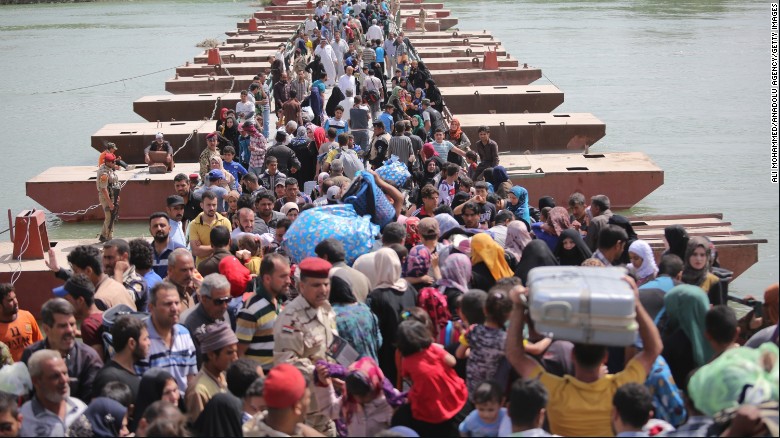
Any "defeat" of ISIS, however one defines it, would certainly include re-taking ISIS-controlled areas of Iraq and holding them.  Part of the problem is that, similar to the "Anbar awakening" in 2007, such a strategy necessarily involves a serious and committed effort by local Sunnis to expel a distasteful group.  There is one key difference, this time.  In 2007, the U.S. military paid local Sunni groups to fight and expel al Qaeda.  This time, the Iraqi government is nominally in control of ground operations and put simply, there is little Sunni appetite to participate with a Shia-led government that has turned a blind eye to atrocities against Sunnis, used violence to break up Sunni protest camps, and has directly participated in the political disenfranchisement of Sunnis.  While many Sunnis bravely risk their lives to oppose ISIS control of their lands, there is a very understandable reticence to work side by side with the government that has spent much of its time oppressing and vilifying them.

Iraqis flee the city of Ramadi as ISIS forces take over after an 18-month fight with the Iraqi military (Source: CNN)
=
In short, Sunnis need to be invested in the future of their government.  They are certainly not invested in the current form of Iraqi government, and its history since the U.S. departure has suggested that they don't have much reason to support and be invested in such a government.  The Obama administration acknowledges that there must be meaningful Sunni participation in any Iraqi government.  However, that was already the plan when the United States was deeply involved in developing Iraq's governmental structure.  The plan was for a Sunni vice president and protections of Sunni citizens.  Obviously, that plan has not transpired, with the Sunni vice president arrested and expelled from the government soon after the U.S. departure.

How does one rebuild trust in a participatory Iraqi government?  One step in the right direction was the ouster of Prime Minister Nouri Maliki, whose name toward the end of his tenure had become synonymous with Sunni oppression.  However, the changing of the guard has not translated to better relations between Sunni and Shia; rather, Shia militia rage through Sunni areas unabated, committing atrocities.

There has been a little discussion lately -- but not much -- of a three-state solution or some autonomy-heavy federalism in Iraq.  Indeed, the timing of such a discussion might seem ludicrous as ISIS controls vast swathes of what would be a Sunni state.  However, a few things should be kept in mind.  First, a three-state solution or heavily decentralized state was more widely discussed during the early years of the insurgency in Iraq.  The very reason is the same that warrants discussing it now: getting Sunnis invested in their own future.  Second, there is no reason that a discussion of a three-state solution must concede ISIS control over northwestern Iraq.  One could suggest, for example, that a northwestern Iraq referendum on independence or decentralized government occur only after Iraqi forces retake ISIS-controlled territory.

For those worried about the possibility of a Sunni state becoming a haven for terrorism: keep in mind that ISIS already controls much of the territory, and that the inability of Iraq's Shias and Sunnis to make political peace has in large part led to the lack of a united front to combat ISIS.  Indeed, so long as Iraq's Shia leaders fail to include and indeed openly oppress the Sunni, there is no incentive for Sunni to fight for such leaders.  Fighting for their own state, or own self-controlled region within a partitioned state, might give more Sunnis a real reason to expel ISIS and hold any territory it takes from the terrorist organization.

Of course, the political partition of Iraq needn't necessarily be a "three-state" solution.  One possibility, for example, is a two-state solution: an independent Kurdish state and a "federal" Sunni-Shia state with a weak central government and significant autonomy to the two federal regions.

Any type of devolution or partitioning of Iraq would involve the tricky issue of oil revenues.  Indeed, some people see oil revenue as overriding other concerns and thereby necessitating a strong central government.  Ultimately, however, any central government in Iraq is doomed if it is not ready to cede significant political autonomy to Sunni regions.  Moreover, control over their own future might be the only incentive significant enough to bring Sunnis to the fore of the fight against ISIS.

Saturday, November 30, 2013

U.S. Role in Afghanistan Post-2014

In early October, prospects for a continued U.S. presence in Afghanistan post-2014 looked bleak.  If the U.S. and Afghanistan could not negotiate an agreement soon, the U.S. would have to begin arrangements for a complete withdrawal of troops by the end of 2014.  Hoping to salvage the situation, U.S. Secretary of State John Kerry traveled to Afghanistan.  In mid-October, Kerry and Afghan president Hamid Karzai negotiated the terms of a Bilateral Security Agreement (BSA) that would keep U.S. troops in Afghanistan post-2014.  The chief sticking point had been whether alleged crimes committed by U.S. soldiers would fall under U.S. or Afghan jurisdiction.  The BSA gave the U.S. jurisdiction over these alleged crimes, a term that Karzai had opposed.  When the BSA was signed, Karzai said that the decision regarding jurisdiction must be made not by him but, rather, by the loya jirga -- a council of approximately 3,000 Afghan elders.

Fast forward to last week.  First, just as the loya jirga convened, President Karzai developed a new position on the BSA -- indicating that it should not be signed until after Afghanistan's April 2014 presidential elections.    After four days of deliberations, the loya jirga responded by approving the BSA and recommending that Karzai promptly sign it.  Karzai refused, indicating that he would not sign it until after the April 2014 elections and after the U.S. brought peace: "Peace is our precondition.  America should bring us peace and then we will sign it."

U.S. National Security Adviser Susan Rice traveled to Afghanistan to speak with Karzai.  Karzai now has a fresh set of demands that were not part of the original BSA:
Karzai told Rice that he would sign only after the United States helps his government begin peace talks with the Taliban and agrees to release all 17 Afghan citizens being held in the Guantanamo Bay detention center in Cuba, according to Afghan and U.S. officials. 
In addition to those new demands, the Afghan leader reiterated that he will not sign if “another [U.S.] soldier steps foot into an Afghan home,” Karzai spokesman Aimal Faizi said. The United States has already promised to show “restraint” in “home entries” by U.S. troops and to carry them out only in conjunction with Afghan troops, but the tactic remains a part of U.S. operations against some insurgents here.
Rice responded by noting that if the BSA was not signed by the end of the year, the U.S. would have no choice but to prepare for the complete withdrawal of U.S. troops by the end of 2014.  The stakes were raised two days ago when, during a NATO strike against an insurgent, a two-year old was tragically killed and two women were injured.  The U.S. maintains that the strike targeted a mid-level Taliban commander traveling on a road, whereas Karzai and his administration maintain that the attack struck a residential home.  Both sides agree, however, that the civilians were killed during the attack.  Karzai noted that he would not sign the agreement if such "oppression" continued.

Putting aside Karzai's competing demands for the U.S. to provide peace and security while ensuring zero civilian casualties, the larger question is whether he will in fact sign the BSA by the end of the year.  Why, one might ask, can't the U.S. simply wait until April 2014 to find out whether Karzai will sign the BSA.  The answer, quite frankly, is that this is not feasible.  There are currently more than 86,000 NATO and affiliated troops in Afghanistan; 60,000 of these are American.  The logistics of transporting the troops; transporting, selling, or destroying the equipment; securing the bases; continuing to train Afghan forces; and myriad other issues, are simply staggering.  A succinct yet excellent account of the challenges posed by the logistics of the withdrawal from Afghanistan can be found here (the article, written in February 2013, anticipated that most troops would be withdrawn by the end of 2014).  In short, logistics alone -- setting politics aside for the moment -- dictate that the U.S. decide soon whether or not to withdraw troops.  While pundits may claim that the U.S. "should stay patient" and that waiting until after April to sign the BSA is acceptable, facts indicate otherwise.  If the U.S. is to keep troops in the country, for example, it cannot completely remove the infrastructure it currently has in place.

Of course, this post is simply reporting the situation with respect to ongoing negotiations as well as the pragmatic issue of logistical challenges.  Another question entirely is whether the benefits of a continued U.S. troop presence outweigh the costs in terms of lives lost (American, Afghan, and others), money, and anti-American sentiment.  That's a question we'll let you decide for yourselves.

Monday, November 25, 2013

Syrian peace talks scheduled, peace itself delayed

Amidst the surprising news from the Middle East this week was word that peace talks have been agreed upon by the two opposing sides in the Syrian civil war. Scheduled for late January in Geneva, this positive development is most certainly clouded by its more intricate details.

The first is the purported objective: transition. The opposition has consistently refused talks unless they included Syrian President Bashar al-Assad ceding power. Assad, meanwhile, has refused to cede power under any circumstances. In many ways, this is what the civil war has become all about. Although numerous reports mention that transitional government is a clear goal of the peace talks, it is curious whether both sides see that goal similarly. Assad's camp may view transition as inclusive of current government officials, while the opposition may believe it would completely exclude those currently in power. It would be unsurprising if this would become the main sticking point during the talks, if they actually take place that is.

The second is the question of who is capable of wholly leading the opposition, and, related, whether the opposition is cohesive enough to be led. More extremist groups, such as the Islamic State in Iraq and the Levant (ISIL), continue to advance and take control of swathes of territory. Even less extremist groups do not accept the full authority of the political opposition, as clearly exemplified by this quote: Opposition political delegations do not have any power or influence on the Syrian street. On the whole, the Syrian National Council has foreign backing, but limited support within the opposition itself. At the same time, fighting continues in Syria, and its prevalence over the near future will be a testament to both cohesion and preparedness to peace. All of this makes one wonder: will the talks even take place?

There is little objective change in the civil war conditions of late. In fact, the United Nations seems to be spurring the peace talks based mostly on 'hope,' as opposed to more serious developments It is doubtful whether this is the best practice approach and leads to questions over whether the two opposing sides are even in agreement over what the purpose of the peace talks is. The world will know soon enough. In the meantime, it should hope.

Sunday, October 6, 2013

Counterterrorism Sunday

While the U.S. government is ostensibly shut down, its special forces engaged in two very aggressive counterterrorism operations this weekend.

First, in Libya, U.S. forces captured Anas al-Liby, an al Qaeda operative who has been on the FBI's Most Wanted Terrorists list since 2001 for his role in the 1998 embassy bombings in Kenya and Tanzania.  Specifically, he conducted surveillance in Nairobi, Kenya -- on the U.S. embassy and other potential targets -- in preparation for the ultimate attack on the U.S. embassy.  In 2000, al-Liby was indicted in the U.S. for his role in that bombing; the FBI offered a reward of up to $5 million for his capture.

Flash forward to this Saturday, when U.S. forces captured al-Liby in the early morning hours on the streets of Tripoli.  U.S. officials have stated that al-Liby is in a secure location and will ultimately face trial.  Some of the fallout has focused on the extent of Libyan knowledge or acceptance of the U.S. operation:
A senior American official said the Libyan government had been apprised of the operation and provided assistance, but it was unclear in what capacity. An assistant to the prime minister of the Libyan transitional government said the government had been unaware of any operation or of Abu Anas’s capture. Asked if American forces had ever conducted raids inside Libya or collaborated with Libyan forces, Mehmoud Abu Bahia, assistant to the defense minister, replied, “Absolutely not.”
Legally speaking -- with respect to international law, that is -- Libyan involvement matters.  If a host state grants permission for a foreign military action within its borders, there is no breach of its territorial sovereignty (scholarly articles discussing the connection between international law and military action with a host state's cooperation can be found here and here).  Of course, even if the Libyan government did permit and/or cooperate with the U.S. operation, the public denial would not be unprecedented.  Indeed, for years, Pakistan criticized U.S. drone strikes in that country; in 2011, however, its very public announcement regarding the CIA departing an air base implicitly acknowledged that the U.S. had been launching drone strikes from air bases inside Pakistan.  Thus, do not be surprised if time reveals Libyan knowledge and/or approval of the U.S. operation.

Second, in Somalia, a U.S. attack targeted the al Qaeda-affiliated al-Shabaab group.  Al-Shabaab, which controls substantial swaths of territory in Somalia, recently claimed responsibility for the terrorist attack and hostage-taking crisis at a Kenyan shopping mall.  Information continues to be released about that attack; indeed, just today, Kenyan officials released information about several of the militants.  Reports indicate that the U.S. operation this weekend was aborted early, and that the fate of the intended target remains unknown.

Ultimately, while the government shutdown and looming debt ceiling continue to dominate the news, the significance of these two attacks should not be underestimated.  Indeed, the capture of al-Liby on the streets of Tripoli may evoke comparisons to the now-infamous abduction of a terror suspect from the streets of Milan.  The chief difference, at least at this point, is that the U.S. intends to try al-Liby in court.  As far as what these attacks portend for U.S. foreign policy in northern Africa, it is far too early to tell.  If one were to ask whether this represents a "shift" to an African focus, I would simply reply: we've been there for awhile.

Tuesday, September 17, 2013

Meanwhile, in other nation-building news...

While the world remains focused on developments in the Syrian chemical weapon stockpile saga, the European Union unveiled an aid package of roughly $2.4 billion to the fragile Somali government -- dubbed a "new deal for Somalia."  The EU aid seeks to "sustain the gains made by the government and support the reconstruction of the country after two decades of civil war."  While the al Qaeda-linked al-Shabaab terrorist group still controls much of Somalia, key cities such as Mogadishu are in government control.  That government, which has been in power for one year, is buttressed by African Union and Ethiopian troops. Somali and affiliated forces have made important gains -- notably in port cities -- and the Somali president Hassan Mohamud hopes that the funds can prompt further progress:

For Mohamud, there were four key priorities among many -- security, legal reform, public finances and economic recovery. 
"The New Deal must deliver on the ground soon," he told delegates. After years of suffering, "expectations from our people are understandably high. We must not let them down."
As for U.S. involvement, much of it has been behind-the-scenes training of African Union troops.  Of course, there are also the untold number of covert drone strikes targeting al-Shabaab and other militants in Somalia.  The planned withdraw of Ethiopian troops from certain areas, meanwhile, raises fresh concerns about the African Union's ability to maintain Somali government control in large areas of land.

In short, while both sides are firmly entrenched and the civil war rages on, the Somali government currently has momentum; the EU aid package constitutes a large part of President Mohamud's efforts to maintain that momentum.  Stay tuned to see whether the coming months show any serious shifts in the country's balance of power.

Monday, June 17, 2013

Pakistan's Quagmire an International Concern

Another day, another disquieting incident in Pakistan, home of possibly the world's most dangerous nuclear weapons program. Militants attacked a bus of students from a women's university, and then proceeded to attack the hospital where survivors were being treated. Although this attack garnered little attention outside of minor news blurbs, it included all the facets that Western nations are concerned about: homegrown terrorism, suicide bombers, a coordinated attack, and significant civilian casualties. Responsibility for the attack was claimed by Lashkar-e-Jhangvi, a group with links to al-Qaeda.

As with each attack, international concerns about the security of Pakistan's nuclear arsenal surface. Can Pakistan, a country with deep internal divisions, keep itself together? This attack, on the very fundamental elements of reform Pakistan has struggled with - women's rights - comes on the heels of and as a test to the newly elected government of Nawaz Sharif.

Sharif, a political mainstay of Pakistani politics (this is his third term), has a slew of election promises to uphold. While improving the economy will be quite a challenge on the heels of an accelerating US withdrawal from neighboring Afghanistan, ending drone strikes in a country that reels from the majority of American targets will be an even more daunting task. Pakistan has been the center of US operations and there is little evidence to suggest that even as the physical American presence on the ground decreases, the threat of the US military will as well.

Attacks like the one this past week are exactly why. A country with fundamentalist, militant opposition, an active military, and nuclear weapons, is a dangerous mix. And concerns nations far removed from the subcontinental neighborhood. It wouldn't be such bad idea if these stories made more than a dent in the international news blotter.

Sunday, June 2, 2013

Foreign Arms in Syria

As the civil war rages on in Syria, foreign countries continue to wade in the murky waters of arms deals to government and rebel forces.

Russia, for one, is providing advanced anti-aircraft missiles to Syria.  Despite initial reports that the missiles had already arrived, Russian sources indicated that the missiles -- part of a 2010 arms deal -- wouldn't arrive in Syria for months.  Those same sources said, however, that delivery could be expedited based on conditions on the ground in Syria or changing positions/activities of Western governments.

On Monday, meanwhile, the EU ended its arms embargo on Syria, opening the door for countries like Britain and France to arm the rebels.  Canada's foreign minister responded to the news negatively, claiming that more arms flowing into Syria will only cause further bloodshed.

To make matters even worse, news came out Friday that the developer of Russia's MiG fighters will ink a deal to ship at least 10 fighter jets to Syria.  While details are sketchy, one can only hope that such a deal does not come to pass.

In short, while there does not appear to be any move toward direct military intervention by foreign governments, all indications seem to point to a weapons influx in the near future.  This of course brings us back to the question: who are we arming?  According to numerous accounts, the most organized and effective faction of the Syrian rebels is Jabhat al-Nusra -- a group with ties to al-Qaeda in Iraq.  The U.S. State Department designated Jabhat al-Nusra as a terrorist organization in December 2012, and the UN just added the group to its sanctions blacklist.

Therefore, those states looking to arm the Syrian rebels have some issues to address:

-Providing arms to Jabhat al-Nusra would violate the UN sanctions.
-Providing arms to other Syrian groups would likely be less effective, not to mention the fact that the arms could well end up in the hands of Jabhat al-Nusra fighters.  Indeed, reports indicate that entire units of Free Syria Army soldiers have defected to Jabhat al-Nusra.
-Providing arms could provoke an arms race between Western powers and Russia to equip their respective sides.
-Providing arms could be the first step in the road to direct military intervention.

An arms escalation could further derail peace talks.  A U.S.-Russia conference planned for early June to discuss Syria, for example, will not be taking place in light of the recent arms developments.  With a weapons influx seemingly imminent, peace in Syria appears as elusive as ever.

Previous posts on Syria:


Friday, March 8, 2013

Algeria Hostage Planner Reported Killed

Amid the hubbub of Washington politics, the French continue to participate in offensives in North Africa. No one is really paying attention, which is a shame, since, if reports surfacing last week are true, the French have proven to significantly aid US foreign policy in the region.

Chadian troops assisting in the rebuff of militant forces in Mali have claimed to have killed Moktar Belmoktar, a regional rebel leader. Belmoktar has been active in the region for years, and has been continuously linked not just to organized crime, but also al Qaeda. Of course, nothing is taken for granted, as Chadian forces also claimed to have killed another significant regional leader days earlier. Belmoktar shot to infamy as the planner of the raid on the Algerian gas facility in January, which left scores of foreigners dead and nearly ignited the region. France has, in the meantime, taken possession of the bodies and is expected to carry out definitive DNA tests in the coming days. AQIM acknowledged the death of Abdelhamid Abou Zeid (the other leader), but strongly denied Belmoktar's loss, insisting he was still alive and fighting. None of this really says anything other than some rebel fighters were killed, not yet at least.

Since his death, Belmoktar's role in regional terrorism may have grown. Sources in recent days are further reporting that Belmoktar received a suspicious phone call after the attack in Benghazi last year that may tie him to that attack. If true (though we may never know), US access to further information about AQIM operations may be weakened with Belmoktar's and Zeid's deaths. At the same time, it will make it easier for the US and the President in particular to put the incident behind them.

So what does it all mean? Not much of anything until more information is known. Clearly the Sahara is not the prime asymmetrical warfare environment that other parts of the Middle East are. Nonetheless, the killing of rebel and al Qaeda leaders elsewhere has resulted in fragmentation, but not dissolution of terrorist cells and organizations. The combination of factors may hinder AQIM operations, but without the continued development of the region's societies and governments, AQIM won't disappear. The biggest question will certainly be - will this be enough for the French, and, if so, will that make a difference when the battles are left solely to the regional forces, who have yet to coalesce into a cohesive bunch.

Wednesday, January 30, 2013

US Drone Program Expands to West Africa

A low key headline on CNN speaks volumes about potential future engagement options for the United States: U.S. to establish military presence next to Mali. Read beyond the headline and it is clear that not only will there be troops in Niger, there will be drones (previous Illexum notes on drones can be found here and here). On one hand, this is a critical move by US forces in recognizing that the Sahara and Sahel are key to future counterterrorism operations, albeit several years late. One does need to note that there is a drone base in Djibouti, which has primarily focused on East Africa and the Arabian Peninsula. Djibouti and Mali are worlds apart. Therefore, on the other hand , it is certainly frightening to watch the expansion of the drone program while still lacking clear rules of engagement and a full legal sign-off. While certainly seen in light of the recent conflict in Mali, this agreement was no doubt in the making already (though perhaps not prior to the beginning of Mali's disintegration nearly a year ago). With AQIM and other jihadists operating boldly throughout the desert landscape and regional armies all-but powerless to stop them, it is only a matter of time before this program is fast-tracked to get off the ground, literally.

Friday, January 18, 2013

Counterterrorism in North Africa: A Tale of Two Crises

Previous posts have addressed the French military intervention in Mali.  In the meantime, to the very near northeast, another former French colony has grabbed the world's attention since militants took hostages at an Algerian gas field Wednesday.  Widespread confusion has ensued, with reports Thursday suggesting some or most hostages escaped.

Today, we've learned more information -- namely, that an Algerian military operation has freed hundreds of hostages while at least 12 have died and approximately 30 remain unaccounted for (update: that number appears to now be 7 hostages still being held).  The hostage crisis and the French intervention in Mali are inextricably intertwined.  Indeed, early reports indicated that the terrorists in Algeria cited French intervention in Mali as cause for their actions, demanding that French and other Western countries cease operations in Mali.

The hostages at the gas field, many of them workers at the facility, hail from all over the world.  Most were Algerian nationals, but among the hostages are British, French, American, Japanese, Belgian, Irish, Romanian, Malaysian, Filipino, and more.  Clearly, the sheer number of countries' nationals involved in this tragedy demand a global reaction that will continue beyond the hostage crisis, but the exact nature of that reaction remains to be seen.  Some people will suggest a policy of disengagement and/or containment, where these countries are left to their own devices.  Recent history has shown us the price of failed states, however, both as a power vacuum for internal strife and a haven for outside terror and militant groups.  As the Malian government faces a threat from internal militants, the French have opted for a strong armed force to buttress Malian forces and address the threat.  This raises an interesting (and unclear) legal question, namely: under international law, what are the principles under which French or other forces might legitimately intervene and/or provide assistance to the Malian military junta?

Deborah Pearlstein over at OpinioJuris suggests the most logical legal principle would be consent from Mali, which raises its own web of complications:

Attacking anything in Mali raises territorial sovereignty concerns. Is there a government there that could lawfully consent to the U.S. use of force in country such that the U.S. wouldn't risk violating UN Charter article 2 prohibitions against the use of force? Consent, best I can tell, is the only option here. There's no UN Security Council resolution authorizing the use of force. . . . So consent it is, and it would come from, best case, a government that seized power by coup and to which we've otherwise cut off military aid. The U.S. still maintains an embassy in Mali (as does Mali in the U.S.), so perhaps consent is not legally insurmountable. But I'd wonder both what the terms of the U.S. aid cut-off were, and whether there's any precedent for this.

One possible example from recent history is U.S. involvement in Yemen.  A (hopefully) brief digression:  When looking at a legal basis for U.S. drone strikes in Yemen, one would likely look to the 2002 AUMF as justification under domestic law.  Under international law, however, the situation is trickier.  While one might claim that U.S. action in Pakistan is a logical geographic extension of action in Afghanistan, the same cannot be said of Yemen.  Rather, the most likely source of justification under international law is consent and collective self-defense.  Let me be more specific: by permitting the U.S. to engage in military actions within its borders, Yemen relinquishes its territorial sovereignty.  This doesn't solve the issue entirely, however; if Yemen's permission was all that was needed to permit U.S. drone strikes within Yemen's borders, then Yemen could theoretically permit action by the U.S. that it would not be allowed to legally commit on its own.  Instead, the U.S. must be engaging in some sort of permitted military action under international law -- in this case, Yemen's self-defense against  militants in a non-international armed conflict.  Military action in Yemen has indeed shown Yemeni forces severely battling Ansar al-Sharia and AQAP.  Although much of the U.S. involvement has been covert, enough has surfaced to indicate that U.S. military cooperation with Yemen has reached new peaks over the past year and has proven effective at targeting terrorists in the region.

U.S. military cooperation with Yemen has mostly come in the form of intelligence-sharing, aid, and U.S. drone strikes at areas Yemeni forces cannot reach themselves.  Obviously, the French involvement in Mali is a stark contrast in many respects, with over 1,000 French troops committed in Mali.  There are lessons to be learned from U.S. military cooperation with Middle Eastern countries such as Yemen (and, even  Pakistan, once upon a time, when it used to provide the U.S. with airfields and intel for drone strikes).  Those lessons can include proper levels of engagement, proper division of labor between domestic and foreign military actions, and navigating the murky waters of cooperation with a not-always-ideal domestic government.  In this case, France (and to the extent it becomes involved, the U.S.) can learn from the complex U.S. involvement in Pakistan.  The U.S. and Pakistan did not often see eye to eye, and indeed the relationship has become increasingly strained over the past two years.  However, even in the face of stark disagreements (especially over hardly-secret Pakistani military aid to Afghan Taliban forces), the U.S. and Pakistan teamed up to target Pakistani Taliban forces -- an area of overlapping interests.  Similarly, to the extent the U.S. considers involvement in Mali -- a country with whose government the U.S. has expressed serious reservations -- it might look for limited engagement in areas of shared interest.  Of course, the downside to such involvement will be that, once again, the U.S. will risk calls of hypocrisy for supporting a non-democratic government.  The alternative of extremists gaining a stronger foothold, on the other hand, is something that is in nobody's interest.

Sunday, August 12, 2012

Shadow Wars: Yemen Edition

From the mid-2000s onward, the U.S. has fought a shadow war in Pakistan.  U.S. relations with Pakistan have ebbed and flowed in that time, with Pakistan often providing intelligence on targets and airstrip space while publicly decrying the drone attacks.

Fast forward to the past two years, where the U.S. has ramped up its involvement in Yemen.  While U.S. officials hem and haw, never officially acknowledging the extent of our actions and involvement there, analysts say that we're at war.  This sounds familiar: for years, the U.S. conducted the massive, covert drone (and special ops) war in Pakistan without publicly acknowledging it.  Officials have become more open about operations in Pakistan in recent years, in part in order to provide legal justification for the continued, aggressive drone campaign.

While the similarities between Pakistan and Yemen are clearly evident, there are some important differences that America must keep in mind as it tailors its response to the growing threat of al Qaeda in the Arabian Peninsula (AQAP).  First, AQAP is considered by some analysts, with good reason, to be the most active and lethal al Qaeda affiliate.  The underwear bomber, the cargo plane bomb plot (the one with the printer ink cartridges), and the failed NYC bomber were all organized or inspired by AQAP.  Even the perpetrator of the Fort Hood massacre, Maj. Hasan, conversed online extensively with now-deceased AQAP leader (and propaganda leader of al Qaeda) Anwar al-Awlaki.  Thus, the U.S. must not underestimate the threat posed by this al Qaeda affiliate, and the extent of our recent involvement there suggests that the government is well-aware of the threat and has ramped up operations accordingly.

Furthermore, military operations between U.S. and Yemeni forces is much more cooperative than that of U.S. and Pakistan military personnel.  Indeed, the level of mistrust between U.S. and Pakistani military forces (stemming from repeated Pakistani military leaks to Taliban forces) existed for years but was on display for the entire world to see during the bin Laden raid.  U.S. military, meanwhile, cooperate with Yemeni counterterrorist operations in much more direct ways:
In an escalation of America’s clandestine war in Yemen, a small contingent of U.S. troops is providing targeting data for Yemeni airstrikes as government forces battle to dislodge Al Qaeda militants and other insurgents in the country’s restive south, U.S. and Yemeni officials said.

Operating from a Yemeni base, at least 20 U.S. special operations troops have used satellite imagery, drone video, eavesdropping systems and other technical means to help pinpoint targets for an offensive that intensified this week, said U.S. and Yemeni officials who asked not to be identified talking about the sensitive operation.

The U.S. forces also advised Yemeni military commanders on where and when to deploy their troops, two senior Obama administration officials said. The U.S. contingent is expected to grow, a senior military official said.
 Clearly, we are heavily engaged in Yemen right now, but to what end?  The always-prescient writers at Danger Room raise this question, and suggest that President Obama admit we're at war and articulate the strategic.  Just as there was a time lag regarding operations in Pakistan, however, I think keeping mum about Yemen might make sense for the near future.  First, while operations are ramping up, they are nowhere near the level of activity that took place in Pakistan for years without official acknowledgement.  While this is not in and of itself a justification to keep quiet about operations, keeping quiet about Yemen allows the U.S. government to be adaptable to the quickly-changing conditions in Yemen.  Perhaps the U.S. will not decide whether its goal is "defeat" or merely containment of AQAP until more is known about the feasibility of each option.

The U.S. has already articulated reasons for providing aid to Yemen for infrastructure and civil society-building.  Meanwhile, when providing billions in aid to Pakistan for years, the U.S. openly admitted that the funds were geared toward helping our partner in the war on terror combat the threat of the Taliban and al Qaeda.  The U.S. should, at the very least, articulate a broad policy of providing counter-terrorism assistance to Yemen.  I don't know think this would necessarily involve articulating our end-game in that country, especially when the combination of the Arab Spring and the rise of AQAP make the country one of the most unstable in a very unstable region of the world.  Ultimately, while our current activities appear to be a proactive effort to tamp down the rise of AQAP, our ultimate long game in Yemen might have to be a reactionary one reflective of the realities of our ability to control the direction and fate of the country.

Wednesday, July 25, 2012

Silence: The World's Reaction to Islamism in Mali

This could be a fun exercise: point out Mali on the world map. Much like Iraq, many adults likely do not know where Mali is, or even possibly what continent it is on. Somewhat ironically, many have likely heard of Timbuktu, the ancient center of learning, which is found in present-day Mali. Although the general population is much unaware of Mali, it is deplorable that statesmen around the world, unceremoniously including those here in the US, are ignoring the situation in Mali.

To give a quick rundown. In March, soldiers staged a coup and ousted the government. Tuareg rebels, more or less tied to Al-Qaeda in the Islamic Maghreb (AQIM), quickly expanded their insurgency and now all-but control the country's north. Meanwhile, a military government, propped up by the coup, continues to control the quickly deteriorating government, or what's left of it. The ingredients for a failed state are quickly manifesting themselves and mixing into a violent concoction.

International reaction? Condemnation. US reaction? None, though a quick Google search does show that the US has now allotted $10 million for Malian refugees. The F-22 Raptor fighter plane costs $150 million a pop. By the time that money reaches Mali, it will be all-but spent.

In summary, the international reaction has resembled a couple of crickets having a conversation. While the West seemingly focuses its attention to its own crises, it ignores the problems brewing on its borders. Mali is ever close to the countries clinging to delicate democratic ideals and processes borne out of the Arab Spring. More critically, Mali's lawless north presents an opportunity for Muslim extremists to carve out space for independent action. It's happened in Africa before, with Sudan and Libya entertaining some relationships with international terrorists. But Mali is a new case - there is no strongman keeping it together. Mali is closer to Afghanistan - remote and on the verge of collapse. So while Syria is a trendy topic, Mali is ignored.

It seems that, with every moment, the world leans closer to collapse. The West is so enamored with saving its own economies that it fails to ignore the problems that may affect those economies in the not-too-distant future. Perhaps, and this is just a thought, condemnation isn't enough. Action is needed if Mali is to regain its internal sovereignty. While Mali may no longer be critical to the international system as in its heyday, it would be wise for the international community to think critically and support, either directly or indirectly, the capacity Mali requires to avoid it becoming a hotbed for international terrorism.