Showing posts with label Pakistan. Show all posts

Monday, April 13, 2015

Pakistani Terrorist Commander Ordered Released on Bail, Likely Affecting Pak-Indian Relations

The world was horrified by the 2008 Mumbai attacks, in which terrorists stormed a number of buildings in India and killed 168 people.  All but one of the gunmen died; the surviving gunman was convicted and executed in 2012 for his actions.  The terrorists were Pakistani and came from the group Lashkar-e-Taiba (LeT), a Pakistani terrorist group with historical ties to the Pakistani government and military and highly suspected current ties with Pakistan's chief intelligence service.

The operational leader and co-founder of LeT, Zaki-ur-Rehman Lakhvi, was arrested in 2008 in connection with the attack.  He has been incarcerated for the past 7 years.  Back in December 2014, a court ordered Lakhvi released on bail.  The Pakistani government opposed the decision and kept him incarcerated, but this past Thursday the Pakistani supreme court ordered that Lakhvi be released immediately.
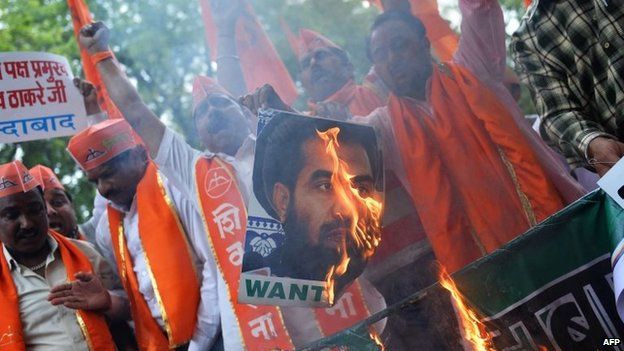

Protests in India followed the court ruling ordering Lakhvi released (Source: BBC)


This will likely have negative effects on India-Pakistan relations, which have somewhat thawed following the election of India's Prime Minister Modi and a positive exchange of letters amongst the countries' leaders.

What is especially troubling is how little is known about Lakhvi's trial, which has been ongoing since 2009 and is not open to the public:
The commander, Zaki-ur-Rehman Lakhvi, and six other members of the Lashkar-e-Taiba militant group have been on trial since 2009 at a high-security jail in Rawalpindi, just south of Islamabad, on charges of participating in the Mumbai operation. 
But the trial has been conducted largely in secrecy, and its halting pace has given rise to speculation that its progress is being influenced by the vagaries of wider tensions between Pakistan and India.
While this doesn't mean the case is dismissed, only time will tell whether Lakhvi appears for the remainder of the trial.  While locked up, he wasn't exactly treated like a commander of a terrorist organization:

While Pakistan's government claimed that it was cracking down on terrorists, Zakiur-Rehman Lakhvi and six of his comrades in Rawalpindi's sprawling Adyala Jail had several rooms next to the jailer's office at their disposal. 
And with the jailer's permission, they had a television, mobile phones and access to the internet, as well as dozens of visitors a day. 
"He [Lakhvi] can receive any number of guests, any time of day or night, seven days a week," said one jail official while the terror suspect was under lock and key.
No special permission was required for visitors, who were not even asked to identify themselves to jail authorities.
That access allowed Lakhvi to retain his position as a high-ranking LeT commander even while he was incarcerated.  This is not simply a question of prison conditions.  LeT has been declared a terrorist organization by the United States and the UN Security Council and banned in Pakistan since 2002.

Letting one of their commanders continue to run the organization from prison is an insult to the memories of those who have died at the hands of LeT terror.  While arresting him and bringing him to trial in Pakistan were steps in the right direction for a government that has often been seen as having sympathies toward LeT, the recent supreme court ruling that released him is a step in the wrong direction.  While the Pakistani government publicly opposed that decision, it has been treating him in a manner for the past 5+ years that suggests it is not as eager to take on LeT as it claims.  Reaction in India to the decision has, unsurprisingly, been quite negative.  If Lakhvi and other LeT officials are ultimately acquitted, that negativity will likely manifest itself in worsening relations between two countries that seemed on track to gradually improve their historically volatile relationship.

Monday, August 18, 2014

India and Pakistan: Domestic and Foreign Policies Collide

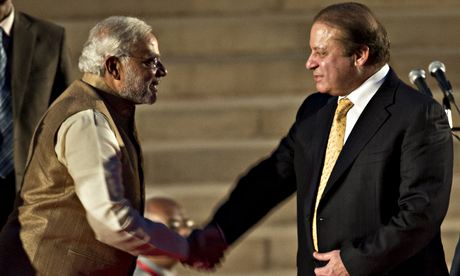
May 2014 brought the promise of progress in India-Pakistan relations.  After the historic swearing-in of Indian Prime Minister Narendra Modi - the first ever attended by a Pakistani prime minister - people were cautiously optimistic about relations between the feuding nuclear powers.  That optimism was extended when Modi and Pakistani Prime Minister Nawaz Sharif publicly exchanged letters of gratitude toward each other, which followed up on the meeting the two held after Modi's swearing-in.  In his letter, Modi also expressed India's sympathy toward Pakistan after the terror attack on Karachi's airport.

Prime Ministers Narendra Modi and Nawaz Sharif shake hands after Modi's swearing-in (source: The Guardian).

These developments were promising, and they may well continue.  Of course, it will take more than a meeting and a letter exchange to overcome decades of mistrust and border attacks.  Furthermore, both prime ministers must still deal with local populations that are not so quick to mend old wounds.  Moving too quickly toward improved relations will undercut the support both leaders need to rule.  Indeed, Sharif was condemned for the very decision to attend Modi's inauguration.

Unfortunately, both leaders have already gone back to the tried-and-true tact of using the other country as an easy target for domestic woes.  Last week, for example, Modi declared in a speech to Indian troops that Pakistan now wages a "proxy war of terrorism" because it lacks the capabilities to wage a conventional war.

Sharif, meanwhile, finds his own prime ministership at risk in the midst of large-scale protests.  Those protests are led by political rival Imran Khan of the PTI party.  Khan is calling for Sharif's ouster due to issues ranging from alleged vote-rigging in the 2013 elections to the "dynastic" nepotism of the Sharifs.  Although he has called on protesters to keep their actions peaceful, he has also called on them to stop paying taxes and bills as part of the larger protest.

Perhaps it should not come as a surprise that, in the midst of this internal challenge to Sharif's rule, Pakistani military forces attacked Indian border posts at 20 different locations yesterday.  Incidentally, none of Pakistan's major English-language outlets - Dawn, The News International, and The Express Tribune - reported on the attacks.

Ultimately, the political strategy of pandering to the local population while trying to present a more suitable international front is nothing new.  Its most recent notable iteration may be Iran's positions during the recent nuclear talks.  Iran may try to woo investors and welcome the UN nuclear watchdog, on the one hand, but talk about destruction of the U.S. in the event of an attack, on the other.  In the case of Pakistan and India, the effort to garner local support by castigating the other country is a short-term tactic.  It is also one that finds itself increasingly outdated in the digital age, where information from non-local sources is more readily available.  The longer-term strategy of mending old wounds is harder; it will involve less flashy developments like multiple trade summits, cooperation in counter-terrorism investigations, and regular regional meetings to address issues facing the two and their smaller neighbors.  This will take time, perseverance, patience, and restraint, none of which lend themselves well to the political arena.  Ultimately, the coming months will tell whether May 2014 was a new beginning or merely an aberration in the long-standing dispute.


Monday, June 9, 2014

Not (Yet) Safe: The Karachi Airport

The details remain sketchy and the perpetrators remain mysterious, but the terrorist attack has been rebutted and the intent is clear: ten terrorists attempted to take over the Karachi, Pakistan airport. All ten are now (supposedly) dead (interesting to note that hospitals remain on high alert in the area); however, the attack once again raises concerns about safety and security in Pakistan. Up to 13 others were killed, including security forces and airline staff, in an attack that took upwards of five hours to subdue.

(Jinnah International Airport, Karachi, Pakistan, Source: Wikipedia)

Jinnah International Airport in Karachi is Pakistan's largest and busiest airline hub for both passengers and cargo. Gunmen stormed past security, possibly by might, possibly by deception, possibly both, through the cargo section of the airport, which is housed in the old terminal complex.

The attack, though unsuccessful, brings to light the precarious security situation in Pakistan. How could an airport in a city of over 20 million and a country with strong military and security apparatuses come under such brazen attack by a detachment of ten? With airport security high on the list, reviews of cargo operations and security deficits in outdated terminals will undoubtedly become prioritized around the world.

At the same time, Pakistani military operations to flush out Taliban terrorists from Waziristan may intensify as part of a tit-for-tat game that has been ongoing for years. In fact, the military had warned of a possible attack in response to its own recent incursion. Moving forward, will Pakistan choose retribution, or will the nation's leaders opt to take a page out of Sri Lanka's book, and end the strife once and for all, regardless of the political, economic, and social costs? Neither option is particularly pleasant.

Monday, June 17, 2013

Pakistan's Quagmire an International Concern

Another day, another disquieting incident in Pakistan, home of possibly the world's most dangerous nuclear weapons program. Militants attacked a bus of students from a women's university, and then proceeded to attack the hospital where survivors were being treated. Although this attack garnered little attention outside of minor news blurbs, it included all the facets that Western nations are concerned about: homegrown terrorism, suicide bombers, a coordinated attack, and significant civilian casualties. Responsibility for the attack was claimed by Lashkar-e-Jhangvi, a group with links to al-Qaeda.

As with each attack, international concerns about the security of Pakistan's nuclear arsenal surface. Can Pakistan, a country with deep internal divisions, keep itself together? This attack, on the very fundamental elements of reform Pakistan has struggled with - women's rights - comes on the heels of and as a test to the newly elected government of Nawaz Sharif.

Sharif, a political mainstay of Pakistani politics (this is his third term), has a slew of election promises to uphold. While improving the economy will be quite a challenge on the heels of an accelerating US withdrawal from neighboring Afghanistan, ending drone strikes in a country that reels from the majority of American targets will be an even more daunting task. Pakistan has been the center of US operations and there is little evidence to suggest that even as the physical American presence on the ground decreases, the threat of the US military will as well.

Attacks like the one this past week are exactly why. A country with fundamentalist, militant opposition, an active military, and nuclear weapons, is a dangerous mix. And concerns nations far removed from the subcontinental neighborhood. It wouldn't be such bad idea if these stories made more than a dent in the international news blotter.

Monday, May 20, 2013

Cautious Optimism Amidst Elections and Violence in Pakistan

With former Prime Minister Nawaz Sharif winning last week's elections, the future of the country remains unclear.

On the one hand, Sharif's succession to power will mark the rare democratic transfer of power in Pakistan.  Furthermore, Sharif ran a campaign promising economic revitalization in a country desperate for electricity and the resources to rebuild a struggling (possibly crumbling) economy.  Sharif's election also raises the specter of military détente and improved relations with India.

On the other hand, violent militant attacks continue to plague Pakistan.  On election day alone, more than 30 people were killed and more than 200 wounded by militant bombings and attacks.  Then, on the eve of a run-off election in her district, the vice president of the Tehreek-e-Insaf party (PTI, the party headed by former cricket player/celebrity Imran Khan), was murdered execution-style.  The idea of a major party's second-in-command being brutally murdered would be almost unfathomable in western democracies, yet it barely registers as a major news item.  The brazenness of such an attack on a party leader, moreover, may be a more ominous sign of Pakistan's stability than the scattered violence.

Incoming PM Sharif has a lot on his plate, yet one can only hope that a focus on economic revitalization will help promote stability in the country and the region at large.  Economic revitalization is not and should not be a separate issue from Indian relations; indeed, India appears ready to engage in cross-border transmission and pipeline projects that would go a long way toward easing Pakistan's crippling energy problems.  Given the large stakes, Mr. Sharif would do well to move swiftly.

Tuesday, March 26, 2013

Musharraf Returns to Fragmented Country

Perez Musharraf returned to Pakistan this past weekend, hoping to participate in the upcoming elections this May.  Of course, he faces a slew of problems ranging from death threats, pending legal charges that include treason for his 1999 coup, and a general lack of excitement about his return.

Although not particularly popular in Pakistan, Musharraf benefits from a highly fragmented political field that includes the Pakistan Peoples Party, the Pakistan Muslim League-Nawaz, headed by former Prime Minister and bitter Musharraf rival Nawaz Sharif (i.e. the guy who was PM when Musharraf staged his coup), and former cricket star-turned-politician Imran Khan.  Khan enjoys popularity due to a disillusioned populace receptive to his anti-two party message.  If anything, the highly fragmented field with a disgraced former leader facing criminal charges and popular non-politician figure resembles another country where recent elections raised more questions than answers.

In any event, the world will increasingly begin to follow political developments in Pakistan as hopefully free and fair elections draw near and the country continues to struggle with its own identity as well as its relationships with neighbors and the world at large.

Wednesday, January 9, 2013

India Claims Two of Its Soldiers Killed by Pakistani Troops in Kashmir

India claims that regular Pakistani troops killed two Indian soldiers in a cross-border attack on Tuesday.  Indian officials further claim that the Pakistani troops beheaded one of the soldiers and mutilated both bodies.  Pakistan has officially denied that the incident occurred.  One Indian official described this incident as the most serious infiltration since the 2003 cease-fire.

Indian officials are objecting to the alleged killings and what they describe as the inhumane treatment of the soldiers.  Pakistan, in addition to denying the incident even occurred, has said it would not oppose a UN investigation into the matter.  While both sides are denouncing each other, they have also attempted to ensure that the incident does not escalate into broader hostilities.  India has summoned a high-ranking Pakistani official stationed in Delhi to meet with its foreign minister, to which Pakistan has not objected.  Furthermore, the Indian foreign minister noted: "We cannot and must not allow the escalation of any unwholesome event like this."  On the other hand, the minister promised a "proportionate" response to the attack.  Presumably, parties on both sides are attempting to placate upset citizens at home while presenting a rational and even-handed front abroad.  In the age of globalization, however, governments walk a fine line in trying to present one view at home and another abroad.  Pakistan in particular has had this problem in recent years, with its officials often making anti-American statements at home while pushing for military and other aid from the United States and cooperating with the U.S. on a variety of counter-terrorism initiatives (the one that comes to mind is Pakistani officials decrying U.S. incursions into its airspace for drone strikes while simultaneously providing bases and intel for those same strikes).  As far as what comes of the Kashmir flare-up, we'll just have to wait and see.