Showing posts with label counter-terrorism. Show all posts

Tuesday, August 11, 2015

First ISIS Detainee Turned Over to Iraqi Kurds for Trial

News broke late last week that ISIS detainee Nasrin As’ad Ibrahim (alias Umm Sayyaf) was handed over to the Kurdish Regional Government in Iraq.  U.S. forces captured Umm Sayyaf in May during a raid in which her husband, Fathi ben Awn ben Jildi Murad al-Tunisi - a powerful ISIS leader involved in oil and gas development - was killed.  The Wall Street Journal reported that Umm Sayyaf "provided valuable insights into Islamic State’s financial operations and leaders" during questioning in the 3-month period she was detained by American forces.

In July, the Washington Post reported that federal prosecutors were preparing charges against Umm Sayyaf.  The Post also noted that "[a] prosecution of Umm Sayyaf for her suspected role in taking Mueller hostage would be the first publicly known FBI case involving an alleged senior figure in the Islamic State."   Reports indicate that the decision to transfer her to Iraq's Kurdish regional government, rather than bring her back to the United States to face charges, stemmed in part from the fact that Iraq does not extradite its citizens.

U.S. Secretary of Defense Ash Carter speaks to reporters about the operation that led to Umm Sayyaf's capture (Source: WSJ)


This begs the question: what is the current status of U.S.-Iraqi extradition agreements?  This is not merely an academic question.  If the United States continues to conduct military operations against ISIS forces within Iraqi territory, will it be unable to bring ISIS terrorists to trial in the United States?  Once a prisoner is in the U.S., the U.S. has tools at its disposal to try him or her for material support of terrorism.  Specifically, 18 U.S. Code 2339A and 2339B criminalize the material support of terrorists and terrorist organizations.  Though not heavily publicized, the FBI and U.S. Attorney's Offices have been making domestic arrests for material support of terrorism -- often when an individual is at the airport on his way to Syria to join ISIS.  Moreover, the U.S. has jurisdiction over conduct violative of its "material support" statutes even when that conduct occurs outside of the geographic bounds of the United States.  For example, 2339B contains an entire "Extraterritorial Jurisdiction" section that states there is jurisdiction for a material support of terrorist organizations offense if "after the conduct required for the offense occurs an offender is brought into or found in the United States, even if the conduct required for the offense occurs outside the United States."  Thus, were Umm Sayyaf or another high-profile ISIS member captured and brought into the United States, the appropriate U.S. Attorney's Office could charge and prosecute said ISIS member.

In order to get said ISIS member to the U.S., however, one might have to deal with the issue raised by the Iraqis in the present case: extradition.  The United States in fact has a still-existing extradition treaty with Iraq that dates back to 1936.  That treaty lays out the charges and procedures under which either party can request extradition of an individual located within the geographic bounds of the other party.  Reviewing the treaty, terrorism is not mentioned but "murder" and "kidnapping" are charges in which Umm Sayyaf may have been a participant and therefore potentially charged in the United States.  One hurdle, however: Article VIII of the treaty notes that "neither of the High Contracting Parties shall be bound to deliver up its own citizens."  Therefore, Iraq would not be bound to turn over an Iraqi citizen to face charges in the U.S., but nothing in the treaty prohibits Iraq from voluntarily doing so.  The treaty was used most recently in 2014, when Iraq extradited a U.S. citizen back to the U.S. to face fraud charges related to defense contracting.

However, there is another, newer hurdle to extradition: the Iraqi Constitution.  Article 21 of the Constitution of Iraq states that "[n]o Iraqi shall be surrendered to foreign entities and authorities."  This is a much more explicit prohibition that the more discretionary language of the 1936 extradition treaty.  As the U.S. continues to wage military operations against ISIS, one must wonder if the Umm Sayyaf incident has led American and Iraqi military and political personnel to discuss creative ways to comply with the Iraqi Constitution and also bring ISIS detainees to the United States.  What if, for example, a high-level ISIS commander known to have been involved in killing American citizens is captured by U.S. military personnel?  At some point, the American government would justifiably want to see certain ISIS detainees brought to the U.S. to face trial.  Indeed, the decision to hand Umm Sayyaf over to the Kurdish regional government rather than the central government may have reflected a reluctance to turn her over to the central Iraqi government (of course, it could have also been a strategic decision to avoid placing the Shiite government in charge of an important ISIS detainee).

One possible solution would be to establish clear U.S. custody of a detainee from the moment of capture.  If the Arabic version of the Iraqi Constitution is interpreted the same as the English version, that constitution prohibits the surrendering of Iraqi citizens to foreign authorities.  If Iraq never has custody over a detainee, the thinking would go, there would be no constitutional violation because Iraqi authorities never had custody of the detainee.  This is one way in which both governments could work together to help respect the integrity of the Iraqi Constitution while also aggressively pursuing ISIS terrorists.

Wednesday, July 8, 2015

Stopping Home-grown Radicalization in the Internet Age

One of our recent posts addresses the need to develop a better geo-political strategy in Iraq if one hopes to build real and lasting Sunni support in the fight against ISIS.  The threat posed by Islamic extremists, however, is not limited to the foreign battlefield.  Indeed, recent events in the U.S. and Europe have shown the potential to radicalize persons who move about freely in the U.S. or Europe.  ISIS is a media-savvy organization and, indeed, its members often spend countless hours trying to isolate and subsequently convert or radicalize Westerners.

An American in her 20s speaks with the New York Times about ISIS recruitment and conversion efforts (Source: New York Times)

ISIS is not the first Islamic terror organization to utilize the Internet to radicalize Westerners, nor will it be the last.  Indeed, this was already a well-established phenomenon by the time ISIS came on the scene.  The most prominent example was Anwar al-Awlaki, the U.S.-Yemeni dual citizen who was a senior member of al Qaeda in the Arabian Peninsula (AQAP) before being killed by a U.S. drone strike.  Al-Awlaki wrote on a blog, posted YouTube videos, wrote for al Qaeda's Inspire magazine, and directly communicated with individuals online, as part of AQAP recruitment and radicalization efforts.  For example, he communicated with Fort Hood shooter Nidal Hassan online prior to Hassan's actions; recruited the Christmas day "underwear bomber" Umar Farouk Abdulmutallab in person and online; and inspired Times Square bomber Faisal Shahzad's attempted car bombing in 2010.  Al-Awlaki, in a sense, paved the way for the current wave of online radicalization that includes the ISIS and/or al Qaeda-inspired Charlie Hebdo attack and the ISIS-inspired failed attack at a Mohammed cartoon contest in Texas this past May.

Internet radicalization -- either by direct communication with vulnerable persons in Western countries or by the ability of Islamic terror's message to inspire lone wolf attacks -- will continue to present a security challenge to Western countries for years to come.  This security challenge is self-apparent: it is much more difficult for a terrorist group to coordinate attacks on U.S. soil than it is for a lone-wolf U.S. citizen radicalized by such a group to carry out an attack.  This begs the question: how do we stop home-grown radicalization?

Part of the solution is tracking the communications.  This has been a touchy political subject in the United States ever since Edward Snowden leaked details of NSA data collection programs to journalists.  Still, data collected in accordance with the 2008 FISA amendments (not the Patriot Act-based surveillance program, which did not specifically authorize bulk data collection and which was ruled unconstitutional by the Court of Appeals for the Second Circuit) led to, among other things, the tracking of emails by an Albanian who sent money to a Pakistani terror group and ultimately was detained trying to travel to Pakistan.  The legality of the 2008 FISA amendments will continue to be litigated even as the U.S. starts conducting its surveillance differently in accordance with the 2015 "FREEDOM Act."

Another part of the solution is stopping the radicalization itself at its roots.  Farah Pandith, an analyst with the Center for Strategic and International Studies with years of experience in the National Security Council and the State Department, strongly supports outreach efforts to counter the narrative ISIS and other Islamic extremists are presenting online:
Their narrative pits a monolithic Muslim “us” against a non-Muslim “them,” validating and valorizing the “us” under the veil of religion and purpose. Confronted by this narrative, some Muslim millennials see martyrdom as an attractive job description. Others simply support the extremist team by sporting the bumper sticker, wearing the colors; they’ll alter the cultural landscape so that everyone around them accepts extremism as the norm. 
Yes, we’re waging a military war against ISIS—a war we must win. But ISIS can’t have an army if it lacks recruits. Behind its growing physical army is a virtual army. A viable long-term strategy will devote itself to vanquishing both armies by countering the spread of the underlying ideology.
Or, put more succinctly, she notes that millennial Muslims are "having a crisis of identity [and] . . .[w]e have not flooded the marketplace with alternative narratives to move their minds."

Such efforts at combating radicalization will not be easy to quantify, and indeed, will not have such readily-identifiable benchmarks as cities recaptured or terrorists killed or detained.  However, such efforts may be just as necessary in preventing domestic terror attacks. 


Monday, April 13, 2015

Pakistani Terrorist Commander Ordered Released on Bail, Likely Affecting Pak-Indian Relations

The world was horrified by the 2008 Mumbai attacks, in which terrorists stormed a number of buildings in India and killed 168 people.  All but one of the gunmen died; the surviving gunman was convicted and executed in 2012 for his actions.  The terrorists were Pakistani and came from the group Lashkar-e-Taiba (LeT), a Pakistani terrorist group with historical ties to the Pakistani government and military and highly suspected current ties with Pakistan's chief intelligence service.

The operational leader and co-founder of LeT, Zaki-ur-Rehman Lakhvi, was arrested in 2008 in connection with the attack.  He has been incarcerated for the past 7 years.  Back in December 2014, a court ordered Lakhvi released on bail.  The Pakistani government opposed the decision and kept him incarcerated, but this past Thursday the Pakistani supreme court ordered that Lakhvi be released immediately.


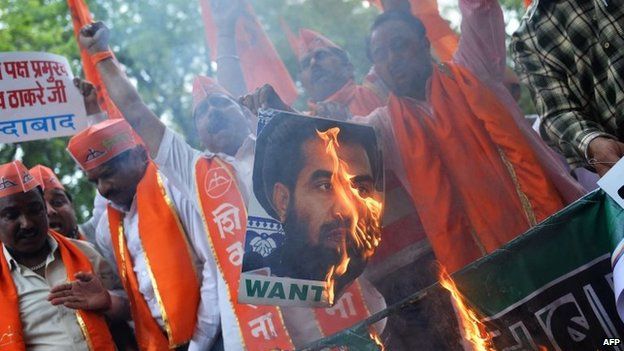
Protests in India followed the court ruling ordering Lakhvi released (Source: BBC)


This will likely have negative effects on India-Pakistan relations, which have somewhat thawed following the election of India's Prime Minister Modi and a positive exchange of letters amongst the countries' leaders.

What is especially troubling is how little is known about Lakhvi's trial, which has been ongoing since 2009 and is not open to the public:
The commander, Zaki-ur-Rehman Lakhvi, and six other members of the Lashkar-e-Taiba militant group have been on trial since 2009 at a high-security jail in Rawalpindi, just south of Islamabad, on charges of participating in the Mumbai operation. 
But the trial has been conducted largely in secrecy, and its halting pace has given rise to speculation that its progress is being influenced by the vagaries of wider tensions between Pakistan and India.
While this doesn't mean the case is dismissed, only time will tell whether Lakhvi appears for the remainder of the trial.  While locked up, he wasn't exactly treated like a commander of a terrorist organization:

While Pakistan's government claimed that it was cracking down on terrorists, Zakiur-Rehman Lakhvi and six of his comrades in Rawalpindi's sprawling Adyala Jail had several rooms next to the jailer's office at their disposal. 
And with the jailer's permission, they had a television, mobile phones and access to the internet, as well as dozens of visitors a day. 
"He [Lakhvi] can receive any number of guests, any time of day or night, seven days a week," said one jail official while the terror suspect was under lock and key.
No special permission was required for visitors, who were not even asked to identify themselves to jail authorities.
That access allowed Lakhvi to retain his position as a high-ranking LeT commander even while he was incarcerated.  This is not simply a question of prison conditions.  LeT has been declared a terrorist organization by the United States and the UN Security Council and banned in Pakistan since 2002.

Letting one of their commanders continue to run the organization from prison is an insult to the memories of those who have died at the hands of LeT terror.  While arresting him and bringing him to trial in Pakistan were steps in the right direction for a government that has often been seen as having sympathies toward LeT, the recent supreme court ruling that released him is a step in the wrong direction.  While the Pakistani government publicly opposed that decision, it has been treating him in a manner for the past 5+ years that suggests it is not as eager to take on LeT as it claims.  Reaction in India to the decision has, unsurprisingly, been quite negative.  If Lakhvi and other LeT officials are ultimately acquitted, that negativity will likely manifest itself in worsening relations between two countries that seemed on track to gradually improve their historically volatile relationship.

Sunday, January 11, 2015

New Series: The Changing World of Territorial Sovereignty (ISIS Edition)

Welcome to a new series on the Changing World of Territorial Sovereignty, where Illexum will explore the ways in which the traditional views of territorial sovereignty have transformed or eroded.  When discussing threats to traditional statehood, the focus is usually on globalization and other new developments that decrease the functions of the traditional state.  However, less attention is paid to the erosion of the traditional view of territorial sovereignty -- in other words, the ways in which states, media, scholars, and public opinion view and analyze territorial sovereignty.

To say that this issue is broad and lends itself to a wide array of sub-topics is an understatement; such topics include direct state-on-state military action, state-on-nonstate action, prolonged military activity vs. limited military strikes, the extent to which states can permit other states to engage in extensive military operations against their own non-state actors, and the extent to which active support from one state toward non-state actors of another states infringes upon the latter's sovereignty.  This is far from an exhaustive list, but it merely underscores the difficulty in analyzing the topic.  Illexum will, of course, place a higher degree of focus on examples from today's news.  We will include some historical analyses as well, however, because those are also instructive on how we will view territorial sovereignty going forward.

The first topic that we will explore is ISIS - specifically, how U.S. military action against ISIS (and other groups, such as al-Nusra) affects traditional notions of territorial sovereignty.  ISIS is a good example of the erosion of territorial sovereignty, given that it currently controls territory in both Syria and Iraq.  Thus, from the outset, the challenge of containing or rolling back ISIS necessarily involves a different approach to the issue of territorial sovereignty.  Moreover, the nation-states in which ISIS operates have very different relationships with the United States.  While the Iraqi government invites U.S. military assistance in fighting ISIS, the Syria's President Bashar al-Assad is not so eager to invite U.S. military involvement.

Brief Background: U.S. Military Action Against ISIS

Unsurprisingly, therefore, the first U.S. action against ISIS took place in Iraq.  First, on August 7, 2014, the U.S. dropped aid packages to displaced Iraqis who had been forced to evacuate to the mountainside in light of ISIS advances.  Specifically, the U.S. launched airstrikes on August 8, 2014, against ISIS artillery that was being used to attack Kurdish forces.  The humanitarian aid drops continued throughout August, as did the airstrikes against ISIS.

The two questions that plagued the United States political and military leadership, however, were 1) whether the U.S. would put troops on the ground and 2) whether military operations would expand to the civil war-ravaged Syria.  As to the first question, President Obama initially declared (in early August 2014) that the United States would not be sending troops back to Iraq to fight ISIS;
As Commander in Chief, I will not allow the United States to be dragged into fighting another war in Iraq, so as we support Iraqis as they take the fight to these terrorists, American combat troops will not be returning to fight in Iraq because there is no American military solution to the larger crisis in Iraq,
Of course, a few hundred American troops already had started returning to Iraq in June 2014, albeit as "advisers" to Iraqi and Kurdish military  forces.  As the airstrikes ramped up in August 2014, the U.S. sent 150 more advisers to Iraq, with Defense Secretary Chuck Hagel emphasizing that this was not a "combat boots on the ground" type situation.  In November 2014, President Obama authorized sending a total of 3,100 troops to Iraq - still, he claimed, in an advisory and training capacity.  The latest update is that President Obama will soon request authorization from Congress for military action against ISIS (despite claiming that the 2001 Authorization of the Use of Military Force (AUMF) already gives it the authority to engage in action against ISIS).

As to the second question, the United States did indeed expand its war against ISIS to Syria, launching airstrikes within Syria's borders in September.  Incidentally, the strikes were not limited to ISIS; in September, the U.S. launched strikes against the shadowy Khorosan Group and in November, it attacked the al Qaeda splinter group Jabbat al-Nusra.  Of course, some analysts say that the Khorosan Group is merely a subset of al-Nusra, and that the Obama administration played up the Khorosan Group in order to build up public support for its military action in Syria.  The strikes against ISIS have continued into the new year, with the U.S. launching strikes against ISIS in Iraq and Syria just this past weekend.

Smoke rises over Kobane, Syria, after a U.S. airstrike against ISIS on December 25, 2014 (Source: The Guardian)


Implications for the Erosion of Territorial Sovereignty

The traditional notions of territorial sovereignty have eroded in recent years, especially in those regions where borders or entire regions are out of government control.  Over the last twenty years, this has been especially pronounced in the context of U.S. counter-terrorism.  Airstrikes have been a go-to American response to terrorism, whether it be a response to the 1998 embassy bombings or the prolonged drone war in Pakistan.

There are two common scenarios for drone strikes against militants (though, of course, one can certainly imagine other situations) - those in which the host state expressly or implicitly condones the military action, and those in which the host state opposes such action.  How, one might ask, does such military action fit within the international legal framework for military action?  The United Nations charter prohibits military action that violates territorial sovereignty: "All Members shall refrain in their international relations from the threat or use of force against the territorial integrity or political independence of any state."  The notable exceptions to the use of force against another state are Security Council-authorized actions and "individual or collective self-defence if an armed attack occurs against a Member of the United Nations."  Typically, the United States presents its military actions as self-defense in response to the armed attack of 9-11 (or, in the case of Iraq, anticipatory self-defense).  Moreover, in those cases where a state invites U.S. action as part of its own counter-terrorism efforts, one might legitimately describe such action as "collective self-defense."  What is unclear in this scenario is whether such a country must formally request assistance in self-defense, or whether secret, behind-the-scenes discussions suffice.  For example, current U.S. military action in Iraq is done with the knowledge and cooperation of the Iraqi government.  The U.S. drone war in Pakistan, meanwhile, was done behind closed doors; Pakistan would often openly condemn U.S. strikes while secretly providing intelligence and targeting information to the U.S. for those very strikes.

When a state openly opposes military operations by a third party within its borders, the legal basis for such action becomes unclear.  In Syria, for example, the United States has taken action against ISIS and al-Nusra.  It has not taken open military action against President al-Assad's forces, although it has provided weaponry, training, and other support for anti-Assad forces.  What presents the United States with a distinct legal challenge, however, is how to justify its invasion of sovereign territory by airstikes and special forces operations.  There is no collective self-defense, as can be argued in Iraq and potentially in Pakistan.  The claim of self-defense is a stretch, given that the U.S. has had to make the dubious claim that ISIS is part of al Qaeda in order to justify such action under the AUMF and the theory that 9-11 constituted an armed attack against which the United States is still engaged in self-defense.  Another theory that has found its way into legal scholarship is that states that cannot control their own borders, or engage in atrocities against their own people, "waive" any claim to territorial sovereignty.  This theory, known as "involuntary sovereignty waiver," has been put forth to justify military action in Iraq in 1991 and Serbia in 1999.

The United States has not directly put forth a coherent legal theory for its military action in Syria, and it may well not want to.  General norms of international law disfavor unilateral or mostly-unilateral military action, which is why the U.S. is always eager to garner multinational support to buttress the legitimacy of its actions.  Even where those actions are multilateral, however, the legal underpinnings for the military action remain the same.  The only difference is the political distinction between the world's sole superpower engaging in unilateral military action and that same superpower working with other states to thwart the spread of ISIS.  Like most other international norms, the sanctity of territorial sovereignty is often the product of the prevailing political viewpoints -- or whatever the current military and political realities dictate.  The United States does not want to be perceived as engaging in numerous military actions that violate territorial sovereignty.  At the same time, its words and actions have made it clear that the United States views territorial sovereignty as subservient to its own defense needs, whether those needs be real or perceived.  The very notion of a "global war on terror," by its very name, suggests that territorial sovereignty is not as resolute or finite as it was once perceived to be.

As the United States gets dragged into yet another military conflict on foreign soil, however, one must ask -- if Syria doesn't want us there, and the country is in the midst of a devastating civil war, what will further military engagement in the area accomplish?  Will the United States continue its mission creep and deploy forces (either alone or in concert with Iraqi, Kurdish, or other military forces) ever closer to the Syrian border?  Will we engage in ground operations in Syria, and if so, will we have the logistical base to do so?  This is what happens when you engage in military action in a hostile country, and why the violation of territorial sovereignty matters -- what sort of environment does the United States expect to find, in such a deeply divided country?  It would face enemies on multiple fronts, and its scarce allies hold very little territory right now.  If the United States deepens its military involvement, it risks getting to the point where the only way to protect its own forces would be a large-scale deployment - something the country hardly has the stomach for.

Sunday, December 29, 2013

Egypt Update: Muslim Brotherhood Declared Terrorist Organization (And Doesn't Seem Happy About It)

Egypt's ruling government threw kerosene on an already-raging fire this past Wednesday when it declared the Muslim Brotherhood to be a terrorist organization.

The impetus for the latest act of one-upmanship in the ongoing power struggle -- a court already banned participation in the Brotherhood back in September -- was a deadly car bombing on Tuesday that left 16 dead and more than 100 wounded.  Immediately after the attack, government officials tied the Muslim Brotherhood to the attack and claimed the organization had shown its "ugly face as a terrorist organization shedding blood and messing with Egypt's security."  The Brotherhood, meanwhile, condemned the terrorist attack and denied any involvement.

Egyptians survey the destruction in the aftermath of Tuesday's deadly terrorist attack (NYT).


On Wednesday, the al Qaeda-linked group Ansar Beit al-Maqdis -- which has been responsible for two notable terrorist attacks in recent months -- claimed responsibility for Tuesday's car bombing.  This was not exactly a surprise, given that security analysts had already noted that Ansar was likely behind the attack.

With Ansar Beit al-Maqdis' claim of responsibility, the Egyptian government shifted its line of attack against the Muslim Brotherhood by claiming there are links between the Muslim Brotherhood and Ansar Beit al-Maqdis.  Without addressing Ansar Beit al-Maqdis' claim of responsibility, moreover, the Egyptian government labeled the Muslim Brotherhood a terrorist organization and again blamed it for the terrorist attack:
Deputy Prime Minister Hossam Eissa announced the move, which will give the authorities more power to crack down on the Brotherhood.

He said that those who belonged to the group, financed it or promoted its activities would face punishment.

The decision was in response to Tuesday's suicide bombing of a police headquarters in Mansoura, in the Nile Delta, which killed 16 people and wounded more than 100, he said.

"Egypt was horrified from north to south by the hideous crime committed by the Muslim Brotherhood group. . . . This was in context of dangerous escalation to violence against Egypt and Egyptians and a clear declaration by the Muslim Brotherhood group that it still knows nothing but violence. It's not possible for Egypt the state nor Egypt the people to submit to the Muslim Brotherhood terrorism."

Egypt would notify Arab countries who had signed a 1998 anti-terrorism treaty of the decision, he added.
(BBC).

Additionally, although the deputy prime minister did not specifically mention Ansar Beit al-Maqdis, other government officials stepped in to claim a link between the groups:
Ansar Bayt Al-Maqdis, an Al-Qaeda inspired group based in the Sinai Peninsula, claimed responsibility for the Mansoura bombing. However an Egyptian security official, speaking to Asharq Al-Awsat on condition of anonymity, affirmed that the Muslim Brotherhood had formed an alliance with the Al-Qaeda-linked Ansar Bayt Al-Maqdis and another group, the Al-Furqan Brigade.
To date, however, the Muslim Brotherhood has denounced the attacks and no evidence of any supposed alliance has been forthcoming.

The designation of the Brotherhood as a terrorist organization will likely lead to the closure of Brotherhood-affiliated organizations that "provide health care and other services to rural and urban areas that lack infrastructure."  Additionally, the government swiftly moved to act upon the new label this past Thursday, arresting people for membership in the group:
Sixteen of the arrests were in the Nile Delta province of Sharkiya. The state news agency said those held were accused of "promoting the ideology of the Muslim Brotherhood group, distributing its leaflets, and inciting violence against the army and police". Security sources gave a country-wide total of 38 arrests on terrorism charges.

From now on, anyone taking part in Brotherhood protests will be jailed for five years, Interior Ministry spokesman Hany Abdel Latif told state TV. Jail terms for those accused under the terror law stretch up to life imprisonment. "The sentence could be death for those who lead this organization," he said.
Unsurprisingly, the Muslim Brotherhood has denounced the government's actions, stating on Twitter that the move is a "worthless decision from an illegal gov't without any evidence and will not change anything in reality."  The move has also intensified Brotherhood-led protests against the current regime.

The government's action may well be an effort to bolster support before the constitutional referendum scheduled next month.  Whatever the outcome of the referendum, however, protests and clashes between the Brotherhood and the interim government will likely continue.  The reason is that the two groups, both of which participated in the 2011 protests that ousted Hosni Mubarak, do not view the other as legitimate.  The Muslim Brotherhood won the first democratic elections in post-Mubarak Egypt, but its ineffectual governance led to massive protests and regime change by way of a coup.  The anti-Brotherhood elements, meanwhile, have consistently struggled to adapt to a political system of voting in lieu of protests.  Their current move of designating the Brotherhood as a terrorist organization reflects a desire to marginalize, rather than successfully compete against, its only viable competitor on the Egyptian political scene.  If anything, however, the government's thinly-veiled pretense only makes its own rule appear more illegitimate.  Like the Brotherhood's Morsi, the current government is discovering that ruling the fractured country is much more difficult than gaining power.

Saturday, November 30, 2013

U.S. Role in Afghanistan Post-2014

In early October, prospects for a continued U.S. presence in Afghanistan post-2014 looked bleak.  If the U.S. and Afghanistan could not negotiate an agreement soon, the U.S. would have to begin arrangements for a complete withdrawal of troops by the end of 2014.  Hoping to salvage the situation, U.S. Secretary of State John Kerry traveled to Afghanistan.  In mid-October, Kerry and Afghan president Hamid Karzai negotiated the terms of a Bilateral Security Agreement (BSA) that would keep U.S. troops in Afghanistan post-2014.  The chief sticking point had been whether alleged crimes committed by U.S. soldiers would fall under U.S. or Afghan jurisdiction.  The BSA gave the U.S. jurisdiction over these alleged crimes, a term that Karzai had opposed.  When the BSA was signed, Karzai said that the decision regarding jurisdiction must be made not by him but, rather, by the loya jirga -- a council of approximately 3,000 Afghan elders.

Fast forward to last week.  First, just as the loya jirga convened, President Karzai developed a new position on the BSA -- indicating that it should not be signed until after Afghanistan's April 2014 presidential elections.    After four days of deliberations, the loya jirga responded by approving the BSA and recommending that Karzai promptly sign it.  Karzai refused, indicating that he would not sign it until after the April 2014 elections and after the U.S. brought peace: "Peace is our precondition.  America should bring us peace and then we will sign it."

U.S. National Security Adviser Susan Rice traveled to Afghanistan to speak with Karzai.  Karzai now has a fresh set of demands that were not part of the original BSA:
Karzai told Rice that he would sign only after the United States helps his government begin peace talks with the Taliban and agrees to release all 17 Afghan citizens being held in the Guantanamo Bay detention center in Cuba, according to Afghan and U.S. officials. 
In addition to those new demands, the Afghan leader reiterated that he will not sign if “another [U.S.] soldier steps foot into an Afghan home,” Karzai spokesman Aimal Faizi said. The United States has already promised to show “restraint” in “home entries” by U.S. troops and to carry them out only in conjunction with Afghan troops, but the tactic remains a part of U.S. operations against some insurgents here.
Rice responded by noting that if the BSA was not signed by the end of the year, the U.S. would have no choice but to prepare for the complete withdrawal of U.S. troops by the end of 2014.  The stakes were raised two days ago when, during a NATO strike against an insurgent, a two-year old was tragically killed and two women were injured.  The U.S. maintains that the strike targeted a mid-level Taliban commander traveling on a road, whereas Karzai and his administration maintain that the attack struck a residential home.  Both sides agree, however, that the civilians were killed during the attack.  Karzai noted that he would not sign the agreement if such "oppression" continued.

Putting aside Karzai's competing demands for the U.S. to provide peace and security while ensuring zero civilian casualties, the larger question is whether he will in fact sign the BSA by the end of the year.  Why, one might ask, can't the U.S. simply wait until April 2014 to find out whether Karzai will sign the BSA.  The answer, quite frankly, is that this is not feasible.  There are currently more than 86,000 NATO and affiliated troops in Afghanistan; 60,000 of these are American.  The logistics of transporting the troops; transporting, selling, or destroying the equipment; securing the bases; continuing to train Afghan forces; and myriad other issues, are simply staggering.  A succinct yet excellent account of the challenges posed by the logistics of the withdrawal from Afghanistan can be found here (the article, written in February 2013, anticipated that most troops would be withdrawn by the end of 2014).  In short, logistics alone -- setting politics aside for the moment -- dictate that the U.S. decide soon whether or not to withdraw troops.  While pundits may claim that the U.S. "should stay patient" and that waiting until after April to sign the BSA is acceptable, facts indicate otherwise.  If the U.S. is to keep troops in the country, for example, it cannot completely remove the infrastructure it currently has in place.

Of course, this post is simply reporting the situation with respect to ongoing negotiations as well as the pragmatic issue of logistical challenges.  Another question entirely is whether the benefits of a continued U.S. troop presence outweigh the costs in terms of lives lost (American, Afghan, and others), money, and anti-American sentiment.  That's a question we'll let you decide for yourselves.

Sunday, October 6, 2013

Counterterrorism Sunday

While the U.S. government is ostensibly shut down, its special forces engaged in two very aggressive counterterrorism operations this weekend.

First, in Libya, U.S. forces captured Anas al-Liby, an al Qaeda operative who has been on the FBI's Most Wanted Terrorists list since 2001 for his role in the 1998 embassy bombings in Kenya and Tanzania.  Specifically, he conducted surveillance in Nairobi, Kenya -- on the U.S. embassy and other potential targets -- in preparation for the ultimate attack on the U.S. embassy.  In 2000, al-Liby was indicted in the U.S. for his role in that bombing; the FBI offered a reward of up to $5 million for his capture.

Flash forward to this Saturday, when U.S. forces captured al-Liby in the early morning hours on the streets of Tripoli.  U.S. officials have stated that al-Liby is in a secure location and will ultimately face trial.  Some of the fallout has focused on the extent of Libyan knowledge or acceptance of the U.S. operation:
A senior American official said the Libyan government had been apprised of the operation and provided assistance, but it was unclear in what capacity. An assistant to the prime minister of the Libyan transitional government said the government had been unaware of any operation or of Abu Anas’s capture. Asked if American forces had ever conducted raids inside Libya or collaborated with Libyan forces, Mehmoud Abu Bahia, assistant to the defense minister, replied, “Absolutely not.”
Legally speaking -- with respect to international law, that is -- Libyan involvement matters.  If a host state grants permission for a foreign military action within its borders, there is no breach of its territorial sovereignty (scholarly articles discussing the connection between international law and military action with a host state's cooperation can be found here and here).  Of course, even if the Libyan government did permit and/or cooperate with the U.S. operation, the public denial would not be unprecedented.  Indeed, for years, Pakistan criticized U.S. drone strikes in that country; in 2011, however, its very public announcement regarding the CIA departing an air base implicitly acknowledged that the U.S. had been launching drone strikes from air bases inside Pakistan.  Thus, do not be surprised if time reveals Libyan knowledge and/or approval of the U.S. operation.

Second, in Somalia, a U.S. attack targeted the al Qaeda-affiliated al-Shabaab group.  Al-Shabaab, which controls substantial swaths of territory in Somalia, recently claimed responsibility for the terrorist attack and hostage-taking crisis at a Kenyan shopping mall.  Information continues to be released about that attack; indeed, just today, Kenyan officials released information about several of the militants.  Reports indicate that the U.S. operation this weekend was aborted early, and that the fate of the intended target remains unknown.

Ultimately, while the government shutdown and looming debt ceiling continue to dominate the news, the significance of these two attacks should not be underestimated.  Indeed, the capture of al-Liby on the streets of Tripoli may evoke comparisons to the now-infamous abduction of a terror suspect from the streets of Milan.  The chief difference, at least at this point, is that the U.S. intends to try al-Liby in court.  As far as what these attacks portend for U.S. foreign policy in northern Africa, it is far too early to tell.  If one were to ask whether this represents a "shift" to an African focus, I would simply reply: we've been there for awhile.

Friday, January 18, 2013

Counterterrorism in North Africa: A Tale of Two Crises

Previous posts have addressed the French military intervention in Mali.  In the meantime, to the very near northeast, another former French colony has grabbed the world's attention since militants took hostages at an Algerian gas field Wednesday.  Widespread confusion has ensued, with reports Thursday suggesting some or most hostages escaped.

Today, we've learned more information -- namely, that an Algerian military operation has freed hundreds of hostages while at least 12 have died and approximately 30 remain unaccounted for (update: that number appears to now be 7 hostages still being held).  The hostage crisis and the French intervention in Mali are inextricably intertwined.  Indeed, early reports indicated that the terrorists in Algeria cited French intervention in Mali as cause for their actions, demanding that French and other Western countries cease operations in Mali.

The hostages at the gas field, many of them workers at the facility, hail from all over the world.  Most were Algerian nationals, but among the hostages are British, French, American, Japanese, Belgian, Irish, Romanian, Malaysian, Filipino, and more.  Clearly, the sheer number of countries' nationals involved in this tragedy demand a global reaction that will continue beyond the hostage crisis, but the exact nature of that reaction remains to be seen.  Some people will suggest a policy of disengagement and/or containment, where these countries are left to their own devices.  Recent history has shown us the price of failed states, however, both as a power vacuum for internal strife and a haven for outside terror and militant groups.  As the Malian government faces a threat from internal militants, the French have opted for a strong armed force to buttress Malian forces and address the threat.  This raises an interesting (and unclear) legal question, namely: under international law, what are the principles under which French or other forces might legitimately intervene and/or provide assistance to the Malian military junta?

Deborah Pearlstein over at OpinioJuris suggests the most logical legal principle would be consent from Mali, which raises its own web of complications:

Attacking anything in Mali raises territorial sovereignty concerns. Is there a government there that could lawfully consent to the U.S. use of force in country such that the U.S. wouldn't risk violating UN Charter article 2 prohibitions against the use of force? Consent, best I can tell, is the only option here. There's no UN Security Council resolution authorizing the use of force. . . . So consent it is, and it would come from, best case, a government that seized power by coup and to which we've otherwise cut off military aid. The U.S. still maintains an embassy in Mali (as does Mali in the U.S.), so perhaps consent is not legally insurmountable. But I'd wonder both what the terms of the U.S. aid cut-off were, and whether there's any precedent for this.

One possible example from recent history is U.S. involvement in Yemen.  A (hopefully) brief digression:  When looking at a legal basis for U.S. drone strikes in Yemen, one would likely look to the 2002 AUMF as justification under domestic law.  Under international law, however, the situation is trickier.  While one might claim that U.S. action in Pakistan is a logical geographic extension of action in Afghanistan, the same cannot be said of Yemen.  Rather, the most likely source of justification under international law is consent and collective self-defense.  Let me be more specific: by permitting the U.S. to engage in military actions within its borders, Yemen relinquishes its territorial sovereignty.  This doesn't solve the issue entirely, however; if Yemen's permission was all that was needed to permit U.S. drone strikes within Yemen's borders, then Yemen could theoretically permit action by the U.S. that it would not be allowed to legally commit on its own.  Instead, the U.S. must be engaging in some sort of permitted military action under international law -- in this case, Yemen's self-defense against  militants in a non-international armed conflict.  Military action in Yemen has indeed shown Yemeni forces severely battling Ansar al-Sharia and AQAP.  Although much of the U.S. involvement has been covert, enough has surfaced to indicate that U.S. military cooperation with Yemen has reached new peaks over the past year and has proven effective at targeting terrorists in the region.

U.S. military cooperation with Yemen has mostly come in the form of intelligence-sharing, aid, and U.S. drone strikes at areas Yemeni forces cannot reach themselves.  Obviously, the French involvement in Mali is a stark contrast in many respects, with over 1,000 French troops committed in Mali.  There are lessons to be learned from U.S. military cooperation with Middle Eastern countries such as Yemen (and, even  Pakistan, once upon a time, when it used to provide the U.S. with airfields and intel for drone strikes).  Those lessons can include proper levels of engagement, proper division of labor between domestic and foreign military actions, and navigating the murky waters of cooperation with a not-always-ideal domestic government.  In this case, France (and to the extent it becomes involved, the U.S.) can learn from the complex U.S. involvement in Pakistan.  The U.S. and Pakistan did not often see eye to eye, and indeed the relationship has become increasingly strained over the past two years.  However, even in the face of stark disagreements (especially over hardly-secret Pakistani military aid to Afghan Taliban forces), the U.S. and Pakistan teamed up to target Pakistani Taliban forces -- an area of overlapping interests.  Similarly, to the extent the U.S. considers involvement in Mali -- a country with whose government the U.S. has expressed serious reservations -- it might look for limited engagement in areas of shared interest.  Of course, the downside to such involvement will be that, once again, the U.S. will risk calls of hypocrisy for supporting a non-democratic government.  The alternative of extremists gaining a stronger foothold, on the other hand, is something that is in nobody's interest.

Sunday, August 12, 2012

Shadow Wars: Yemen Edition

From the mid-2000s onward, the U.S. has fought a shadow war in Pakistan.  U.S. relations with Pakistan have ebbed and flowed in that time, with Pakistan often providing intelligence on targets and airstrip space while publicly decrying the drone attacks.

Fast forward to the past two years, where the U.S. has ramped up its involvement in Yemen.  While U.S. officials hem and haw, never officially acknowledging the extent of our actions and involvement there, analysts say that we're at war.  This sounds familiar: for years, the U.S. conducted the massive, covert drone (and special ops) war in Pakistan without publicly acknowledging it.  Officials have become more open about operations in Pakistan in recent years, in part in order to provide legal justification for the continued, aggressive drone campaign.

While the similarities between Pakistan and Yemen are clearly evident, there are some important differences that America must keep in mind as it tailors its response to the growing threat of al Qaeda in the Arabian Peninsula (AQAP).  First, AQAP is considered by some analysts, with good reason, to be the most active and lethal al Qaeda affiliate.  The underwear bomber, the cargo plane bomb plot (the one with the printer ink cartridges), and the failed NYC bomber were all organized or inspired by AQAP.  Even the perpetrator of the Fort Hood massacre, Maj. Hasan, conversed online extensively with now-deceased AQAP leader (and propaganda leader of al Qaeda) Anwar al-Awlaki.  Thus, the U.S. must not underestimate the threat posed by this al Qaeda affiliate, and the extent of our recent involvement there suggests that the government is well-aware of the threat and has ramped up operations accordingly.

Furthermore, military operations between U.S. and Yemeni forces is much more cooperative than that of U.S. and Pakistan military personnel.  Indeed, the level of mistrust between U.S. and Pakistani military forces (stemming from repeated Pakistani military leaks to Taliban forces) existed for years but was on display for the entire world to see during the bin Laden raid.  U.S. military, meanwhile, cooperate with Yemeni counterterrorist operations in much more direct ways:
In an escalation of America’s clandestine war in Yemen, a small contingent of U.S. troops is providing targeting data for Yemeni airstrikes as government forces battle to dislodge Al Qaeda militants and other insurgents in the country’s restive south, U.S. and Yemeni officials said.

Operating from a Yemeni base, at least 20 U.S. special operations troops have used satellite imagery, drone video, eavesdropping systems and other technical means to help pinpoint targets for an offensive that intensified this week, said U.S. and Yemeni officials who asked not to be identified talking about the sensitive operation.

The U.S. forces also advised Yemeni military commanders on where and when to deploy their troops, two senior Obama administration officials said. The U.S. contingent is expected to grow, a senior military official said.
 Clearly, we are heavily engaged in Yemen right now, but to what end?  The always-prescient writers at Danger Room raise this question, and suggest that President Obama admit we're at war and articulate the strategic.  Just as there was a time lag regarding operations in Pakistan, however, I think keeping mum about Yemen might make sense for the near future.  First, while operations are ramping up, they are nowhere near the level of activity that took place in Pakistan for years without official acknowledgement.  While this is not in and of itself a justification to keep quiet about operations, keeping quiet about Yemen allows the U.S. government to be adaptable to the quickly-changing conditions in Yemen.  Perhaps the U.S. will not decide whether its goal is "defeat" or merely containment of AQAP until more is known about the feasibility of each option.

The U.S. has already articulated reasons for providing aid to Yemen for infrastructure and civil society-building.  Meanwhile, when providing billions in aid to Pakistan for years, the U.S. openly admitted that the funds were geared toward helping our partner in the war on terror combat the threat of the Taliban and al Qaeda.  The U.S. should, at the very least, articulate a broad policy of providing counter-terrorism assistance to Yemen.  I don't know think this would necessarily involve articulating our end-game in that country, especially when the combination of the Arab Spring and the rise of AQAP make the country one of the most unstable in a very unstable region of the world.  Ultimately, while our current activities appear to be a proactive effort to tamp down the rise of AQAP, our ultimate long game in Yemen might have to be a reactionary one reflective of the realities of our ability to control the direction and fate of the country.