Showing posts with label ISIS. Show all posts

Tuesday, August 11, 2015

First ISIS Detainee Turned Over to Iraqi Kurds for Trial

News broke late last week that ISIS detainee Nasrin As’ad Ibrahim (alias Umm Sayyaf) was handed over to the Kurdish Regional Government in Iraq.  U.S. forces captured Umm Sayyaf in May during a raid in which her husband, Fathi ben Awn ben Jildi Murad al-Tunisi - a powerful ISIS leader involved in oil and gas development - was killed.  The Wall Street Journal reported that Umm Sayyaf "provided valuable insights into Islamic State’s financial operations and leaders" during questioning in the 3-month period she was detained by American forces.

In July, the Washington Post reported that federal prosecutors were preparing charges against Umm Sayyaf.  The Post also noted that "[a] prosecution of Umm Sayyaf for her suspected role in taking Mueller hostage would be the first publicly known FBI case involving an alleged senior figure in the Islamic State."   Reports indicate that the decision to transfer her to Iraq's Kurdish regional government, rather than bring her back to the United States to face charges, stemmed in part from the fact that Iraq does not extradite its citizens.

U.S. Secretary of Defense Ash Carter speaks to reporters about the operation that led to Umm Sayyaf's capture (Source: WSJ)


This begs the question: what is the current status of U.S.-Iraqi extradition agreements?  This is not merely an academic question.  If the United States continues to conduct military operations against ISIS forces within Iraqi territory, will it be unable to bring ISIS terrorists to trial in the United States?  Once a prisoner is in the U.S., the U.S. has tools at its disposal to try him or her for material support of terrorism.  Specifically, 18 U.S. Code 2339A and 2339B criminalize the material support of terrorists and terrorist organizations.  Though not heavily publicized, the FBI and U.S. Attorney's Offices have been making domestic arrests for material support of terrorism -- often when an individual is at the airport on his way to Syria to join ISIS.  Moreover, the U.S. has jurisdiction over conduct violative of its "material support" statutes even when that conduct occurs outside of the geographic bounds of the United States.  For example, 2339B contains an entire "Extraterritorial Jurisdiction" section that states there is jurisdiction for a material support of terrorist organizations offense if "after the conduct required for the offense occurs an offender is brought into or found in the United States, even if the conduct required for the offense occurs outside the United States."  Thus, were Umm Sayyaf or another high-profile ISIS member captured and brought into the United States, the appropriate U.S. Attorney's Office could charge and prosecute said ISIS member.

In order to get said ISIS member to the U.S., however, one might have to deal with the issue raised by the Iraqis in the present case: extradition.  The United States in fact has a still-existing extradition treaty with Iraq that dates back to 1936.  That treaty lays out the charges and procedures under which either party can request extradition of an individual located within the geographic bounds of the other party.  Reviewing the treaty, terrorism is not mentioned but "murder" and "kidnapping" are charges in which Umm Sayyaf may have been a participant and therefore potentially charged in the United States.  One hurdle, however: Article VIII of the treaty notes that "neither of the High Contracting Parties shall be bound to deliver up its own citizens."  Therefore, Iraq would not be bound to turn over an Iraqi citizen to face charges in the U.S., but nothing in the treaty prohibits Iraq from voluntarily doing so.  The treaty was used most recently in 2014, when Iraq extradited a U.S. citizen back to the U.S. to face fraud charges related to defense contracting.

However, there is another, newer hurdle to extradition: the Iraqi Constitution.  Article 21 of the Constitution of Iraq states that "[n]o Iraqi shall be surrendered to foreign entities and authorities."  This is a much more explicit prohibition that the more discretionary language of the 1936 extradition treaty.  As the U.S. continues to wage military operations against ISIS, one must wonder if the Umm Sayyaf incident has led American and Iraqi military and political personnel to discuss creative ways to comply with the Iraqi Constitution and also bring ISIS detainees to the United States.  What if, for example, a high-level ISIS commander known to have been involved in killing American citizens is captured by U.S. military personnel?  At some point, the American government would justifiably want to see certain ISIS detainees brought to the U.S. to face trial.  Indeed, the decision to hand Umm Sayyaf over to the Kurdish regional government rather than the central government may have reflected a reluctance to turn her over to the central Iraqi government (of course, it could have also been a strategic decision to avoid placing the Shiite government in charge of an important ISIS detainee).

One possible solution would be to establish clear U.S. custody of a detainee from the moment of capture.  If the Arabic version of the Iraqi Constitution is interpreted the same as the English version, that constitution prohibits the surrendering of Iraqi citizens to foreign authorities.  If Iraq never has custody over a detainee, the thinking would go, there would be no constitutional violation because Iraqi authorities never had custody of the detainee.  This is one way in which both governments could work together to help respect the integrity of the Iraqi Constitution while also aggressively pursuing ISIS terrorists.

Sunday, July 26, 2015

Turkey Joins Fight Against ISIS... and Possibly Kurds

Summary
The big news in counter-terrorism circles this week was that Turkey was becoming actively involved in the fight against ISIS.  In part a response to an ISIS suicide bombing on July 20th, 2015, Turkish support will include launching its own airstrikes.  More importantly, perhaps, Turkey will permit the United States to launch airstrikes from the Incirlik Air Base in southern Turkey.  Although prompted by an ISIS suicide bombing, Turkey's military action in the region will likely include heavy doses of anti-Kurdish activity against both Syrian and Turkish Kurds.

Brief Background
Of course, Turkey's interest in the Syrian civil war has never been straightforward.  The chief threat to Turkey's security over the past several decades has been the PKK, a Kurdish separatist group in Turkey classified as a terrorist organization by NATO and the U.S.  Like the Kurdish populations in Iraq and Syria, the PKK has attempted to create an independent Kurdish state in the region.  Turkey has always opposed these efforts but still entered into a cease-fire with the PKK in spring 2013.

In December 2014, meanwhile, the Turkish parliament authorized military action against ISIS.  At the time, it was not clear if Turkey would take immediate action against ISIS.  Turkey has been committed to toppling Bashar al-Assad and military action against ISIS could effectively keep Assad in power.

Turkish soldiers patrol the border near Syria.  (Source: Wall Street Journal)


Fast forward to early July, 2015.  Kurdish successes against ISIS in northern Syria led to the Syrian Kurdish group Kurdish Democratic Union Party (PYD) controlling a 250-mile continuous area along the Syria-Turkey border.  Turkey did not appreciate this development, given PYD's real or perceived friendliness toward PKK.  These Kurdish gains led analysts to speculate that Turkey will join the fight in Syria -- not necessarily to topple Assad or defeat ISIS, but to prevent the development of a Kurdish proto-state.

Turkey's intervention in Syria turned from speculative to real this week following Monday's suicide bombing by ISIS in the Turkish border town of Suruc that killed 32 and injured more than 100.  On Thursday, Turkey and the United States reached an agreement in which the U.S. can use Turkey's Incirlik Air Base to launch strikes against ISIS.  On Friday and Saturday, Turkey launched strikes against ISIS in Syria but also against multiple PKK facilities in northern Iraq.

Analysis
Turkey has been uneasy about entering the Syrian civil war for multiple reasons.  While it is certainly anti-ISIS, Turkey does not want to empower Assad or the PYD and accordingly has been reluctant to enter the fray.  In short, it recognizes the very real consequences of creating a power vacuum next door.  Turkey's interests in the region transcend borders.  Indeed, Turkey's strike against PKK in Iraq's Kurdistan region is an indication that it will not be deterred by national boundaries.

Of course, while Turkey has been on the sidelines, other groups have been making advances.  Some of the most effective strikes against ISIS have been by the Peshmerga in Iraq and the PYD in Syria.  The Peshmerga's successes in a string of Iraqi military setbacks once again raised talks of a possible push for a Kurdish state.  In Syria, PYD's ability to control a continuous region has made Turkey fearful of a Kurdish-controlled region on its border.  Syrian rebels have made advances as well, though not enough to suggest they're anywhere near the most powerful force in the region.

Turkey may still be looking to hedge its bets -- hence its decision to let the U.S. use its base for U.S. air strikes.  The ISIS suicide bombing in Suruc certainly spurred Turkey into action; it needs to both actually protect its people and also be publicly seen doing so.  On the other hand, Turkey's decision to strike PKK strongholds at the same time as ISIS is an indication that it does not view the battlefront in simple terms of pro- and anti-ISIS groups.  Rather, it recognizes multiple actors that represent threats to its national security and is trying to act on multiple fronts.  This is not unlike the initial U.S. strikes in Syria, where the U.S. launched strikes against al Nusra (al Qaeda's affiliate in Syria) in addition to ISIS.  As yet another country becomes involved in Syria's civil war and the multi-state effort to destroy ISIS, the futures of Syria, Iraq, Kurdish independence movements, and ISIS all remain unclear.  If Kurdish movements continue to fight ISIS and control territory effectively, the Kurdish people of these various states will clamor even more for an independent state.  Syria and Iraq are still struggling to hold artificial states together, and those struggles will likely continue for the next several years without any clear resolution.  While this will result in countless more tragic deaths, there is nothing the U.S. can do to impose its will on the people of these countries.  It will find its use of military force most effective where its national security needs intersect with local security concerns.  ISIS currently provides a common enemy, but even military defeat of ISIS will not bring stability to a region that rarely knows peace.  In Iraq, at least, the fight against ISIS could be transformative if Sunnis had something worth fighting for.  In Syria, the fight against ISIS may benefit Assad in the short term (a consequence Turkey has long recognized).  This may be a necessary consequence, even if it's something the U.S. does not have to accept in the long-term.

-------------

Update, 7/27/15 at 9:40am: On Monday, 7/27/15, reports emerged that Turkey was already launching strikes against Syrian Kurds.  Turkey denied that the Syrian Kurds were a target of their ongoing military operations.

Wednesday, July 8, 2015

Stopping Home-grown Radicalization in the Internet Age

One of our recent posts addresses the need to develop a better geo-political strategy in Iraq if one hopes to build real and lasting Sunni support in the fight against ISIS.  The threat posed by Islamic extremists, however, is not limited to the foreign battlefield.  Indeed, recent events in the U.S. and Europe have shown the potential to radicalize persons who move about freely in the U.S. or Europe.  ISIS is a media-savvy organization and, indeed, its members often spend countless hours trying to isolate and subsequently convert or radicalize Westerners.

An American in her 20s speaks with the New York Times about ISIS recruitment and conversion efforts (Source: New York Times)

ISIS is not the first Islamic terror organization to utilize the Internet to radicalize Westerners, nor will it be the last.  Indeed, this was already a well-established phenomenon by the time ISIS came on the scene.  The most prominent example was Anwar al-Awlaki, the U.S.-Yemeni dual citizen who was a senior member of al Qaeda in the Arabian Peninsula (AQAP) before being killed by a U.S. drone strike.  Al-Awlaki wrote on a blog, posted YouTube videos, wrote for al Qaeda's Inspire magazine, and directly communicated with individuals online, as part of AQAP recruitment and radicalization efforts.  For example, he communicated with Fort Hood shooter Nidal Hassan online prior to Hassan's actions; recruited the Christmas day "underwear bomber" Umar Farouk Abdulmutallab in person and online; and inspired Times Square bomber Faisal Shahzad's attempted car bombing in 2010.  Al-Awlaki, in a sense, paved the way for the current wave of online radicalization that includes the ISIS and/or al Qaeda-inspired Charlie Hebdo attack and the ISIS-inspired failed attack at a Mohammed cartoon contest in Texas this past May.

Internet radicalization -- either by direct communication with vulnerable persons in Western countries or by the ability of Islamic terror's message to inspire lone wolf attacks -- will continue to present a security challenge to Western countries for years to come.  This security challenge is self-apparent: it is much more difficult for a terrorist group to coordinate attacks on U.S. soil than it is for a lone-wolf U.S. citizen radicalized by such a group to carry out an attack.  This begs the question: how do we stop home-grown radicalization?

Part of the solution is tracking the communications.  This has been a touchy political subject in the United States ever since Edward Snowden leaked details of NSA data collection programs to journalists.  Still, data collected in accordance with the 2008 FISA amendments (not the Patriot Act-based surveillance program, which did not specifically authorize bulk data collection and which was ruled unconstitutional by the Court of Appeals for the Second Circuit) led to, among other things, the tracking of emails by an Albanian who sent money to a Pakistani terror group and ultimately was detained trying to travel to Pakistan.  The legality of the 2008 FISA amendments will continue to be litigated even as the U.S. starts conducting its surveillance differently in accordance with the 2015 "FREEDOM Act."

Another part of the solution is stopping the radicalization itself at its roots.  Farah Pandith, an analyst with the Center for Strategic and International Studies with years of experience in the National Security Council and the State Department, strongly supports outreach efforts to counter the narrative ISIS and other Islamic extremists are presenting online:
Their narrative pits a monolithic Muslim “us” against a non-Muslim “them,” validating and valorizing the “us” under the veil of religion and purpose. Confronted by this narrative, some Muslim millennials see martyrdom as an attractive job description. Others simply support the extremist team by sporting the bumper sticker, wearing the colors; they’ll alter the cultural landscape so that everyone around them accepts extremism as the norm. 
Yes, we’re waging a military war against ISIS—a war we must win. But ISIS can’t have an army if it lacks recruits. Behind its growing physical army is a virtual army. A viable long-term strategy will devote itself to vanquishing both armies by countering the spread of the underlying ideology.
Or, put more succinctly, she notes that millennial Muslims are "having a crisis of identity [and] . . .[w]e have not flooded the marketplace with alternative narratives to move their minds."

Such efforts at combating radicalization will not be easy to quantify, and indeed, will not have such readily-identifiable benchmarks as cities recaptured or terrorists killed or detained.  However, such efforts may be just as necessary in preventing domestic terror attacks. 


Sunday, June 7, 2015

Return to the Concept of a Three-State Solution in Iraq

Any "defeat" of ISIS, however one defines it, would certainly include re-taking ISIS-controlled areas of Iraq and holding them.  Part of the problem is that, similar to the "Anbar awakening" in 2007, such a strategy necessarily involves a serious and committed effort by local Sunnis to expel a distasteful group.  There is one key difference, this time.  In 2007, the U.S. military paid local Sunni groups to fight and expel al Qaeda.  This time, the Iraqi government is nominally in control of ground operations and put simply, there is little Sunni appetite to participate with a Shia-led government that has turned a blind eye to atrocities against Sunnis, used violence to break up Sunni protest camps, and has directly participated in the political disenfranchisement of Sunnis.  While many Sunnis bravely risk their lives to oppose ISIS control of their lands, there is a very understandable reticence to work side by side with the government that has spent much of its time oppressing and vilifying them.

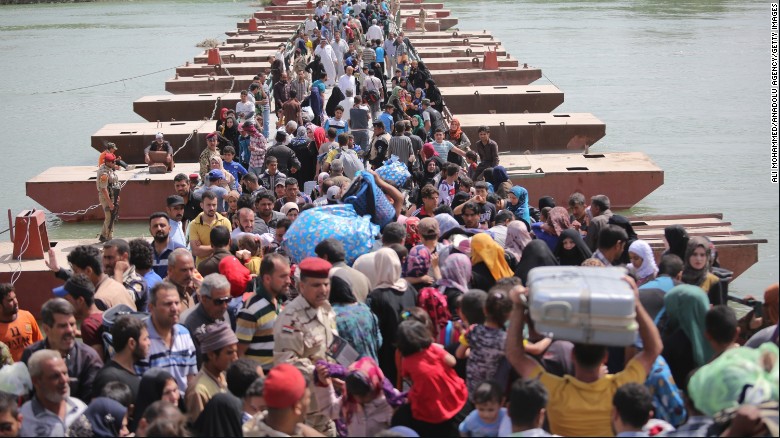
Iraqis flee the city of Ramadi as ISIS forces take over after an 18-month fight with the Iraqi military (Source: CNN)
=
In short, Sunnis need to be invested in the future of their government.  They are certainly not invested in the current form of Iraqi government, and its history since the U.S. departure has suggested that they don't have much reason to support and be invested in such a government.  The Obama administration acknowledges that there must be meaningful Sunni participation in any Iraqi government.  However, that was already the plan when the United States was deeply involved in developing Iraq's governmental structure.  The plan was for a Sunni vice president and protections of Sunni citizens.  Obviously, that plan has not transpired, with the Sunni vice president arrested and expelled from the government soon after the U.S. departure.

How does one rebuild trust in a participatory Iraqi government?  One step in the right direction was the ouster of Prime Minister Nouri Maliki, whose name toward the end of his tenure had become synonymous with Sunni oppression.  However, the changing of the guard has not translated to better relations between Sunni and Shia; rather, Shia militia rage through Sunni areas unabated, committing atrocities.

There has been a little discussion lately -- but not much -- of a three-state solution or some autonomy-heavy federalism in Iraq.  Indeed, the timing of such a discussion might seem ludicrous as ISIS controls vast swathes of what would be a Sunni state.  However, a few things should be kept in mind.  First, a three-state solution or heavily decentralized state was more widely discussed during the early years of the insurgency in Iraq.  The very reason is the same that warrants discussing it now: getting Sunnis invested in their own future.  Second, there is no reason that a discussion of a three-state solution must concede ISIS control over northwestern Iraq.  One could suggest, for example, that a northwestern Iraq referendum on independence or decentralized government occur only after Iraqi forces retake ISIS-controlled territory.

For those worried about the possibility of a Sunni state becoming a haven for terrorism: keep in mind that ISIS already controls much of the territory, and that the inability of Iraq's Shias and Sunnis to make political peace has in large part led to the lack of a united front to combat ISIS.  Indeed, so long as Iraq's Shia leaders fail to include and indeed openly oppress the Sunni, there is no incentive for Sunni to fight for such leaders.  Fighting for their own state, or own self-controlled region within a partitioned state, might give more Sunnis a real reason to expel ISIS and hold any territory it takes from the terrorist organization.

Of course, the political partition of Iraq needn't necessarily be a "three-state" solution.  One possibility, for example, is a two-state solution: an independent Kurdish state and a "federal" Sunni-Shia state with a weak central government and significant autonomy to the two federal regions.

Any type of devolution or partitioning of Iraq would involve the tricky issue of oil revenues.  Indeed, some people see oil revenue as overriding other concerns and thereby necessitating a strong central government.  Ultimately, however, any central government in Iraq is doomed if it is not ready to cede significant political autonomy to Sunni regions.  Moreover, control over their own future might be the only incentive significant enough to bring Sunnis to the fore of the fight against ISIS.

Sunday, March 8, 2015

Boko Haram: A New Beginning?

Boko Haram, whose name loosely translates to "Western education is a sin," has been operating in Nigeria since the early 2000's. It was not designated as a Foreign Terrorist Organization by the United States Department of State until 2013, although there was likely sufficient evidence to make the designation earlier. During those ten years, as Boko Haram and its influence grew, it was sometimes difficult to grasp the organization's potential longevity, though time itself should have been an indicating factor over the years.

(Boko Haram attacks, BBC)

This week, Boko Haram leaders pledged allegiance to ISIS, a move that could reflect a new beginning for the terrorist group. Evidence that ISIS has been influencing Boko Haram has existed for the past few months. It could also simply demonstrate the reach and dominance of ISIS. All in all, the full impact of this 'bayat' are not entirely clear. Increased coordination between different organizations is certainly of concern, reminding nations of similar coordination under the al-Qaeda umbrella. At the same time, Boko Haram could simply be jumping on the ISIS bandwagon. 

Monday, March 2, 2015

Battling ISIS - A Short Update

Despite the numerous groups battling ISIS, there has been arguably minimal organized support from Western governments, who are most equipped, militarily speaking. Nonetheless, alongside the flow of individuals from Western nations to fight for ISIS, there has been a smaller flow of individuals from Western nations fighting against ISIS. Many of these individuals have little affiliation with the Middle East. Some have military training, some do not.

Meanwhile, in the closing days of February, Ashley Johnston, an Australian, died fighting ISIS. He is believed to be the first Westerner to die fighting with the numerous groups battling ISIS. Seemingly immediately after his death, Australia made it a crime to be Australian and exist in Mosul, with few exceptions. Although the law has good intentions, it almost feels like a stopgap measure. What does it accomplish? How will it be proven that you were in Mosul? Will it really prevent Australians who want to be there from being there?

Perhaps some thought should be given not necessarily as to how the government can directly support or oppose individual efforts, but how to stop the movement overall - how to defeat ISIS entirely.

Thursday, February 6, 2014

A Fundamentalist Divide: Al Qaeda Separates Itself from ISIL

It seems you can be "too much," even for al Qaeda. On Monday, the terrorist group formally cut off its relationship with the Islamic State in Iraq and the Levant (ISIL, also known as ISIS). This declaration follows al Qaeda's demand that ISIL remain separate from the al Nusra Front, al Qaeda's branch in Syria, which ISIL has attempted to consolidate into itself over the past year. In fact, it is apparent that ISIL and al Qaeda have been at odds for several years, dating to the mid 2000s. While it is unlikely that the two groups will become equal rivals, it is, at the same time, clear that they may view themselves that way in the near future. In the ongoing infighting of Syria's opposition forces, al Qaeda has propped up its links to the al Nusra Front and ISIL signed a truce with Suqour al Sham. Consolidation in the region could mean less infighting, but could also lead to a severely split opposition, making it more difficult for outside powers to support either side.

(Map of ISIL operations, Source: Red24)

Critically, al Qaeda's declaration may reflect which battle it now envisions as more winnable - Syria or Iraq. While it has made occasional gains in Iraq, al Qaeda forces, by and large, have been continually beaten back. Moreover, the continued presence of American troops and related support hinder operations in Iraq. Syria, meanwhile, has limited Western interference while it collapses - The Economist's "The Death of a Country" piece ran nearly a year ago - leaving a potential vacuum of power in all but al Assad's western strongholds. In the end, this could make Syria's near term future only more violent, a fact that is difficult to imagine given the United Nations' February 4 report detailing the violence there today. 

Wednesday, January 29, 2014

Homebrew: the Islamic State of Iraq and the Levant

Growing out of the chaos of Middle Eastern insurgencies, the al Qaeda-linked Islamic State of Iraq and the Levant (ISIL), also referred to as the Islamic State of Iraq and Syria (ISIS), has built its presence and spread fear throughout the region. Often viewed as one of the more violent terrorist groups in the Middle East, ISIL has taken over towns in Iraq - the first time insurgents have controlled these towns since 2003 - and is contributing to infighting among opposition fighters in Syria.

ISIL fighters have been careful, focusing on political aims to establish themselves, only to later identify with more fundamental positions. When necessary, socioeconomic and political arguments are employed to attempt to garner support among the locals. Once established, their strength limits the options to opponents, both civilian and military, as is the case in Syria. In a sense, entrenched positions are difficult to change.

ISIL's origins remain somewhat shrouded, and its role in the region has become unclear. Some reports suggest that ISIL is linked to Bashar al-Assad, Syria's President, as an attempt to fracture and debase the opposition. Others suggest that ISIL is little more than a concept Syria developed to change the face of its civil war. The BBC, though, has ISIL's formation pinned down to April 2013 as an independent terrorist organization. Analysts tend to tie it to insurgents previously known as al Qaeda in Iraq (AQI), which may be best described as an evolutionary step in that organization's history. There is much information floating around, but most of it only lightly touches on why there was an outgrowth across borders. Why did the influx of fighters into the regional coalesce into much more coherent organizations than previously? Why are they more successful now? (apart from the withdrawal from Iraq, for that can't be the reason for everything)

Countries in the region continue to grow wary. Jordan has gone so far as to note that ISIL does not operate within its borders and that the terrorist group is "no threat." This is a surprising statement given ISIL's operations in two of Jordan's neighbors. Meanwhile, ISIL has threatened to attack Turkish cities over a disputed closed border crossing. It seems that ISIL's reach may yet expand.

Looking ahead, the horizon for ISIL is unclear. Expansion opens up new fronts, builds enemies, and attracts attention. Showing its face in Syria has increased its exposure and has proven of little benefit. At the same time, there is concern for a large lawless region in northwest Syria controlled by ISIL turning into another Afghanistan. Regional powers are keen to get it all under control though, and it is unlikely for a large power vacuum to redevelop, given recent history. This homegrown movement may not get much bigger, but might redouble its efforts where it already controls the land.