Showing posts with label Muslim. Show all posts

Sunday, June 7, 2015

Return to the Concept of a Three-State Solution in Iraq

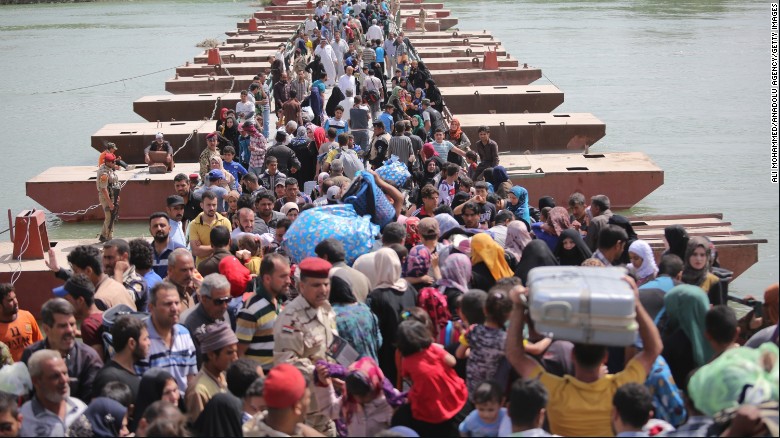
Any "defeat" of ISIS, however one defines it, would certainly include re-taking ISIS-controlled areas of Iraq and holding them.  Part of the problem is that, similar to the "Anbar awakening" in 2007, such a strategy necessarily involves a serious and committed effort by local Sunnis to expel a distasteful group.  There is one key difference, this time.  In 2007, the U.S. military paid local Sunni groups to fight and expel al Qaeda.  This time, the Iraqi government is nominally in control of ground operations and put simply, there is little Sunni appetite to participate with a Shia-led government that has turned a blind eye to atrocities against Sunnis, used violence to break up Sunni protest camps, and has directly participated in the political disenfranchisement of Sunnis.  While many Sunnis bravely risk their lives to oppose ISIS control of their lands, there is a very understandable reticence to work side by side with the government that has spent much of its time oppressing and vilifying them.

Iraqis flee the city of Ramadi as ISIS forces take over after an 18-month fight with the Iraqi military (Source: CNN)
=
In short, Sunnis need to be invested in the future of their government.  They are certainly not invested in the current form of Iraqi government, and its history since the U.S. departure has suggested that they don't have much reason to support and be invested in such a government.  The Obama administration acknowledges that there must be meaningful Sunni participation in any Iraqi government.  However, that was already the plan when the United States was deeply involved in developing Iraq's governmental structure.  The plan was for a Sunni vice president and protections of Sunni citizens.  Obviously, that plan has not transpired, with the Sunni vice president arrested and expelled from the government soon after the U.S. departure.

How does one rebuild trust in a participatory Iraqi government?  One step in the right direction was the ouster of Prime Minister Nouri Maliki, whose name toward the end of his tenure had become synonymous with Sunni oppression.  However, the changing of the guard has not translated to better relations between Sunni and Shia; rather, Shia militia rage through Sunni areas unabated, committing atrocities.

There has been a little discussion lately -- but not much -- of a three-state solution or some autonomy-heavy federalism in Iraq.  Indeed, the timing of such a discussion might seem ludicrous as ISIS controls vast swathes of what would be a Sunni state.  However, a few things should be kept in mind.  First, a three-state solution or heavily decentralized state was more widely discussed during the early years of the insurgency in Iraq.  The very reason is the same that warrants discussing it now: getting Sunnis invested in their own future.  Second, there is no reason that a discussion of a three-state solution must concede ISIS control over northwestern Iraq.  One could suggest, for example, that a northwestern Iraq referendum on independence or decentralized government occur only after Iraqi forces retake ISIS-controlled territory.

For those worried about the possibility of a Sunni state becoming a haven for terrorism: keep in mind that ISIS already controls much of the territory, and that the inability of Iraq's Shias and Sunnis to make political peace has in large part led to the lack of a united front to combat ISIS.  Indeed, so long as Iraq's Shia leaders fail to include and indeed openly oppress the Sunni, there is no incentive for Sunni to fight for such leaders.  Fighting for their own state, or own self-controlled region within a partitioned state, might give more Sunnis a real reason to expel ISIS and hold any territory it takes from the terrorist organization.

Of course, the political partition of Iraq needn't necessarily be a "three-state" solution.  One possibility, for example, is a two-state solution: an independent Kurdish state and a "federal" Sunni-Shia state with a weak central government and significant autonomy to the two federal regions.

Any type of devolution or partitioning of Iraq would involve the tricky issue of oil revenues.  Indeed, some people see oil revenue as overriding other concerns and thereby necessitating a strong central government.  Ultimately, however, any central government in Iraq is doomed if it is not ready to cede significant political autonomy to Sunni regions.  Moreover, control over their own future might be the only incentive significant enough to bring Sunnis to the fore of the fight against ISIS.

Monday, April 15, 2013

Sticking to the Facts is the Hardest Part...

When it comes to terrorist incidents, sticking to the facts is the hardest thing to do. Conversations naturally boil down to polemics that insinuate motive and reasoning. It's easy to forget, for example, that Muslim terrorists were initially blamed for the Oklahoma City bombing in 1995. Therefore, initial reports that a Saudi national was the prime suspect may prove to be a dead lead.

The facts are limited, but also clear:

1. This was nearly certainly a terrorist attack (even if the President is hesitant to use that word). Some initial reports that it may have been a gas explosion are likely to be unfounded.

2. There were multiple explosive devices. Some reports suggest up to seven, although this could later come to be far too extensive (and is already being noted as such). For 5/7 devices to fail would be significant.

3. There was likely shrapnel in the explosive device. This suggests more of an intent to kill than injure, maim, or elicit terror.

That's pretty much the extent of the facts right now, apart from the casualties. It's too early to label the bombing as international terrorism or Muslim extremism - it could very well turn out to be right-wing extremism and/or domestic terrorism.

For the time being, while the professionals do their work, it's best to help those in need and keep those in Boston in mind.

Tuesday, August 28, 2012

Coexistence & the Two-State Solution

It can be claimed that Israeli society is as polarized as it has ever been. Critical rifts run through: secular vs. religious, Jewish vs. Muslim, immigrant vs. native, and many others within those labels as well as across them.

Recently, a group of Jewish teenagers beat an Arab teenager to within inches of his life (he has since been released). Unsurprising to many observers, a general lack of enmity toward Arabs by religious Jewish populations may have been an underlying cause. Many Israelis recognize the inevitability of coexistence and the two-state solution - the alternative is all-out war and annihilation. However, some continue to believe that they are participating in a zero-sum game. In reality, the situation is one where both sides can benefit. It is therefore positive to see that Israel ordered its schools to discuss the beating, as well as the feelings that may have fueled it. What would be even more positive would be to see would be for this incident to be labeled, officially speaking, racist and the charges being level with the hate crime category in the United States. The government should take the stance that this kind of activity will not be tolerated in the society that Israel seeks to build.