Showing posts with label EU. Show all posts

Monday, December 9, 2013

Ukraine, Overlooked, Underreported

It's interesting to read about the ongoing protest movement in Ukraine and then examine the lack of coverage in the United States. Throughout the 2000s, color revolutions were widely praised and reported on. They were viewed as clear indicators that democratic progress could not be halted and was organic to populations throughout the world. However, the 2010s brought out the Arab Spring, which has led to a more convoluted environment in the Middle East than anyone can truly outline. Moreover, those color revolutions, in many senses, only half-panned out - democracy, where it was itching to flourish, has stagnated.

In case you were wondering, this is going on in Ukraine:
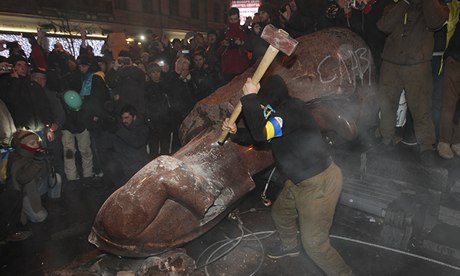
    (source: Sergei Chuzavkov/AP via Guardian)

What is that, you may be asking? Those are opposition protesters toppling and destroying a statue of Lenin that has stood since 1946, a la the famous toppling of the statue of Saddam Hussein (more photos via the previous link). Shortly thereafter, a European Union (EU) flag was raised where the statue had stood. These protesters are not yet at "revolution status," but they sure are making a point.

That point is that Ukraine is a deeply divided country, politically, linguistically, and, to an extent, culturally, though outsiders often ignore this. Though Ukraine is one nation-state, it is surprisingly evenly cut in half between East and West.

One part of Ukraine wishes to align itself with Russia, which is gradually building up its own outsider-EU political superstructure via the Collective Security Treaty Organization (CSTO) and the more recent Customs Union of Belarus, Kazakhstan, and Russia. Both historically, and in present day, Russia has wielded extraordinary influence over landlocked regions of Eurasia. Russia has served as an outlet to both West and East, and as a protector of limited sovereignty to those who follow it.

Meanwhile, the other part of Ukraine wants to continue its ongoing, lengthy process with the European Union. Eventually, this groups wishes to break free from Russia's grasp and join the European Union outright. This would greatly extend the borders of the European Union and the extent that those borders parallel Russia's.

And that's where the trouble started. Ukraine's president, Viktor Yanukovych, who has kept his opponent from the previous election Yulia Tymoshenko languishing in jail on largely dubious grounds, and his government elected to halt discussions with the EU and instead lean toward Russia. Part of the wedge is the jailing of Tymoshenko, which Western nations feel is unjust and illegal. The rest is a nation still feeling its way out of the shadows of the USSR, all these years later.

Perhaps this won't be a color revolution, but a real revolution, unlike those seen since the 1990s. 100,000 protesters can't be a quiet voice. Then again, this could all the same tear the country in half, an effect that has been brewing for decades.

Tuesday, September 17, 2013

Meanwhile, in other nation-building news...

While the world remains focused on developments in the Syrian chemical weapon stockpile saga, the European Union unveiled an aid package of roughly $2.4 billion to the fragile Somali government -- dubbed a "new deal for Somalia."  The EU aid seeks to "sustain the gains made by the government and support the reconstruction of the country after two decades of civil war."  While the al Qaeda-linked al-Shabaab terrorist group still controls much of Somalia, key cities such as Mogadishu are in government control.  That government, which has been in power for one year, is buttressed by African Union and Ethiopian troops. Somali and affiliated forces have made important gains -- notably in port cities -- and the Somali president Hassan Mohamud hopes that the funds can prompt further progress:

For Mohamud, there were four key priorities among many -- security, legal reform, public finances and economic recovery. 
"The New Deal must deliver on the ground soon," he told delegates. After years of suffering, "expectations from our people are understandably high. We must not let them down."
As for U.S. involvement, much of it has been behind-the-scenes training of African Union troops.  Of course, there are also the untold number of covert drone strikes targeting al-Shabaab and other militants in Somalia.  The planned withdraw of Ethiopian troops from certain areas, meanwhile, raises fresh concerns about the African Union's ability to maintain Somali government control in large areas of land.

In short, while both sides are firmly entrenched and the civil war rages on, the Somali government currently has momentum; the EU aid package constitutes a large part of President Mohamud's efforts to maintain that momentum.  Stay tuned to see whether the coming months show any serious shifts in the country's balance of power.

Sunday, June 2, 2013

Foreign Arms in Syria

As the civil war rages on in Syria, foreign countries continue to wade in the murky waters of arms deals to government and rebel forces.

Russia, for one, is providing advanced anti-aircraft missiles to Syria.  Despite initial reports that the missiles had already arrived, Russian sources indicated that the missiles -- part of a 2010 arms deal -- wouldn't arrive in Syria for months.  Those same sources said, however, that delivery could be expedited based on conditions on the ground in Syria or changing positions/activities of Western governments.

On Monday, meanwhile, the EU ended its arms embargo on Syria, opening the door for countries like Britain and France to arm the rebels.  Canada's foreign minister responded to the news negatively, claiming that more arms flowing into Syria will only cause further bloodshed.

To make matters even worse, news came out Friday that the developer of Russia's MiG fighters will ink a deal to ship at least 10 fighter jets to Syria.  While details are sketchy, one can only hope that such a deal does not come to pass.

In short, while there does not appear to be any move toward direct military intervention by foreign governments, all indications seem to point to a weapons influx in the near future.  This of course brings us back to the question: who are we arming?  According to numerous accounts, the most organized and effective faction of the Syrian rebels is Jabhat al-Nusra -- a group with ties to al-Qaeda in Iraq.  The U.S. State Department designated Jabhat al-Nusra as a terrorist organization in December 2012, and the UN just added the group to its sanctions blacklist.

Therefore, those states looking to arm the Syrian rebels have some issues to address:

-Providing arms to Jabhat al-Nusra would violate the UN sanctions.
-Providing arms to other Syrian groups would likely be less effective, not to mention the fact that the arms could well end up in the hands of Jabhat al-Nusra fighters.  Indeed, reports indicate that entire units of Free Syria Army soldiers have defected to Jabhat al-Nusra.
-Providing arms could provoke an arms race between Western powers and Russia to equip their respective sides.
-Providing arms could be the first step in the road to direct military intervention.

An arms escalation could further derail peace talks.  A U.S.-Russia conference planned for early June to discuss Syria, for example, will not be taking place in light of the recent arms developments.  With a weapons influx seemingly imminent, peace in Syria appears as elusive as ever.

Previous posts on Syria:


Wednesday, May 29, 2013

Is Canadian Oil Dirty?

While vociferous debate has sprung up in the United States over the proposed Keystone XL pipeline, a different kind of debate is brewing, starting in the European Union. The big question being being asked in Brussels is whether fuel should be taxed based on the level of pollution it produces as a byproduct. Moreover, how severe should that penalty be?

Although the tar sands may hold 170bn barrels of oil, getting it out is tricky, complex, and messy. The operation in Canada's back country is already considered by many to be an ecological and environmental disaster of historic proportions:
Prominent scientists even warn that the impact of tar sands oil production on climate change could outstrip nearly all other known contributors.

The European Union is on the verge of classifying fuel that comes from Canada's wild tar sands as dirtier than other types, thereby making it more expensive over time. Canada is pleading with the EU and even going through intermediaries in the United Kingdom to water down the proposal or scrap it altogether, even though Canada currently exports no oil to Europe.  Canada has gone so far as to threaten to take its case to the WTO.

The fear is not of Europe itself, but a precedent-setting international domino effect. Canada, the country of great environmental beauty, may actually end up on the wrong side of the climate change debate. This could spell the end not only of Canada's resource-intensive economy, but also the economic driver that has held Canada high during the recently leaner economic times elsewhere. It is, in a sense, an existential crisis that Canada has drummed up, all on its own.

Thursday, May 17, 2012

Europe's Greek Tragedy?

As Greece heads towards elections on June 17, the drama is unfolding not unlike one of its ancient tragedies. While Europe is enveloped in the melodrama of successively failing Greek governments and the potential for Greece's exit from the Eurozone (even becoming termed the "Grexit" as I've learned from The Economist), the rest of the world is watching cautiously.

The question on every European politican's mind is whether an exit by Greece, a seriously indebted outlier, could trigger the collapse of the Eurozone altogether and the death knell of an integrated Europe. Greece is followed, in no short order, by Portugal and Ireland, with Italy and Spain not lagging far behind. Further concern over France and the Netherlands continues to grow daily. It is perhaps Germany who seems the strongest, but 40% of its exports are to the Eurozone. If a domino effect were to occur, Europe would be shorn apart.

At least until mid-June, it seems that the threat is grave, but overstated. The "contagion" problem, and the ramifications of the collapse of the Euro are so great, that it is unlikely that Europe's stronger economies, namely Germany, would allow a weak economy to so significantly affect them. Protection against the sovereign risk of a Greek default or a Greek exit is minimal, with the default being more likely and easier to work through (though not easy in any means). In essence, Europe's strong would need to convince investors, the people, and other nations that a Greek exit would have little to no effect on the Euro. All in all, that is highly unlikely to occur, and even less so in the course of a single month.

Therefore, if Greece were to stay, it would need to be controlled. In order for it to be controlled, a more unified Eurozone fiscal and budgetary policy would need to be implemented. So although we see a Europe today in crisis, is it really in any more crisis than when Ireland rejected the Lisbon Treaty in 2008 or when the European Union enlarged in 2004 and 2007? Recall that the Lisbon Treaty was ratified in time and European expansion has slowed, but never fully stopped (Croatia looks to be next to join). This is the dichotomous story of Europe since World War II - always either about to collapse into itself or integrate further. The value of integration has been well illustrated over the decades, and the value of collapse well understood by two major wars and some smaller, but still noteworthy conflicts. The question really remains: do today's politicians, and today's citizens for that matter, remember what happened when Europe collapses? If they don't, or if they choose to ignore it, the tragedy they're watching may simply be a story within a story, with the themselves as the main characters failing to see the relationship to their own situation.