Showing posts with label terrorism. Show all posts

Tuesday, August 11, 2015

First ISIS Detainee Turned Over to Iraqi Kurds for Trial

News broke late last week that ISIS detainee Nasrin As’ad Ibrahim (alias Umm Sayyaf) was handed over to the Kurdish Regional Government in Iraq.  U.S. forces captured Umm Sayyaf in May during a raid in which her husband, Fathi ben Awn ben Jildi Murad al-Tunisi - a powerful ISIS leader involved in oil and gas development - was killed.  The Wall Street Journal reported that Umm Sayyaf "provided valuable insights into Islamic State’s financial operations and leaders" during questioning in the 3-month period she was detained by American forces.

In July, the Washington Post reported that federal prosecutors were preparing charges against Umm Sayyaf.  The Post also noted that "[a] prosecution of Umm Sayyaf for her suspected role in taking Mueller hostage would be the first publicly known FBI case involving an alleged senior figure in the Islamic State."   Reports indicate that the decision to transfer her to Iraq's Kurdish regional government, rather than bring her back to the United States to face charges, stemmed in part from the fact that Iraq does not extradite its citizens.

U.S. Secretary of Defense Ash Carter speaks to reporters about the operation that led to Umm Sayyaf's capture (Source: WSJ)


This begs the question: what is the current status of U.S.-Iraqi extradition agreements?  This is not merely an academic question.  If the United States continues to conduct military operations against ISIS forces within Iraqi territory, will it be unable to bring ISIS terrorists to trial in the United States?  Once a prisoner is in the U.S., the U.S. has tools at its disposal to try him or her for material support of terrorism.  Specifically, 18 U.S. Code 2339A and 2339B criminalize the material support of terrorists and terrorist organizations.  Though not heavily publicized, the FBI and U.S. Attorney's Offices have been making domestic arrests for material support of terrorism -- often when an individual is at the airport on his way to Syria to join ISIS.  Moreover, the U.S. has jurisdiction over conduct violative of its "material support" statutes even when that conduct occurs outside of the geographic bounds of the United States.  For example, 2339B contains an entire "Extraterritorial Jurisdiction" section that states there is jurisdiction for a material support of terrorist organizations offense if "after the conduct required for the offense occurs an offender is brought into or found in the United States, even if the conduct required for the offense occurs outside the United States."  Thus, were Umm Sayyaf or another high-profile ISIS member captured and brought into the United States, the appropriate U.S. Attorney's Office could charge and prosecute said ISIS member.

In order to get said ISIS member to the U.S., however, one might have to deal with the issue raised by the Iraqis in the present case: extradition.  The United States in fact has a still-existing extradition treaty with Iraq that dates back to 1936.  That treaty lays out the charges and procedures under which either party can request extradition of an individual located within the geographic bounds of the other party.  Reviewing the treaty, terrorism is not mentioned but "murder" and "kidnapping" are charges in which Umm Sayyaf may have been a participant and therefore potentially charged in the United States.  One hurdle, however: Article VIII of the treaty notes that "neither of the High Contracting Parties shall be bound to deliver up its own citizens."  Therefore, Iraq would not be bound to turn over an Iraqi citizen to face charges in the U.S., but nothing in the treaty prohibits Iraq from voluntarily doing so.  The treaty was used most recently in 2014, when Iraq extradited a U.S. citizen back to the U.S. to face fraud charges related to defense contracting.

However, there is another, newer hurdle to extradition: the Iraqi Constitution.  Article 21 of the Constitution of Iraq states that "[n]o Iraqi shall be surrendered to foreign entities and authorities."  This is a much more explicit prohibition that the more discretionary language of the 1936 extradition treaty.  As the U.S. continues to wage military operations against ISIS, one must wonder if the Umm Sayyaf incident has led American and Iraqi military and political personnel to discuss creative ways to comply with the Iraqi Constitution and also bring ISIS detainees to the United States.  What if, for example, a high-level ISIS commander known to have been involved in killing American citizens is captured by U.S. military personnel?  At some point, the American government would justifiably want to see certain ISIS detainees brought to the U.S. to face trial.  Indeed, the decision to hand Umm Sayyaf over to the Kurdish regional government rather than the central government may have reflected a reluctance to turn her over to the central Iraqi government (of course, it could have also been a strategic decision to avoid placing the Shiite government in charge of an important ISIS detainee).

One possible solution would be to establish clear U.S. custody of a detainee from the moment of capture.  If the Arabic version of the Iraqi Constitution is interpreted the same as the English version, that constitution prohibits the surrendering of Iraqi citizens to foreign authorities.  If Iraq never has custody over a detainee, the thinking would go, there would be no constitutional violation because Iraqi authorities never had custody of the detainee.  This is one way in which both governments could work together to help respect the integrity of the Iraqi Constitution while also aggressively pursuing ISIS terrorists.

Wednesday, July 8, 2015

Stopping Home-grown Radicalization in the Internet Age

One of our recent posts addresses the need to develop a better geo-political strategy in Iraq if one hopes to build real and lasting Sunni support in the fight against ISIS.  The threat posed by Islamic extremists, however, is not limited to the foreign battlefield.  Indeed, recent events in the U.S. and Europe have shown the potential to radicalize persons who move about freely in the U.S. or Europe.  ISIS is a media-savvy organization and, indeed, its members often spend countless hours trying to isolate and subsequently convert or radicalize Westerners.

An American in her 20s speaks with the New York Times about ISIS recruitment and conversion efforts (Source: New York Times)

ISIS is not the first Islamic terror organization to utilize the Internet to radicalize Westerners, nor will it be the last.  Indeed, this was already a well-established phenomenon by the time ISIS came on the scene.  The most prominent example was Anwar al-Awlaki, the U.S.-Yemeni dual citizen who was a senior member of al Qaeda in the Arabian Peninsula (AQAP) before being killed by a U.S. drone strike.  Al-Awlaki wrote on a blog, posted YouTube videos, wrote for al Qaeda's Inspire magazine, and directly communicated with individuals online, as part of AQAP recruitment and radicalization efforts.  For example, he communicated with Fort Hood shooter Nidal Hassan online prior to Hassan's actions; recruited the Christmas day "underwear bomber" Umar Farouk Abdulmutallab in person and online; and inspired Times Square bomber Faisal Shahzad's attempted car bombing in 2010.  Al-Awlaki, in a sense, paved the way for the current wave of online radicalization that includes the ISIS and/or al Qaeda-inspired Charlie Hebdo attack and the ISIS-inspired failed attack at a Mohammed cartoon contest in Texas this past May.

Internet radicalization -- either by direct communication with vulnerable persons in Western countries or by the ability of Islamic terror's message to inspire lone wolf attacks -- will continue to present a security challenge to Western countries for years to come.  This security challenge is self-apparent: it is much more difficult for a terrorist group to coordinate attacks on U.S. soil than it is for a lone-wolf U.S. citizen radicalized by such a group to carry out an attack.  This begs the question: how do we stop home-grown radicalization?

Part of the solution is tracking the communications.  This has been a touchy political subject in the United States ever since Edward Snowden leaked details of NSA data collection programs to journalists.  Still, data collected in accordance with the 2008 FISA amendments (not the Patriot Act-based surveillance program, which did not specifically authorize bulk data collection and which was ruled unconstitutional by the Court of Appeals for the Second Circuit) led to, among other things, the tracking of emails by an Albanian who sent money to a Pakistani terror group and ultimately was detained trying to travel to Pakistan.  The legality of the 2008 FISA amendments will continue to be litigated even as the U.S. starts conducting its surveillance differently in accordance with the 2015 "FREEDOM Act."

Another part of the solution is stopping the radicalization itself at its roots.  Farah Pandith, an analyst with the Center for Strategic and International Studies with years of experience in the National Security Council and the State Department, strongly supports outreach efforts to counter the narrative ISIS and other Islamic extremists are presenting online:
Their narrative pits a monolithic Muslim “us” against a non-Muslim “them,” validating and valorizing the “us” under the veil of religion and purpose. Confronted by this narrative, some Muslim millennials see martyrdom as an attractive job description. Others simply support the extremist team by sporting the bumper sticker, wearing the colors; they’ll alter the cultural landscape so that everyone around them accepts extremism as the norm. 
Yes, we’re waging a military war against ISIS—a war we must win. But ISIS can’t have an army if it lacks recruits. Behind its growing physical army is a virtual army. A viable long-term strategy will devote itself to vanquishing both armies by countering the spread of the underlying ideology.
Or, put more succinctly, she notes that millennial Muslims are "having a crisis of identity [and] . . .[w]e have not flooded the marketplace with alternative narratives to move their minds."

Such efforts at combating radicalization will not be easy to quantify, and indeed, will not have such readily-identifiable benchmarks as cities recaptured or terrorists killed or detained.  However, such efforts may be just as necessary in preventing domestic terror attacks. 


Monday, April 13, 2015

Pakistani Terrorist Commander Ordered Released on Bail, Likely Affecting Pak-Indian Relations

The world was horrified by the 2008 Mumbai attacks, in which terrorists stormed a number of buildings in India and killed 168 people.  All but one of the gunmen died; the surviving gunman was convicted and executed in 2012 for his actions.  The terrorists were Pakistani and came from the group Lashkar-e-Taiba (LeT), a Pakistani terrorist group with historical ties to the Pakistani government and military and highly suspected current ties with Pakistan's chief intelligence service.

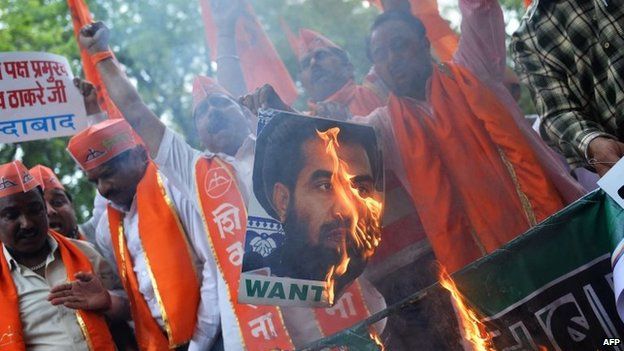
The operational leader and co-founder of LeT, Zaki-ur-Rehman Lakhvi, was arrested in 2008 in connection with the attack.  He has been incarcerated for the past 7 years.  Back in December 2014, a court ordered Lakhvi released on bail.  The Pakistani government opposed the decision and kept him incarcerated, but this past Thursday the Pakistani supreme court ordered that Lakhvi be released immediately.


Protests in India followed the court ruling ordering Lakhvi released (Source: BBC)


This will likely have negative effects on India-Pakistan relations, which have somewhat thawed following the election of India's Prime Minister Modi and a positive exchange of letters amongst the countries' leaders.

What is especially troubling is how little is known about Lakhvi's trial, which has been ongoing since 2009 and is not open to the public:
The commander, Zaki-ur-Rehman Lakhvi, and six other members of the Lashkar-e-Taiba militant group have been on trial since 2009 at a high-security jail in Rawalpindi, just south of Islamabad, on charges of participating in the Mumbai operation. 
But the trial has been conducted largely in secrecy, and its halting pace has given rise to speculation that its progress is being influenced by the vagaries of wider tensions between Pakistan and India.
While this doesn't mean the case is dismissed, only time will tell whether Lakhvi appears for the remainder of the trial.  While locked up, he wasn't exactly treated like a commander of a terrorist organization:

While Pakistan's government claimed that it was cracking down on terrorists, Zakiur-Rehman Lakhvi and six of his comrades in Rawalpindi's sprawling Adyala Jail had several rooms next to the jailer's office at their disposal. 
And with the jailer's permission, they had a television, mobile phones and access to the internet, as well as dozens of visitors a day. 
"He [Lakhvi] can receive any number of guests, any time of day or night, seven days a week," said one jail official while the terror suspect was under lock and key.
No special permission was required for visitors, who were not even asked to identify themselves to jail authorities.
That access allowed Lakhvi to retain his position as a high-ranking LeT commander even while he was incarcerated.  This is not simply a question of prison conditions.  LeT has been declared a terrorist organization by the United States and the UN Security Council and banned in Pakistan since 2002.

Letting one of their commanders continue to run the organization from prison is an insult to the memories of those who have died at the hands of LeT terror.  While arresting him and bringing him to trial in Pakistan were steps in the right direction for a government that has often been seen as having sympathies toward LeT, the recent supreme court ruling that released him is a step in the wrong direction.  While the Pakistani government publicly opposed that decision, it has been treating him in a manner for the past 5+ years that suggests it is not as eager to take on LeT as it claims.  Reaction in India to the decision has, unsurprisingly, been quite negative.  If Lakhvi and other LeT officials are ultimately acquitted, that negativity will likely manifest itself in worsening relations between two countries that seemed on track to gradually improve their historically volatile relationship.

Sunday, December 29, 2013

Egypt Update: Muslim Brotherhood Declared Terrorist Organization (And Doesn't Seem Happy About It)

Egypt's ruling government threw kerosene on an already-raging fire this past Wednesday when it declared the Muslim Brotherhood to be a terrorist organization.

The impetus for the latest act of one-upmanship in the ongoing power struggle -- a court already banned participation in the Brotherhood back in September -- was a deadly car bombing on Tuesday that left 16 dead and more than 100 wounded.  Immediately after the attack, government officials tied the Muslim Brotherhood to the attack and claimed the organization had shown its "ugly face as a terrorist organization shedding blood and messing with Egypt's security."  The Brotherhood, meanwhile, condemned the terrorist attack and denied any involvement.

Egyptians survey the destruction in the aftermath of Tuesday's deadly terrorist attack (NYT).


On Wednesday, the al Qaeda-linked group Ansar Beit al-Maqdis -- which has been responsible for two notable terrorist attacks in recent months -- claimed responsibility for Tuesday's car bombing.  This was not exactly a surprise, given that security analysts had already noted that Ansar was likely behind the attack.

With Ansar Beit al-Maqdis' claim of responsibility, the Egyptian government shifted its line of attack against the Muslim Brotherhood by claiming there are links between the Muslim Brotherhood and Ansar Beit al-Maqdis.  Without addressing Ansar Beit al-Maqdis' claim of responsibility, moreover, the Egyptian government labeled the Muslim Brotherhood a terrorist organization and again blamed it for the terrorist attack:
Deputy Prime Minister Hossam Eissa announced the move, which will give the authorities more power to crack down on the Brotherhood.

He said that those who belonged to the group, financed it or promoted its activities would face punishment.

The decision was in response to Tuesday's suicide bombing of a police headquarters in Mansoura, in the Nile Delta, which killed 16 people and wounded more than 100, he said.

"Egypt was horrified from north to south by the hideous crime committed by the Muslim Brotherhood group. . . . This was in context of dangerous escalation to violence against Egypt and Egyptians and a clear declaration by the Muslim Brotherhood group that it still knows nothing but violence. It's not possible for Egypt the state nor Egypt the people to submit to the Muslim Brotherhood terrorism."

Egypt would notify Arab countries who had signed a 1998 anti-terrorism treaty of the decision, he added.
(BBC).

Additionally, although the deputy prime minister did not specifically mention Ansar Beit al-Maqdis, other government officials stepped in to claim a link between the groups:
Ansar Bayt Al-Maqdis, an Al-Qaeda inspired group based in the Sinai Peninsula, claimed responsibility for the Mansoura bombing. However an Egyptian security official, speaking to Asharq Al-Awsat on condition of anonymity, affirmed that the Muslim Brotherhood had formed an alliance with the Al-Qaeda-linked Ansar Bayt Al-Maqdis and another group, the Al-Furqan Brigade.
To date, however, the Muslim Brotherhood has denounced the attacks and no evidence of any supposed alliance has been forthcoming.

The designation of the Brotherhood as a terrorist organization will likely lead to the closure of Brotherhood-affiliated organizations that "provide health care and other services to rural and urban areas that lack infrastructure."  Additionally, the government swiftly moved to act upon the new label this past Thursday, arresting people for membership in the group:
Sixteen of the arrests were in the Nile Delta province of Sharkiya. The state news agency said those held were accused of "promoting the ideology of the Muslim Brotherhood group, distributing its leaflets, and inciting violence against the army and police". Security sources gave a country-wide total of 38 arrests on terrorism charges.

From now on, anyone taking part in Brotherhood protests will be jailed for five years, Interior Ministry spokesman Hany Abdel Latif told state TV. Jail terms for those accused under the terror law stretch up to life imprisonment. "The sentence could be death for those who lead this organization," he said.
Unsurprisingly, the Muslim Brotherhood has denounced the government's actions, stating on Twitter that the move is a "worthless decision from an illegal gov't without any evidence and will not change anything in reality."  The move has also intensified Brotherhood-led protests against the current regime.

The government's action may well be an effort to bolster support before the constitutional referendum scheduled next month.  Whatever the outcome of the referendum, however, protests and clashes between the Brotherhood and the interim government will likely continue.  The reason is that the two groups, both of which participated in the 2011 protests that ousted Hosni Mubarak, do not view the other as legitimate.  The Muslim Brotherhood won the first democratic elections in post-Mubarak Egypt, but its ineffectual governance led to massive protests and regime change by way of a coup.  The anti-Brotherhood elements, meanwhile, have consistently struggled to adapt to a political system of voting in lieu of protests.  Their current move of designating the Brotherhood as a terrorist organization reflects a desire to marginalize, rather than successfully compete against, its only viable competitor on the Egyptian political scene.  If anything, however, the government's thinly-veiled pretense only makes its own rule appear more illegitimate.  Like the Brotherhood's Morsi, the current government is discovering that ruling the fractured country is much more difficult than gaining power.

Sunday, June 2, 2013

Foreign Arms in Syria

As the civil war rages on in Syria, foreign countries continue to wade in the murky waters of arms deals to government and rebel forces.

Russia, for one, is providing advanced anti-aircraft missiles to Syria.  Despite initial reports that the missiles had already arrived, Russian sources indicated that the missiles -- part of a 2010 arms deal -- wouldn't arrive in Syria for months.  Those same sources said, however, that delivery could be expedited based on conditions on the ground in Syria or changing positions/activities of Western governments.

On Monday, meanwhile, the EU ended its arms embargo on Syria, opening the door for countries like Britain and France to arm the rebels.  Canada's foreign minister responded to the news negatively, claiming that more arms flowing into Syria will only cause further bloodshed.

To make matters even worse, news came out Friday that the developer of Russia's MiG fighters will ink a deal to ship at least 10 fighter jets to Syria.  While details are sketchy, one can only hope that such a deal does not come to pass.

In short, while there does not appear to be any move toward direct military intervention by foreign governments, all indications seem to point to a weapons influx in the near future.  This of course brings us back to the question: who are we arming?  According to numerous accounts, the most organized and effective faction of the Syrian rebels is Jabhat al-Nusra -- a group with ties to al-Qaeda in Iraq.  The U.S. State Department designated Jabhat al-Nusra as a terrorist organization in December 2012, and the UN just added the group to its sanctions blacklist.

Therefore, those states looking to arm the Syrian rebels have some issues to address:

-Providing arms to Jabhat al-Nusra would violate the UN sanctions.
-Providing arms to other Syrian groups would likely be less effective, not to mention the fact that the arms could well end up in the hands of Jabhat al-Nusra fighters.  Indeed, reports indicate that entire units of Free Syria Army soldiers have defected to Jabhat al-Nusra.
-Providing arms could provoke an arms race between Western powers and Russia to equip their respective sides.
-Providing arms could be the first step in the road to direct military intervention.

An arms escalation could further derail peace talks.  A U.S.-Russia conference planned for early June to discuss Syria, for example, will not be taking place in light of the recent arms developments.  With a weapons influx seemingly imminent, peace in Syria appears as elusive as ever.

Previous posts on Syria:


Tuesday, April 23, 2013

On Boston and WMD

Yesterday, Dzhokhar Tsarnaev (the younger of the two brothers responsible for the Boston Marathon bombings) was charged with using a weapon of mass destruction.  Although the brothers' actions were certainly terrible, do they really warrant the loaded terminology of using WMD?

Yes, according to the current federal statute that defines "weapons of mass destruction."  Specifically, the term "weapon of mass destruction" includes "any destructive device" such as
(A) any explosive, incendiary, or poison gas—
(i) bomb,
(ii) grenade,
(iii) rocket having a propellant charge of more than four ounces,
(iv) missile having an explosive or incendiary charge of more than one-quarter ounce,
(v) mine, or
(vi) device similar to any of the devices described in the preceding clauses;
As Danger Room's Spencer Ackerman perhaps presciently pointed out almost a month ago, this overbroad definition begins to blur the distinction between types of weaponry.  Ackerman also noted the inherent "threat inflation" when one party accuses another of possessing or using WMD.

While the bombings in Boston were horrific and tragic, they were exactly that -- bombings.  Making any bomb, grenade, or rocket a WMD, however, dilutes the term.  This is the same issues facing international law courts and scholars who must address calls to expand the definition of genocide.  The fact that the Boston killings aren't a WMD attack in the traditional nomenclature does not and should not in any way downplay the horror of the attacks nor lessen the panoply of options available to federal and state prosecutors.  However, aligning federal criminal statutes with the more conventional understanding of WMD terminology would in the end help lessen confusion -- such as that experienced by many when they found out that pressure-cooker bombs are "WMD."

Thursday, April 18, 2013

Crowdsourced Intelligence

In the nexus between terrorism and technology, there are really only two standards floating upon a sea of change. The first is that despite the plethora of seemingly endlessly advancing technologies available, terrorists consistently utilize some of the most basic accouterments. While Black swan events such as nuclear terrorist elicit concern, it is the everyday kitchen anarchist who creates terror. The second standard is that it is equally impossible to determine beforehand what available technologies will be used to track down (and, in cases, eliminate the terrorist threat). In a mere decade, the United States has progressed from meticulous house-to-house searches to unmanned drones that stalk the night for hours.

In the case of the Boston Marathon bombing, one interesting trend that has developed is the utilization of internet forums to sift through the vast amount of facts (video, stills, etc.) surrounding the attack to crowdsource intelligence on potential suspects based on group analyzation. Up to five potential suspects have been identified, though more officially, only two are being sought. If the pattern is limited to providing intelligence to the appropriate sources, then the vast amount of data being recorded each day is not beneficial to terrorist operations; however, if crowdsourcing moves beyond intelligence review on its face and to tracking those people down, the downsides of ruining a potentially innocent person's life have already been made clear in much more benign circumstances.

It is definitely a fine line to walk, but authorities did request assistance on information on the bombing. That information started to sift in quickly and it will likely not be so long before we start to see whether any, or all, of it is accurate.

Wednesday, August 8, 2012

Terrorism in America: All About Definitions

In examining terrorism, it is always interesting to see who defines what and how they define it. After all, definitions make all the difference. The 1995 Oklahoma City bombing is widely accepted as a case of domestic terrorism. Similarly, the 2009 Fort Hood shooting is generally considered domestic terrorism. Sunday's shooting at a Sikh temple in Wisconsin is stirring debate - the dividing lines between crime, hate crime, and terrorism.

From a foreign policy end, America is always worried about the leaders of minority and majority ethnic groups stirring hatred and inciting possible violence that could lead to war, or what we call these days low-level civil conflict. Meanwhile at home, we value our freedom of speech, even if that means that one group is allowed to express their hatred of another group. Perhaps America should look inward and examine itself within a foreign policy lens.

The potential for home-grown terrorism has existed for a long time. The Turner Diaries is one example of literature around for years (the specious Protocols of the Elders of Zion being another) that illustrates that the concerns America has when a Sunni-Shia clashes in the oil-rich eastern provinces of Saudi Arabia are reflective of concerns regarding violence and terrorism at home. America is no different in its subtexts; the impressive part being its ability to consistently move on, perhaps with the victims of terrorism and hate crimes being so subsumed by its high murder rate (both gun related and otherwise).

A scary thought within all this is perhaps the failure of basic cultural education - that it may be possible for a man with blind hatred and ambition to commit an act of terrorism against one group cannot distinguish it from an entirely different population. This incident speaks volumes about how globalization may be bringing the world closer in many facets, but perhaps not in the most important: understanding of one another.

Regardless of the definition one chooses to apply for terrorism, there has always been one overarching standard: you know it when you see it. In Wisconsin, we saw terrorism.

Friday, June 15, 2012

Amnesty: The Price of Peace?

In my last post, I briefly hinted at the idea of fringe or terrorist groups being brought into the political fold.  Now I'd like to talk about a related topic: amnesty for those groups.

Colombia is the latest example of amnesty issues plaguing a war-torn country seeking peace.  Just yesterday, its senate passed -- by a razor-thin 65-3 margin -- a constitutional amendment (dubbed the "Legal Framework for Peace") that gives Colombia's Congress more authority to legislate the conditions under which rebels are prosecuted.  This means, for example, that the Congress could pass legislation directing prosecutors to only go after rebel leaders or making sentences for rebel crimes more lenient.  Former president Uribe has criticized the amendment, deeming any potential amnesty an inappropriate tool with which to handle FARC and other terrorist or rebel groups.

Also interesting: opposition to this law, and many other amnesty laws, comes from human rights organizations.  Human Rights Watch, for example, opposes the amendment because of its potential for amnesty.  A chief source of contention is amnesty for war crimes, crimes against humanity, and similar crimes that are the focus of international criminal law prosecutions.  Indeed, this is a problem in the international law field: international criminal law relies upon the idea that violators of certain egregious crimes are brought to justice, but countries may have to forego some prosecution (or provide lighter sentences) in order to achieve lasting peace.  Some international legal scholars go so far as to claim that countries cannot provide amnesty to those who violate international criminal law.  This, I believe, is a mistake.  While one does not want to diminish the import of crimes committed in the past, it would be a disservice to the people of a country, not to mention the global community at large, if chances for peace were thwarted in favor of an unyielding prosecutorial principle.

This is not to say, of course, that any peace is good peace.  History will always find ways to remind us of the potential for folly -- Chamberlain's peace with Hitler being the most commonplace example.  Still, countries must have the flexibility to develop unique solutions to their unique situations.  Colombia's constitutional amendment is the latest iteration of this concept.  If its execution turns out to be poor, then Colombia will deserve the criticism it will undoubtedly receive.  The law in its current form, however, is more designed to give the Colombian government greater flexibility in dealing with rebel groups -- something with which I believe most reasonable people could agree.

Saturday, May 12, 2012

Do We Really Need an Arms Trade Treaty?


In a word: no.

Most people don't know that the next big treaty on the United Nations' horizon is an Arms Trade Treaty.  This summer, diplomats, scholars, NGO representatives, and other interested parties, will descend upon the Big Apple to hammer out a multilateral treaty that will (in theory) regulate the international trade of conventional weapons.  While it is always good to promote ideals and advance the rule of law, the most likely outcome of this treaty will be millions of dollars wasted and an ineffective human rights-promoting institution.

So, what exactly are we talking about when we say "arms trade"?  The arms trade includes conventional weaponry -- mostly consisting of firearms, assault rifles, rocket and grenade launchers, artillery, surface-to-air missiles (SAM), anti-ship missiles, tanks, helicopters, and aircraft.  Meanwhile, the term excludes WMD -- nuclear, biological, and chemical weapons.  Conventional weapons arms trade is massive.  Because a great amount is unreported, underreported, and/or illicit, the exact amount is unknown.  The best estimate, though a few years old, puts conventional arms trade at approximately $55 billion per year.

In addition to providing states with finished weaponry, arms exports may assist states that are in the process of developing their own weapons systems.  China, for example, imported parts from Canadian, British, Italian, French, and German companies while developing a new attack helicopter.  Furthermore, China could export those finished attack helicopters to a state like Sudan that has a record of human rights violations.

So, at first glance, the notion of an arms trade treaty seems like a great idea.  However, when looking at the practices of the biggest arms-exporting countries, one might find reason to pause.

The United States, for example, sells billions of dollars of weapons per year and is the single biggest exporter of conventional weapons.  At the same time, the U.S. has an extremely robust arms control regime.  In considering arms exports, the U.S. considers its own national security interests, potential effects on the recipient state and region, and the possibility of re-transfer to third-party states (22 U.S.C. § 2751).  As far as process is concerned, the State Department reviews most sales and Congress has the power to express disapproval for export sales over $1 million; preferential treatment and streamlined approval is given to NATO members and other close allies (22 U.S.C. § 2776).  For various reasons, including state sponsorship of terrorism, U.S. regulations restrict sales to certain state and sub-state actors (including, for example, Burma, China, Cuba, Iran, and Syria).  The U.S. export regime also closely analyzes sales of dual-use items (commercial items that might have military purposes).

While the U.S. arms export regime is considered by many to be the "gold standard," other states and organizations are not always so careful.  The EU's arms export program has some similarities to that of the U.S., but less strict in certain areas -- for example, EU states export hundreds of millions of dollars' worth of weapons per year to China.  Germany also exports arms to Iran, Libya, and Syria.  Russia, meanwhile, has sold billions of dollars' worth of weapons to Iran.  China sells weapons to Sudan, Nepal, Burma, Chad, and Tanzania.  China claims that its arms sales are "cautious and responsible," but it does not participate in any multilateral arms export treaties seeking to prevent the use of exported arms to human rights-violating states.

For those states already desiring to restrict arms sales to certain states, there are several international bodies attempting to address the serious issues.  For example, the U.N. Security Council maintains embargoes against Cote d'Ivoire, Liberia, North Korea, Somalia, al Qaeda and the Taliban, nongovernmental forces in the Democratic Republic of the Congo, nongovernmental forces in Iraq, nongovernmental forces in Lebanon, nongovernmental forces in Rwanda, nongovernmental forces in Sierra Leone, and the Darfur region of Sudan.  These arms embargoes are regularly violated, however.  While widespread violations of Security Council embargoes could well serve as an indicator of an arms trade treaty's ineffectiveness, NGOs actually (and disingenuously) use the embargoes' ineffectiveness to argue for an arms trade treaty.

There are also voluntary multilateral institutions like the Wassenar Arrangement, which promote best practices in arms export control among member states.  Such arrangements are voluntary and non-binding, and thus contain no system for determining or punishing violations of the Arrangement's principles.  At the same time, the Arrangement has the flexibility to allow member states to participate how they see fit; such flexibility and voluntary participation are perhaps the best indicia of states' desire to engage in responsible arms export practices.

Meanwhile, over the last five years, support for an arms trade treaty has increased amongst NGOs, the U.N., and states.  The common theme is that a binding, multilateral treaty would codify the "highest possible common international standards for the import, export and transfer of conventional arms" (this language appears in multiple U.N. General Assembly resolutions).

While the final makeup of an arms trade treaty is unclear, draft resolutions acknowledge "the right of all States to manufacture, import, export, transfer and retain conventional arms for self-defence and security needs and in order to participate in peace support operation."  The treaty will also probably set a base level of standards with which states should comply before exporting arms.  The U.S. insists that states should be able to unilaterally set higher arms control standards, but it remains unclear how this principle would be reconciled with the right of states to import conventional weapons.

Furthermore, setting aside the politically questionable issue of state ratification, one must question the extent to which an arms trade treaty would affect state behavior.  Without U.S. support, the treaty would not include the vast majority of arms export sales.  Meanwhile, Russia and China abstained on the vote for the latest U.N. General Assembly resolution calling for an arms trade treaty.  This is particularly important, as these two states are major arms exporters as well as permanent members of the U.N. Security Council.  This leaves both states well-positioned to block Security Council arms embargoes, block any Security Council action against Russia or China for violating already-existing arms embargoes, and circumvent the provisions of an arms trade treaty without consequence.

What should one think, meanwhile, of the numerous states that support an arms trade treaty but currently do not employ rigorous export controls?  There is already ample evidence of states (even developed European states) permitting arms exports to states with dubious human rights and/or retransfer practices.  Will an arms trade treaty affect their behavior?  Scholars and NGOs supporting an arms trade treaty appear to think so.  They point to violations of an EU embargo on sales to China as evidence of the need for a multilateral treaty.  If a 27-member institution of developed states cannot control its own export practices, however, what is the expected efficacy of a much broader treaty with a much more diverse polity?

Take China, for example.  Faced with China’s dubious export practices, Amnesty International pushes hard for an arms trade treaty and calls upon China to participate in that treaty process.  The countervailing strategy that Amnesty implicitly rejects is strengthened political pressure from other states.  Of course, this might reflect the simple reality that other states are ill-positioned to coerce a state with the world’s largest population, third-largest economy, and a permanent seat on the U.N. Security Council.  Regardless of how one views China's arms export practices, the very dubious likelihood of China and other states changing their arms control practices calls into question the great need for an arms trade treaty.

While we do not know what the arms trade treaty will look like in its final form, it will not likely solve many of the problems its proponents cite as justification for the treaty.  Regional and international structures exist – notably the Wassenaar Arrangement, on the international scale – for those states interested in developing better arms export practices.  Those states currently not interested in setting high arms export standards would not likely care to develop them after an arms trade treaty.  Rather, like human rights treaties, states would likely comply when there are low costs of compliance or when faced with non-treaty coercive pressure.

The United States, in particular, should view the development toward an arms trade treaty with caution.  It should make sure that, regardless of whether it ratifies the treaty, such a treaty embraces high standards of export control and permits states to surpass those standards.  A failure to do so could allow the treaty process to be hijacked by states seeking to set low standards or simply embarrass the United States by forcing it to accept low standards or not sign the treaty at all.  Because the arms trade treaty would not likely solve the problems it identifies, greater attention should be paid to already-existing agreements amongst those states truly seeking to set high standards for export control.  If states earnestly tried to address arms trade problems through those agreements and still found those agreements unavailing, then it might be time to seriously consider an arms trade treaty.


Further reading:
http://www.un.org/disarmament/convarms/ArmsTradeTreaty/
http://www.state.gov/t/us/136849.htm
http://armstradetreaty.blogspot.com/
http://en.wikipedia.org/wiki/Arms_Trade_Treaty
http://www.oxfam.org/en/category/freetags/arms-trade-treaty
http://www.heritage.org/research/reports/2009/08/the-uns-arms-trade-treaty-a-dangerous-multilateral-mistake-in-the-making