Showing posts with label Egypt. Show all posts

Monday, August 31, 2015

Unreliable Energy Focus: Europe's Natural Gas Dreams

Italian energy giant Eni announced today that it has discovered a supergiant gas field in the Mediterranean Sea off the coast of Egypt. The gas field may surpass the South Pars / North Dome field in the Persian Gulf, which is currently the largest in the world. The time it will take to develop the field will depend on the field's exact geology as well as the resources available. It will also depend on Egypt's near-term stability.

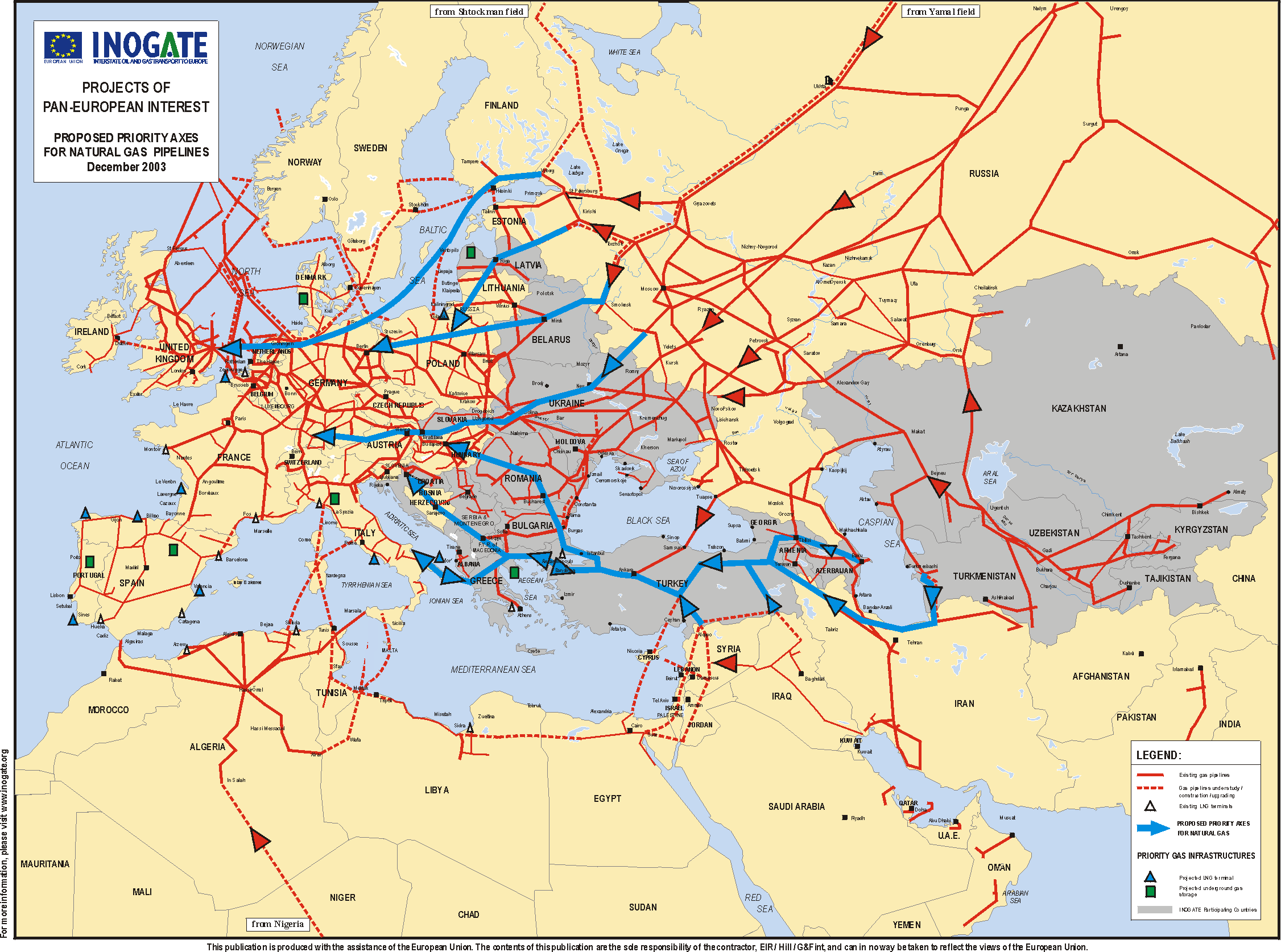
While natural gas near Egypt will greatly support the rising demand by Egypt's growing population, there is likely also another nearby customer interested in natural gas and willing to pay a premium for it - Europe. Apart from Norway, every other European nation is a net energy importer, and natural gas is a particular contributor to that dependency (though not as much as crude oil). European natural gas needs (and the price Europeans are willing to pay for it) would likely far outstrip those of Egypt, though the thought of exporting natural gas that may be needed domestically could prove unpalatable in Egypt's unstable environment.

(Source: Mappery)

For years, Europe has sought to move away from its extreme natural gas dependency on Russia. That dependence has complicated foreign policy, even as Russia's own dependence on its energy reserves for export has proven to be a potential weakness. The new field in the Mediterranean may present Europe with such an opportunity to diversify and divest without much impact to its own economies.

Saturday, July 26, 2014

Building on Trust: Why the US Isn't Getting Very Far in Israel

Israel and Hamas are, by all accounts, at war in Gaza. US Secretary of State John Kerry is in the Middle East, frantically working with Israelis and Egyptians to nail down some sort of halt to hostilities, since the United States cannot work directly with Hamas - a designated terrorist organization. He's not getting very far and it's not entirely surprising. 

(Source: Jack Guez/AFP/Getty Images via The National Post)

Kerry next travels to France, where anti-Semitic rioting has flared in recent days, to attempt to gain support for a ceasefire among European leaders. Earlier, the Israeli cabinet rejected Kerry's ceasefire proposal, which the US has since downplayed as a disagreement on final wording - that no proposal was formally put forth. Part of that rejection involves Israel asserting its objective to continue to destroy tunnels during any ongoing ceasefire. Nonetheless, Israel and Hamas have agreed to a 12-hour humanitarian ceasefire, beginning at 8 AM local time.

It's not shocking to see Israel and the US disagree lately; there's very little substance to the US-Israel relationship under the Obama administration. In fact, it could be argued that there's likely no trust at all among leadership in the two countries. Just this past week, Kerry was caught criticizing the Israeli operation in Gaza. In backtracking, Kerry could only come up with the something trite: "...war is tough. We defend Israel's right to do what it is doing..." Well, of course. In 2011, at the G20 meeting, President Obama was also caught making an offhand remark about Israeli Prime Minister Benjamin Netanyahu, suggesting that he was "fed up with him" and perhaps even agreeing with then-French President Nicolas Sarkozy that Netanyahu was a liar. Earlier in 2011, Obama rebuffed meeting Netanyahu in the US, a surprise given the close US-Israel relationship in the past. The two have met as recently as this past March, with Netanyahu clearly stating that he would do nothing that would hinder Israeli national security. The two have spent more time attempting to lecture one another than to truly discuss options for peace.

The nonexistence of any legitimate relationship clearly undermines cooperative efforts to bring peace to the region. The damage done to the relationship may prove to solely be superficial - something a change in leadership on either side (or likely both sides) may correct. At the same time, the failure to secure any significant gains, not only in Israel, but in the greater Middle East as a whole, is a legacy that the Obama administration does not desire. In addition to the current Israeli-Hamas war, there are wars, on one level or another, in Syria, Iraq, Libya, Yemen, and Mali and political strife in Egypt, Tunisia, Turkey, Bahrain, and Iran (I'm sure I missed some). The toll in Syria alone may be as high as 160,000, not something that history or the administration can (continue to) easily brush aside.

The only options that remain during Obama's final few years in office are to make significant and serious decisions. The Washington Post suggests disarming Hamas; after all, how many political parties typically have a military wing (though it is important to note that some have in the past, including Israeli ones). Such bold action will not be easy, but any easy solutions have long since passed. It is time to make difficult decisions that bring change. Only with change can there be peace.

Monday, February 3, 2014

Stifling Dissent and Thwarting Protests in Post-Revolution States

Protests in Ukraine

The protests in Ukraine have received extensive media coverage in recent weeks.  These protests, which began as an almost spontaneous reaction to President Victor Yanukovych's decision to scuttle a trade deal with the EU at the last minute, have transformed into a massive expression of widespread discontent with the current regime. (The trade deal was more of a spark that ignited protests for myriad underlying reasons.  For a more in-depth treatment of those underlying reasons, see this previous post from early December 2013).

The Yanukovych government's reactions to the protests have varied greatly; the common thread has been their lack of success.  First, three days after the iconic toppling of the Lenin statue in Kiev, the government tried cracking down by forcibly removing protest barricades.  When this proved unavailing, in mid-December the government suggested it would soon sign the trade deal with the EU after all.  It soon went in the complete opposite direction, negotiating a shadowy deal with Russia on December 17th involving a $15 billion loan and large cuts in natural gas prices amounting to approximately a 1/3 drop in prices.  Details of that deal remain unclear, but protesters were suspicious.  In fact, the protests were re-energized in late December 2013.

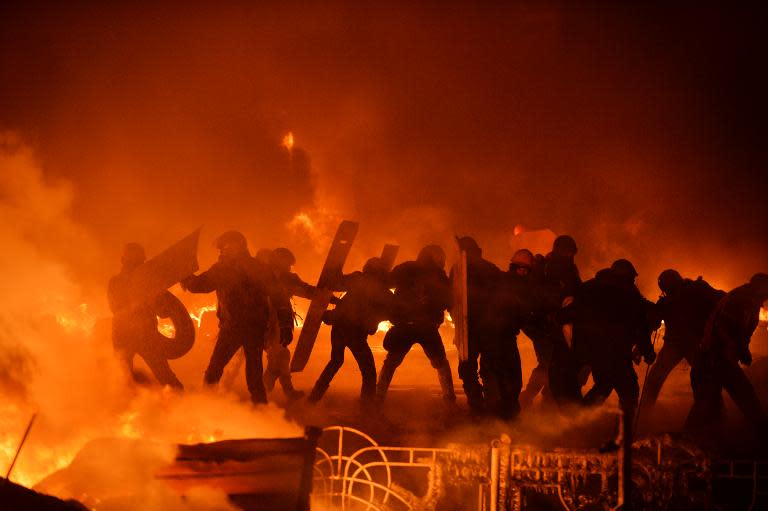
January 25, 2014: Protesters clash with riot police in Kiev, Ukraine. (Source: Yahoo News)


The government's next move was to pass new laws in mid-January greatly restricting the right to protest and sending individuals who slandered government officials to one year of "corrective labor."  Protesters were undeterred, clashed with riot police, and even took over some government buildings.  Yanukovych then offered the prime ministership and top government posts to opposition leaders, which they rejected.  This past Tuesday, the prime minster and his cabinet resigned and the government repealed the anti-protest laws it had passed in mid-January.  The government also passed an amnesty law for the protesters which was conditioned on the fact that they stop protesting within two weeks; the protesters rejected this measure.

Protests in Egypt

In Egypt, the military government has similarly found itself the target of resilient protests.  Its response has escalated and been even harsher than Ukraine's.  Outlawing participation in protests generally and the Muslim Brotherhood specifically failed to end anti-government protests.  The government then labeled the group a terrorist organization and made mere participation in the Brotherhood an offense punishable by five years' imprisonment.  The protests, as well as arrests for them, have continued into the new year.

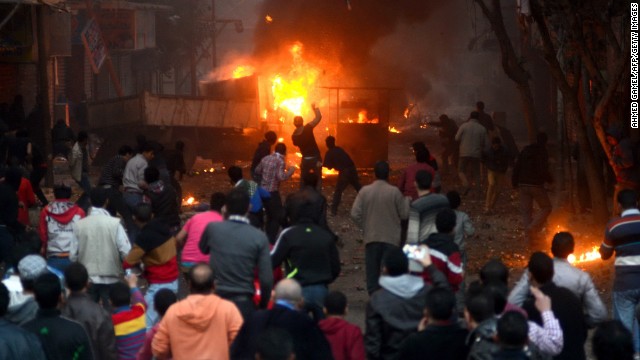
January 17, 2014: Protesters clash with riot police in Cario. (Source: CNN.com)

In 2013, the government also clamped down on freedom of the press.  It shut down media it deemed to harbor pro-Brotherhood sympathies, with the notable exception of al Jazeera.  The seeming exception for al Jazeera has proven illusory, as the government previously imprisoned several of the media organization's employees and just recently indicted 20 al Jazeera reporters -- eight are in custody while the rest were declared fugitives -- for creating "false" portrayals of the Brotherhood's protests.

The Bottom Line

Ukraine and Egypt are both deeply divided countries struggling to forge their respective post-revolution identities.  In Ukraine, the pro-Western movement saw its 2004 Orange Revolution gains dissipate as Victor Yanukovych -- the standardbearer of pre-revolution, pro-Russian policies -- came to power.  Yet Yanukovych himself took steps toward European integration, and the current crisis is a result of his backtracking on those steps.  In Egypt, meanwhile, the 2011 revolution that led to Mubarak's ouster also led to the electoral victory of the Muslim Brotherhood and, after a year of rule under Mohammed Morsi, a return to military rule after a protest-inspired military coup.  That military government is now struggling to clamp down the persistent protests of the ousted Brotherhood.  In Ukraine, the deep split is over pro-Europe and pro-Russian sentiments (and the split is itself largely divided along geographic lines), whereas in Egypt the split is between secularism and Islamism.  In both countries, however, the current crises of legitimacy stem from the governing group's inability to satisfactorily address that divide.

While the narrative of a deeply divided country is hardly unique, and indeed can be found in many countries throughout the world, what is unique to Egypt and Ukraine in current world affairs is the months-long persistence of protests aimed at bringing down a post-revolution regime.  While many people imagine slow steps forward following a pro-democratic revolution, both of these countries have addressed the protests by clamping down on freedoms of protest and the press.  This strategy might have prevailed in the pre-social media days or even today in a tightly-controlled country ala North Korea, but it has proven grossly ineffective in both countries.  As part of their growing pains, the current regimes will have to learn that to govern means to be criticized; to govern effectively, moreover, might even mean listening to your critics.


Previous Illexum Posts
Ukraine: Overlooked, Underreported
Ukraine Protests Grow, Government Wavers, World Begins to Take Notice
Egypt Update: Muslim Brotherhood Declared Terrorist Organization

Sunday, December 29, 2013

Egypt Update: Muslim Brotherhood Declared Terrorist Organization (And Doesn't Seem Happy About It)

Egypt's ruling government threw kerosene on an already-raging fire this past Wednesday when it declared the Muslim Brotherhood to be a terrorist organization.

The impetus for the latest act of one-upmanship in the ongoing power struggle -- a court already banned participation in the Brotherhood back in September -- was a deadly car bombing on Tuesday that left 16 dead and more than 100 wounded.  Immediately after the attack, government officials tied the Muslim Brotherhood to the attack and claimed the organization had shown its "ugly face as a terrorist organization shedding blood and messing with Egypt's security."  The Brotherhood, meanwhile, condemned the terrorist attack and denied any involvement.

Egyptians survey the destruction in the aftermath of Tuesday's deadly terrorist attack (NYT).


On Wednesday, the al Qaeda-linked group Ansar Beit al-Maqdis -- which has been responsible for two notable terrorist attacks in recent months -- claimed responsibility for Tuesday's car bombing.  This was not exactly a surprise, given that security analysts had already noted that Ansar was likely behind the attack.

With Ansar Beit al-Maqdis' claim of responsibility, the Egyptian government shifted its line of attack against the Muslim Brotherhood by claiming there are links between the Muslim Brotherhood and Ansar Beit al-Maqdis.  Without addressing Ansar Beit al-Maqdis' claim of responsibility, moreover, the Egyptian government labeled the Muslim Brotherhood a terrorist organization and again blamed it for the terrorist attack:
Deputy Prime Minister Hossam Eissa announced the move, which will give the authorities more power to crack down on the Brotherhood.

He said that those who belonged to the group, financed it or promoted its activities would face punishment.

The decision was in response to Tuesday's suicide bombing of a police headquarters in Mansoura, in the Nile Delta, which killed 16 people and wounded more than 100, he said.

"Egypt was horrified from north to south by the hideous crime committed by the Muslim Brotherhood group. . . . This was in context of dangerous escalation to violence against Egypt and Egyptians and a clear declaration by the Muslim Brotherhood group that it still knows nothing but violence. It's not possible for Egypt the state nor Egypt the people to submit to the Muslim Brotherhood terrorism."

Egypt would notify Arab countries who had signed a 1998 anti-terrorism treaty of the decision, he added.
(BBC).

Additionally, although the deputy prime minister did not specifically mention Ansar Beit al-Maqdis, other government officials stepped in to claim a link between the groups:
Ansar Bayt Al-Maqdis, an Al-Qaeda inspired group based in the Sinai Peninsula, claimed responsibility for the Mansoura bombing. However an Egyptian security official, speaking to Asharq Al-Awsat on condition of anonymity, affirmed that the Muslim Brotherhood had formed an alliance with the Al-Qaeda-linked Ansar Bayt Al-Maqdis and another group, the Al-Furqan Brigade.
To date, however, the Muslim Brotherhood has denounced the attacks and no evidence of any supposed alliance has been forthcoming.

The designation of the Brotherhood as a terrorist organization will likely lead to the closure of Brotherhood-affiliated organizations that "provide health care and other services to rural and urban areas that lack infrastructure."  Additionally, the government swiftly moved to act upon the new label this past Thursday, arresting people for membership in the group:
Sixteen of the arrests were in the Nile Delta province of Sharkiya. The state news agency said those held were accused of "promoting the ideology of the Muslim Brotherhood group, distributing its leaflets, and inciting violence against the army and police". Security sources gave a country-wide total of 38 arrests on terrorism charges.

From now on, anyone taking part in Brotherhood protests will be jailed for five years, Interior Ministry spokesman Hany Abdel Latif told state TV. Jail terms for those accused under the terror law stretch up to life imprisonment. "The sentence could be death for those who lead this organization," he said.
Unsurprisingly, the Muslim Brotherhood has denounced the government's actions, stating on Twitter that the move is a "worthless decision from an illegal gov't without any evidence and will not change anything in reality."  The move has also intensified Brotherhood-led protests against the current regime.

The government's action may well be an effort to bolster support before the constitutional referendum scheduled next month.  Whatever the outcome of the referendum, however, protests and clashes between the Brotherhood and the interim government will likely continue.  The reason is that the two groups, both of which participated in the 2011 protests that ousted Hosni Mubarak, do not view the other as legitimate.  The Muslim Brotherhood won the first democratic elections in post-Mubarak Egypt, but its ineffectual governance led to massive protests and regime change by way of a coup.  The anti-Brotherhood elements, meanwhile, have consistently struggled to adapt to a political system of voting in lieu of protests.  Their current move of designating the Brotherhood as a terrorist organization reflects a desire to marginalize, rather than successfully compete against, its only viable competitor on the Egyptian political scene.  If anything, however, the government's thinly-veiled pretense only makes its own rule appear more illegitimate.  Like the Brotherhood's Morsi, the current government is discovering that ruling the fractured country is much more difficult than gaining power.
Wednesday, September 11, 2013

Egypt Closing Tunnels to Gaza

The ouster of Egypt's Mohammed Morsi by military coup (or military action in support of popular democratic demand....) has led to an interesting and possibly volatile development in Gaza.

For the past six years, the Egypt-Gaza border crossing has ebbed and flowed from the border crossing blockade under Mubarak to a slightly freer flow of people under the interim military government and Morsi.  Even during Morsi's short-lived rule, however, the border crossing was limited.  For example, the Morsi government limited the border crossing to humanitarian efforts.

While the official border crossing has remained highly restrictive, the unofficial border crossing has thrived.  Specifically, a complex network of hundreds of tunnels connect Gaza to Egypt; these tunnels are the lifeblood of the Hamas-controlled territory's economy.  For example, fuel and building supplies (primarily steel, cement, and gravel) flow into Gaza through the tunnels.  Basic goods, such as flour, sugar, rice, and fish also enter Gaza primarily through the tunnels.  Of course, the human travel through the tunnels is also a simple way to skirt official attention.  Finally, of course, weapons flow through the tunnels.

Of course, all this has changed with Morsi's ouster (although, even during Morsi's rule, in February 2013 the military flooded numerous tunnels as a likely response to the use of those tunnels by militants fighting Egyptian forces in the Sinai).  First, the Egyptian military cracked down on tunnel traffic.  Now, by way of demolition and the potential establishment of a "buffer zone" no-man's land, Egypt may be closing off access to the tunnels for good.  While the weapons help support Hamas rule, it may in fact be the economic effects of the tunnels' closure that hurts Hamas the most.  Hamas taxes the goods flowing through the tunnels; these revenues constitute an estimated 40% of all government revenue and allow Hamas to keep 45,000 civil servants on the payroll.  The loss of these vital taxes could thus impede the ability of Hamas to secure support through the age-old political tactic: patronage.

Furthermore, the fuel and goods shortages have led to price spikes -- spikes that were, in fact, documented late in the Morsi regime, as that regime began the crackdown that has intensified in the wake of Morsi's ouster.  Whether the twofold revenue loss and price spikes will erode support for Hamas in Gaza, only time will tell.


Pictures from inside the tunnels:
http://content.time.com/time/photogallery/0,29307,1931308_1969736,00.html
http://www.wired.com/dangerroom/2009/01/pics-inside-the-2/


Tuesday, August 27, 2013

Coup? What's a Coup?

...our month-long summer hibernation is over...

Coup: a sudden, violent, and illegal seizure of power from a government (Oxford Dictionary)

Coup: a change in government that is not in the nation's interest, when we decide that it's not, and not any sooner (United States government definition)

There is, of course, a formal definition likely somewhere buried in the government's glossary, but it's not quite relevant. It is clear in everyone's eyes that Egypt's change in government was a coup, whether or not the United States supported the change.

Since the overthrow, the United States has been on the "what do we do!?!" fence for what has seemed like an eternity. Formally labeling the change in government a coup leads to all sorts of ramifications, domestically and abroad. Namely, the US aid agreement with Egypt would likely be invalidated by the coup definition. This could complicate matters with the silent, but reciprocal aid given to Israel to avoid a perception of favoritism in the Middle East. Save for Afghanistan, Egypt and Israel are at the top of the list for United States military aid, and largely have been so since their 1979 peace treaty. At home, the government could be on the hook for the contracts that would terminate as a result of halting aid to Egypt - and the price is not cheap.

Quietly, over the past week, reports have leaked that aid to Egypt is not only under review, but may have already been suspended. Of course, this could be a technicality with a time lag - purchases already made for the fiscal year could be in the past and the looming cut so far in the future that it is still under discussion. Other funding tranches may simply not yet be due. Nonetheless, the positive side is sending a signal. The mess needs to be cleaned up and in an orderly fashion - not with civilians bleeding in the streets. Egypt may turn out, after all, to be a comparison against the change in regime in Iraq. What path is the one that leads toward a better future? Only time will tell.

Thursday, July 11, 2013

Egypt Mini-Update: Tacit US Support

It's no question that the United States was never a huge fan of Mohammed Morsi and his relationship to the Muslim Brotherhood. There was always an underlying fear within government policy circles and analysts alike that Morsi's rule was not aboveboard and was growing less and less democratic, both in the way it was conducted and the way it was founded. In a sense, it was felt that Morsi was given a chance, and then blew it.

It is surprising, however, that the United States may have bankrolled some anti-government organizations in Egypt. It almost seems as if the US is funding revolution by trial and error. However, it's important to note that this investigation has been sharply criticized. The channels of US funding have nearly always been a mystery.

More telling is the story of the F-16s. In 2012, the US agreed on donating F-16s to Egypt as part of an aid package. That's right - not a typo - donating and aid package and F-16s. Some in Congress sought to derail the delivery, but that attempt failed. And now, the US is ready to deliver the first of these fighter jets, amid a military coup, growing unrest, and another revolution. What could be more timely?

Tuesday, July 2, 2013

Egypt: Of Protests and Ultimatums

Slightly over a year ago, Muslim Brotherhood candidate Mohammed Morsi won Egypt's first post-revolution presidential election.  Almost 11 months ago, Morsi consolidated power with a power move that questioned whether his nascent rule would last.  5 months ago, regime opponents marched in the streets to express disappointment with Morsi's rule to date.

This past Sunday, protesters took to the streets once more to call for Morsi's resignation.  Seven individuals died protest-related clashes and violence, while scores more were wounded.  The Egyptian military then upped the ante yesterday by issuing Morsi a 48-hour ultimatum to get the situation under control; Morsi has thus far refused the military's demands.  An excellent take on the entire situation, from the streets of Cairo, can be found here.

Put succinctly, nobody is quite sure what Egypt will look like by the end of this week.  Whatever emerges out of Egypt, however, one thing is near-certain: this will be the year of missed opportunities and regrets, on all sides.  Morsi, for example, issued an edict in November 2012, shielding his decisions from court review until the passage of a new constitution -- a move many perceived as illegitimate and power-grabbing.  The opposition, in turn, walked out of the constitution-drafting assembly, only to next complain about the lack of their inclusion.  Soon thereafter, the opposition showed staggering ineptitude and indecisiveness, waiting until the week before the constitutional referendum to decide whether it would even participate in the referendum. The military has largely stayed on the sidelines -- that is, of course, until yesterday's ultimatum.  From Morsi's inability to grasp the scope of the populace's discontent to the opposition's ineffectual attempts at political process in general, the common thread throughout Egypt is misunderstanding and miscommunication.  One can only hope that these are growing pains, rather than a hint of descent into turmoil.

Sunday, February 3, 2013

Egypt: On Elections and Protests

The past week and a half saw great unrest in Egypt as dozens were killed in protests, riots, and clashes with security forces.  Yesterday, the Egyptian PM's car was, according to state TV, pelted with stones by protesters in Tahir Square.

Over the past two years, protests in Egypt seem to be as much the rule as the exception.  Furthermore, protests appear to enjoy more organization than, say, pre-election planning.  One glaring example is this past December's two-step constitutional referendum, passed by a stark 64%-36% margin.  The opposition, which appears to have no trouble galvanizing itself for protests, suffered from a crippling lack of coherence and organization in the weeks and months leading up to the referendum.  For example, with less than a week before the referendum, Egypt's opposition parties had not decided whether to boycott or vote no.  They ultimately decided to participate in the referendum, but it should not come as a surprise that their efforts fell short.  In fact, turnout was low for the referendum overall -- an estimated 32.9% turnout.  Critics and opposition leaders criticized the process, complaining both about a sense of exclusion from the drafting process and vague wording of the text itself.  As the opposition, however, it is your duty to both organize your supporters and offer an alternate vision for your country.  The opposition in Egypt has made its disappointment over Morsi's rule extremely vocal, in the form of protests.  As part of the long road to stable democracy, however, the opposition must become more involved in the less flashy forms of government -- namely, elections (and all the attendant groundwork involved in them) and specific governance and policy issues.  Until it does so, Egypt will continue to muddle through the aftermath of its revolution, its future lurching from one extreme to another.

Wednesday, January 9, 2013

Hamas & Fatah to Meet, Rehash Disagreements

Hamas and Fatah, leaders of the governments in Gaza and the West Bank respectively, have apparently agreed to meet in Cairo under the mediation of Egypt's president, Mohammed Morsi. Although ties have warmed of late, Hamas and Fatah remain polar opposites in their approach toward sovereignty,  independence, and Israel. While Hamas refuses to renounce violence or acknowledge Israel's right to exist, Fatah, through the PA, has already engaged Israel for decades and has pushed for recognition through the United Nations. Unfortunately, Fatah's engagement with Israel has not proved beneficial, with many now viewing Fatah as a mere pawn and Hamas as the voice of the Palestinians. Nonetheless, reconciliation can have many benefits, including a possible return to the peace process. As in any process, two significant roadblocks exist: time and trust. Hamas and Fatah have been enemies not only politically, but also on the street. To imagine their peaceful coexistence under the current framework is difficult. Trust will be difficult to build quickly, and time is short, and yet moves ever slowly in the Middle East. Changes in government, policy, and even public opinion in both other Arab countries (including Egypt itself) and Israel can play havoc on the differences that exist between Hamas and Fatah, differences that may not be resolved in time for reconciliation. A two-state solution with contested multi-party democracy in the Levant may continue to be a dream as disagreements continue to resurface.

Thursday, September 13, 2012

Today: Burn America, Tomorrow: Where are my Nikes?

One word: unemployment

Two words: youth bulge

Combined, these three words are a recipe for disaster the world over, and now being witnessed across the Middle East in riots and protests responding to an unnecessary film. It is ironic that many of those protesting (mainly men in the pictures) will turn tomorrow to look toward American products. Today protesters will attack an embassy or any other symbol of America. Tomorrow (or whichever day in the future one chooses to select) they will buy American products: Nike, Pepsi, etc. Why is it that a separation between an individual action and the collective will of society cannot be made? Is it that there's a connection between the freedoms that exist in the West and the hate that the West allows to be spewed? There is. Is there value in those freedoms that exists in excess of any negative side effects? There is.

Mass unemployment coupled with large youth populations are correlated with violence (a couple of studies are here, and here). Note that there are nuances and correlation does not imply causation. Nonetheless, it is these youth bulges and unemployment that has caused significant concern, and have been widely overlooked as a problem that will resolve itself with time. It won't. While governance is a significant issue, the type of governance that the West promotes resides with the people. If the people cannot be satisfied, governance will collapse. Therefore, the essence of aid and assistance should not be solely focused on forming governments and elections. Employment, including the institutions necessary for it, should also be at the focus. Once this crisis, like the ones that came before it, calm, it is important that the West, upon reflection, recognizes that providing populations with a means is just as important as providing them with heads of state.

Wednesday, August 29, 2012

The Grass Isn't Always Greener on the Other Side

Revolutions, in all their forms, rarely setup a country to be exactly what the revolutionaries wanted it to be. Take for example how Iran emerged out of its 1979 revolution (theocratic), or how Russia has developed following the "transfer of power" from Vladimir Putin to Dmitry Medvedev (dictatorial). Egypt is no outlier to the post-revolutionary balancing act wherein a country seeks to redefine itself on the international stage and appease the populace who clamored for revolution.

In the West, it is therefore troubling that one of the first trips by Egypt's new President, Mohammed Morsi, is to China and Iran. In China, Morsi will focus on business and development. These are important objectives: China is sought after as an alternative to Western influence throughout the world and Egypt is in dire need of an economic kindling in order to validate the revolution. In Iran, he will attend the meeting of the Non-Aligned Movement. Morsi will not visit the United States until the upcoming United Nations meeting.

This trip scheduling may be just logistics, but it will also be seen as a poor choice in the West (Thomas Friedman in particular doesn't like it). The United States is one of the largest aid donors to Egypt and no friend of Tehran's. At the same time, relations with China remain cool, and could head for a downturn if an incoming American president labels China a currency manipulator. Therefore it is troubling that Morsi chose to visit Tehran in person - which no Egyptian president has done since its 1979 treaty with Israel - rather than send a deputy or via alternative diplomatic means.

Morsi is clearly attempting to solidify a position as a moderate. The question everyone wants to know the answer to is: Is he one? At the same time as his trip abroad began, Morsi, albeit in somewhat vague terms, reaffirmed Egypt's position to the treaty with Israel as well as its terms regarding the Egyptian military's presence in the Sinai. One thing to remember is that eventually, everyone is aligned (even if you are aligned with the non-aligned) and the grass isn't always greener on that other side. It might behoove Mr. Morsi to consider not only where a significant amount of Egyptian aid comes from, but also which countries may most benefit the business, development, and political prospects of Egypt for years to come.

Sunday, August 12, 2012

Gaza: An Opportunity for Israeli-Egyptian Cooperation?

The truth is that neither Egypt nor Israel is particularly pleased with the long-term development of Gaza since Israeli disengagement and less so since Hamas took control. Hamas' access to third-party support, financial and otherwise, outside of its neighbors, largely from Iran, gives it significant leverage to develop activities aimed at destabilizing both. With little to no aboveboard economic activity, Gaza's legitimate ties to its neighbors are nothing more than lines in the sand.

Last week, a brazen attack by militants left 16 Egyptian soldiers dead near the border crossing with Rafah. The goal, seemingly to create security problems for both neighbors, is worrisome. While the attack was into Egypt, one vehicle was reportedly driven into Israel for nearly a mile before being destroyed. Egypt has since arrested several suspects, but it's not clear whether this will truly mitigate a growing problem of lawlessness in Sinai, promoted by Hamas and its supporters (even regional news outlets largely share this view). Nonetheless, the Rafah crossing is under constant attack, putting Egypt on the defensive. The border is not the only issue - the problem stems far into Sinai, as evidenced most recently by the attack on peacekeeping forces at its heart. Since Hamas controls the arms, as well as the smuggling tunnels, in Gaza, is there anyone else to blame for the "militant" attacks?

While it is easy to look at the glass half-empty - another security problem in the Middle East threatening to destabilize the region - it can also be seen half-full - an opportunity for two "new" partners (considering Egypt's recent political transition) to cooperate to secure their shared interests. Egypt and Israel have, in the past, cooperated on improving the Rafah crossing in order to benefit legitimate crossing and to mitigate militant operations. Perhaps it will be clearer now that increased cooperation is needed, to secure the border above the sand, destroy the tunnels beneath it, and even to reassert Egypt's presence in Sinai outside of its periphery.

Monday, July 9, 2012

A Grip on Egypt

An interesting dynamic is unfolding in Egypt between the armed forces and the newly-minted president. Following the conclusion of the presidential election on June 17th, it took the Supreme Council of the Armed Forces (SCAF) about a week to declare Mohamed Morsi the winner, even though the Muslim Brotherhood declared their candidate the winner as early as the morning of June 18th and it was fairly clear to most observers who had won. Internationally, rumors swirled that SCAF was not willing to cede power to an Islamist candidate. Meanwhile, SCAF dissolved parliament and reverted its powers back to SCAF.


Clearly, a careful game of chess is being played that will determine who truly controls the new Egypt. The world is watching to see whether Egypt will regress to military-style authoritarianism, progress to some middle-ground of democracy, or shift toward religious autocracy. But doesn't Turkey already represent a regional model where the armed forces continue to wield great power even with relative democracy? Turkey surely has had a different history, but has, in recent years, worked to include religious parties into government. The issue may truly be then the stability of those armed forces, perhaps not in terms of political stability, as both Turkey and Egypt have strong militaries, but in terms of funding.

Both Turkey and Egypt have been recipients of significant U.S. military aid. Direct grants to Turkey largely stopped in the late 1990s, though Turkey does continue to receive aid in other forms. Egypt continues to receive direct military aid to this day. Taking an example, Turkey received received several hundred million dollars in 1998, out of a military budget of $7.2 billion USD. Meanwhile, in 2010, Egypt was the third largest recipient of military assistance, outpaced by only Afghanistan and Israel. Egypt received $1.3 billion in military aid that year. Egypt's military budget meanwhile, has seemingly dropped from around $4.6 billion in 2010 to closer to $4 billion in 2011, likely more than partly due to the Arab Spring. All this means an increasing reliance on US military aid, which makes up more than a quarter of the military's source of funds now.

US military aid to Egypt is largely based on its ability to maintain stability in the region. From a US perspective, that stability is directly tied to the Egypt-Israel Peace Treaty of 1979, a treaty that has always rested on shaky ground in Egypt, but has maintained its status under authoritarian leadership. This is the same treaty that Mr. Morsi has said he would "reconsider." No peace treaty. No military aid. No military. Therefore, it is clearly in the military's best interests to maintain the peace treaty. It ensures continued aid from the US, which helps secure SCAF's power within Egypt.


So who then has the grip on power in Egypt? Is it the military, who need the US? Is it Mr. Morsi, who risks being vulnerable without the military? Or is it the US, who keeps the aid flowing? Clearly, the US role in Egypt's future is more prominent than either Egypt or the US would like to admit. Perhaps a better balancing of aid, between military and other forms, would give the parties jostling over Egypt's future the right incentives to full, long-term democracy.