Showing posts with label Mubarak. Show all posts

Monday, February 3, 2014

Stifling Dissent and Thwarting Protests in Post-Revolution States

Protests in Ukraine

The protests in Ukraine have received extensive media coverage in recent weeks.  These protests, which began as an almost spontaneous reaction to President Victor Yanukovych's decision to scuttle a trade deal with the EU at the last minute, have transformed into a massive expression of widespread discontent with the current regime. (The trade deal was more of a spark that ignited protests for myriad underlying reasons.  For a more in-depth treatment of those underlying reasons, see this previous post from early December 2013).

The Yanukovych government's reactions to the protests have varied greatly; the common thread has been their lack of success.  First, three days after the iconic toppling of the Lenin statue in Kiev, the government tried cracking down by forcibly removing protest barricades.  When this proved unavailing, in mid-December the government suggested it would soon sign the trade deal with the EU after all.  It soon went in the complete opposite direction, negotiating a shadowy deal with Russia on December 17th involving a $15 billion loan and large cuts in natural gas prices amounting to approximately a 1/3 drop in prices.  Details of that deal remain unclear, but protesters were suspicious.  In fact, the protests were re-energized in late December 2013.
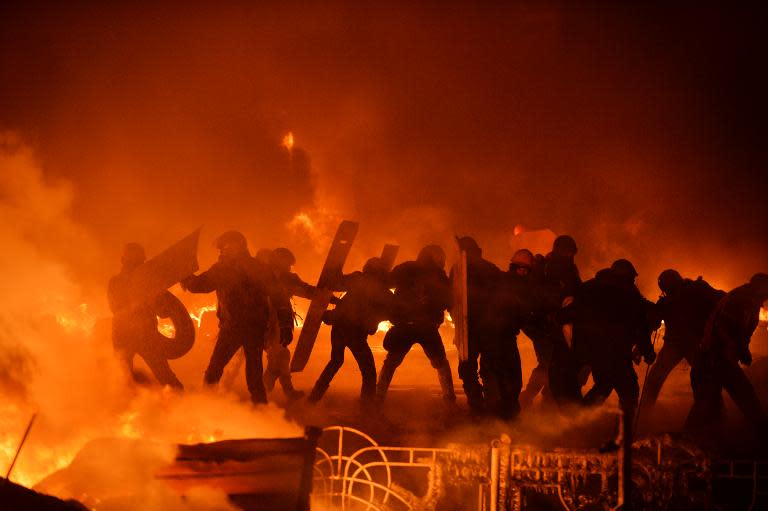
January 25, 2014: Protesters clash with riot police in Kiev, Ukraine. (Source: Yahoo News)


The government's next move was to pass new laws in mid-January greatly restricting the right to protest and sending individuals who slandered government officials to one year of "corrective labor."  Protesters were undeterred, clashed with riot police, and even took over some government buildings.  Yanukovych then offered the prime ministership and top government posts to opposition leaders, which they rejected.  This past Tuesday, the prime minster and his cabinet resigned and the government repealed the anti-protest laws it had passed in mid-January.  The government also passed an amnesty law for the protesters which was conditioned on the fact that they stop protesting within two weeks; the protesters rejected this measure.

Protests in Egypt

In Egypt, the military government has similarly found itself the target of resilient protests.  Its response has escalated and been even harsher than Ukraine's.  Outlawing participation in protests generally and the Muslim Brotherhood specifically failed to end anti-government protests.  The government then labeled the group a terrorist organization and made mere participation in the Brotherhood an offense punishable by five years' imprisonment.  The protests, as well as arrests for them, have continued into the new year.
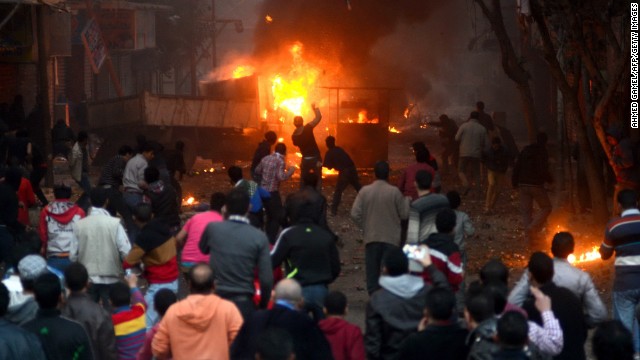
January 17, 2014: Protesters clash with riot police in Cario. (Source: CNN.com)

In 2013, the government also clamped down on freedom of the press.  It shut down media it deemed to harbor pro-Brotherhood sympathies, with the notable exception of al Jazeera.  The seeming exception for al Jazeera has proven illusory, as the government previously imprisoned several of the media organization's employees and just recently indicted 20 al Jazeera reporters -- eight are in custody while the rest were declared fugitives -- for creating "false" portrayals of the Brotherhood's protests.

The Bottom Line

Ukraine and Egypt are both deeply divided countries struggling to forge their respective post-revolution identities.  In Ukraine, the pro-Western movement saw its 2004 Orange Revolution gains dissipate as Victor Yanukovych -- the standardbearer of pre-revolution, pro-Russian policies -- came to power.  Yet Yanukovych himself took steps toward European integration, and the current crisis is a result of his backtracking on those steps.  In Egypt, meanwhile, the 2011 revolution that led to Mubarak's ouster also led to the electoral victory of the Muslim Brotherhood and, after a year of rule under Mohammed Morsi, a return to military rule after a protest-inspired military coup.  That military government is now struggling to clamp down the persistent protests of the ousted Brotherhood.  In Ukraine, the deep split is over pro-Europe and pro-Russian sentiments (and the split is itself largely divided along geographic lines), whereas in Egypt the split is between secularism and Islamism.  In both countries, however, the current crises of legitimacy stem from the governing group's inability to satisfactorily address that divide.

While the narrative of a deeply divided country is hardly unique, and indeed can be found in many countries throughout the world, what is unique to Egypt and Ukraine in current world affairs is the months-long persistence of protests aimed at bringing down a post-revolution regime.  While many people imagine slow steps forward following a pro-democratic revolution, both of these countries have addressed the protests by clamping down on freedoms of protest and the press.  This strategy might have prevailed in the pre-social media days or even today in a tightly-controlled country ala North Korea, but it has proven grossly ineffective in both countries.  As part of their growing pains, the current regimes will have to learn that to govern means to be criticized; to govern effectively, moreover, might even mean listening to your critics.


Previous Illexum Posts
Ukraine: Overlooked, Underreported
Ukraine Protests Grow, Government Wavers, World Begins to Take Notice
Egypt Update: Muslim Brotherhood Declared Terrorist Organization

Sunday, December 29, 2013

Egypt Update: Muslim Brotherhood Declared Terrorist Organization (And Doesn't Seem Happy About It)

Egypt's ruling government threw kerosene on an already-raging fire this past Wednesday when it declared the Muslim Brotherhood to be a terrorist organization.

The impetus for the latest act of one-upmanship in the ongoing power struggle -- a court already banned participation in the Brotherhood back in September -- was a deadly car bombing on Tuesday that left 16 dead and more than 100 wounded.  Immediately after the attack, government officials tied the Muslim Brotherhood to the attack and claimed the organization had shown its "ugly face as a terrorist organization shedding blood and messing with Egypt's security."  The Brotherhood, meanwhile, condemned the terrorist attack and denied any involvement.

Egyptians survey the destruction in the aftermath of Tuesday's deadly terrorist attack (NYT).


On Wednesday, the al Qaeda-linked group Ansar Beit al-Maqdis -- which has been responsible for two notable terrorist attacks in recent months -- claimed responsibility for Tuesday's car bombing.  This was not exactly a surprise, given that security analysts had already noted that Ansar was likely behind the attack.

With Ansar Beit al-Maqdis' claim of responsibility, the Egyptian government shifted its line of attack against the Muslim Brotherhood by claiming there are links between the Muslim Brotherhood and Ansar Beit al-Maqdis.  Without addressing Ansar Beit al-Maqdis' claim of responsibility, moreover, the Egyptian government labeled the Muslim Brotherhood a terrorist organization and again blamed it for the terrorist attack:
Deputy Prime Minister Hossam Eissa announced the move, which will give the authorities more power to crack down on the Brotherhood.

He said that those who belonged to the group, financed it or promoted its activities would face punishment.

The decision was in response to Tuesday's suicide bombing of a police headquarters in Mansoura, in the Nile Delta, which killed 16 people and wounded more than 100, he said.

"Egypt was horrified from north to south by the hideous crime committed by the Muslim Brotherhood group. . . . This was in context of dangerous escalation to violence against Egypt and Egyptians and a clear declaration by the Muslim Brotherhood group that it still knows nothing but violence. It's not possible for Egypt the state nor Egypt the people to submit to the Muslim Brotherhood terrorism."

Egypt would notify Arab countries who had signed a 1998 anti-terrorism treaty of the decision, he added.
(BBC).

Additionally, although the deputy prime minister did not specifically mention Ansar Beit al-Maqdis, other government officials stepped in to claim a link between the groups:
Ansar Bayt Al-Maqdis, an Al-Qaeda inspired group based in the Sinai Peninsula, claimed responsibility for the Mansoura bombing. However an Egyptian security official, speaking to Asharq Al-Awsat on condition of anonymity, affirmed that the Muslim Brotherhood had formed an alliance with the Al-Qaeda-linked Ansar Bayt Al-Maqdis and another group, the Al-Furqan Brigade.
To date, however, the Muslim Brotherhood has denounced the attacks and no evidence of any supposed alliance has been forthcoming.

The designation of the Brotherhood as a terrorist organization will likely lead to the closure of Brotherhood-affiliated organizations that "provide health care and other services to rural and urban areas that lack infrastructure."  Additionally, the government swiftly moved to act upon the new label this past Thursday, arresting people for membership in the group:
Sixteen of the arrests were in the Nile Delta province of Sharkiya. The state news agency said those held were accused of "promoting the ideology of the Muslim Brotherhood group, distributing its leaflets, and inciting violence against the army and police". Security sources gave a country-wide total of 38 arrests on terrorism charges.

From now on, anyone taking part in Brotherhood protests will be jailed for five years, Interior Ministry spokesman Hany Abdel Latif told state TV. Jail terms for those accused under the terror law stretch up to life imprisonment. "The sentence could be death for those who lead this organization," he said.
Unsurprisingly, the Muslim Brotherhood has denounced the government's actions, stating on Twitter that the move is a "worthless decision from an illegal gov't without any evidence and will not change anything in reality."  The move has also intensified Brotherhood-led protests against the current regime.

The government's action may well be an effort to bolster support before the constitutional referendum scheduled next month.  Whatever the outcome of the referendum, however, protests and clashes between the Brotherhood and the interim government will likely continue.  The reason is that the two groups, both of which participated in the 2011 protests that ousted Hosni Mubarak, do not view the other as legitimate.  The Muslim Brotherhood won the first democratic elections in post-Mubarak Egypt, but its ineffectual governance led to massive protests and regime change by way of a coup.  The anti-Brotherhood elements, meanwhile, have consistently struggled to adapt to a political system of voting in lieu of protests.  Their current move of designating the Brotherhood as a terrorist organization reflects a desire to marginalize, rather than successfully compete against, its only viable competitor on the Egyptian political scene.  If anything, however, the government's thinly-veiled pretense only makes its own rule appear more illegitimate.  Like the Brotherhood's Morsi, the current government is discovering that ruling the fractured country is much more difficult than gaining power.