Showing posts with label India. Show all posts

Monday, April 13, 2015

Pakistani Terrorist Commander Ordered Released on Bail, Likely Affecting Pak-Indian Relations

The world was horrified by the 2008 Mumbai attacks, in which terrorists stormed a number of buildings in India and killed 168 people.  All but one of the gunmen died; the surviving gunman was convicted and executed in 2012 for his actions.  The terrorists were Pakistani and came from the group Lashkar-e-Taiba (LeT), a Pakistani terrorist group with historical ties to the Pakistani government and military and highly suspected current ties with Pakistan's chief intelligence service.

The operational leader and co-founder of LeT, Zaki-ur-Rehman Lakhvi, was arrested in 2008 in connection with the attack.  He has been incarcerated for the past 7 years.  Back in December 2014, a court ordered Lakhvi released on bail.  The Pakistani government opposed the decision and kept him incarcerated, but this past Thursday the Pakistani supreme court ordered that Lakhvi be released immediately.
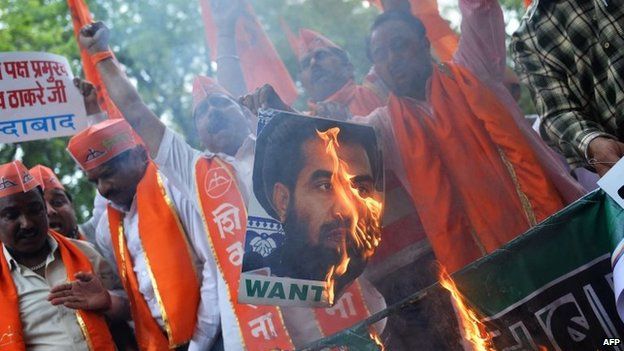

Protests in India followed the court ruling ordering Lakhvi released (Source: BBC)


This will likely have negative effects on India-Pakistan relations, which have somewhat thawed following the election of India's Prime Minister Modi and a positive exchange of letters amongst the countries' leaders.

What is especially troubling is how little is known about Lakhvi's trial, which has been ongoing since 2009 and is not open to the public:
The commander, Zaki-ur-Rehman Lakhvi, and six other members of the Lashkar-e-Taiba militant group have been on trial since 2009 at a high-security jail in Rawalpindi, just south of Islamabad, on charges of participating in the Mumbai operation. 
But the trial has been conducted largely in secrecy, and its halting pace has given rise to speculation that its progress is being influenced by the vagaries of wider tensions between Pakistan and India.
While this doesn't mean the case is dismissed, only time will tell whether Lakhvi appears for the remainder of the trial.  While locked up, he wasn't exactly treated like a commander of a terrorist organization:

While Pakistan's government claimed that it was cracking down on terrorists, Zakiur-Rehman Lakhvi and six of his comrades in Rawalpindi's sprawling Adyala Jail had several rooms next to the jailer's office at their disposal. 
And with the jailer's permission, they had a television, mobile phones and access to the internet, as well as dozens of visitors a day. 
"He [Lakhvi] can receive any number of guests, any time of day or night, seven days a week," said one jail official while the terror suspect was under lock and key.
No special permission was required for visitors, who were not even asked to identify themselves to jail authorities.
That access allowed Lakhvi to retain his position as a high-ranking LeT commander even while he was incarcerated.  This is not simply a question of prison conditions.  LeT has been declared a terrorist organization by the United States and the UN Security Council and banned in Pakistan since 2002.

Letting one of their commanders continue to run the organization from prison is an insult to the memories of those who have died at the hands of LeT terror.  While arresting him and bringing him to trial in Pakistan were steps in the right direction for a government that has often been seen as having sympathies toward LeT, the recent supreme court ruling that released him is a step in the wrong direction.  While the Pakistani government publicly opposed that decision, it has been treating him in a manner for the past 5+ years that suggests it is not as eager to take on LeT as it claims.  Reaction in India to the decision has, unsurprisingly, been quite negative.  If Lakhvi and other LeT officials are ultimately acquitted, that negativity will likely manifest itself in worsening relations between two countries that seemed on track to gradually improve their historically volatile relationship.

Monday, August 18, 2014

India and Pakistan: Domestic and Foreign Policies Collide

May 2014 brought the promise of progress in India-Pakistan relations.  After the historic swearing-in of Indian Prime Minister Narendra Modi - the first ever attended by a Pakistani prime minister - people were cautiously optimistic about relations between the feuding nuclear powers.  That optimism was extended when Modi and Pakistani Prime Minister Nawaz Sharif publicly exchanged letters of gratitude toward each other, which followed up on the meeting the two held after Modi's swearing-in.  In his letter, Modi also expressed India's sympathy toward Pakistan after the terror attack on Karachi's airport.

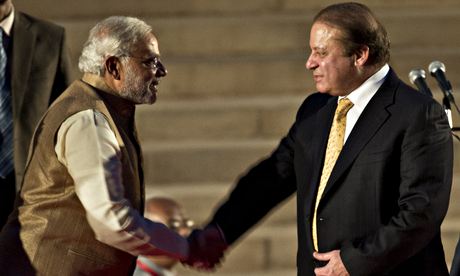
Prime Ministers Narendra Modi and Nawaz Sharif shake hands after Modi's swearing-in (source: The Guardian).

These developments were promising, and they may well continue.  Of course, it will take more than a meeting and a letter exchange to overcome decades of mistrust and border attacks.  Furthermore, both prime ministers must still deal with local populations that are not so quick to mend old wounds.  Moving too quickly toward improved relations will undercut the support both leaders need to rule.  Indeed, Sharif was condemned for the very decision to attend Modi's inauguration.

Unfortunately, both leaders have already gone back to the tried-and-true tact of using the other country as an easy target for domestic woes.  Last week, for example, Modi declared in a speech to Indian troops that Pakistan now wages a "proxy war of terrorism" because it lacks the capabilities to wage a conventional war.

Sharif, meanwhile, finds his own prime ministership at risk in the midst of large-scale protests.  Those protests are led by political rival Imran Khan of the PTI party.  Khan is calling for Sharif's ouster due to issues ranging from alleged vote-rigging in the 2013 elections to the "dynastic" nepotism of the Sharifs.  Although he has called on protesters to keep their actions peaceful, he has also called on them to stop paying taxes and bills as part of the larger protest.

Perhaps it should not come as a surprise that, in the midst of this internal challenge to Sharif's rule, Pakistani military forces attacked Indian border posts at 20 different locations yesterday.  Incidentally, none of Pakistan's major English-language outlets - Dawn, The News International, and The Express Tribune - reported on the attacks.

Ultimately, the political strategy of pandering to the local population while trying to present a more suitable international front is nothing new.  Its most recent notable iteration may be Iran's positions during the recent nuclear talks.  Iran may try to woo investors and welcome the UN nuclear watchdog, on the one hand, but talk about destruction of the U.S. in the event of an attack, on the other.  In the case of Pakistan and India, the effort to garner local support by castigating the other country is a short-term tactic.  It is also one that finds itself increasingly outdated in the digital age, where information from non-local sources is more readily available.  The longer-term strategy of mending old wounds is harder; it will involve less flashy developments like multiple trade summits, cooperation in counter-terrorism investigations, and regular regional meetings to address issues facing the two and their smaller neighbors.  This will take time, perseverance, patience, and restraint, none of which lend themselves well to the political arena.  Ultimately, the coming months will tell whether May 2014 was a new beginning or merely an aberration in the long-standing dispute.


Sunday, March 2, 2014

Qatar's Migrant Worker Problem

With much of the world media covering the Ukraine situation (latest update: Russian troops have taken over Crimea), this post will take a different tact and focus on an issue that is slowly gaining traction: the deadly exploitation of migrant workers in Qatar in the lead-up to the 2022 World Cup.

Back in September 2013, The Guardian issued a scathing article about the conditions faced by migrant workers in Qatar.  That article focused primarily on the conditions of Nepalese workers.  A related article quoted the International Trade Union Confederation in estimating that 4,000 migrant workers would die working on World Cup-related projects by 2022.  Given that Nepal relies on its migrant workers going to Qatar, Nepal was disinclined to criticize Qatar in the wake of those reports.

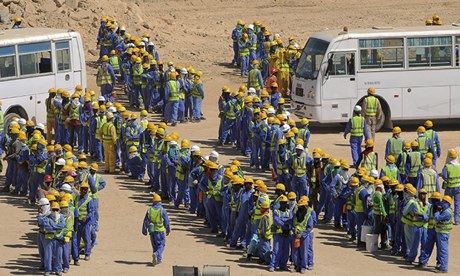
Migrant workers in Qatar line up to take buses back to their living accommodations (Source: The Guardian)

Last week, the issue was raised once again as The Guardian reported that more than 500 Indian migrant workers had died in Qatar since January 2012.  The downside was that the numbers, which were released from the Indian embassy pursuant to a FOIA-type request from media, did not explain the exact nature of those deaths.  The Qatari government capitalized on this omission by making the dubious claim that the worker death rate was normal, given the number of Indian migrant workers in Qatar (500,000), and claiming that there was a "campaign" against Qatar.

Why, with conflict all around the world, is the situation of migrant workers in Qatar a pressing issue?  Well, for one, the kafala system ingrained into Qatar's economic system is a system designed for worker exploitation.  Under the kafala system, a migrant worker is sponsored by an employer; the employer then has near-total control over the migrant worker's life.  The employer can take the worker's passport, withhold pay, make the worker labor long hours (in the Middle Eastern desert) without sufficient access to water, and keep the worker in squalid living conditions.  If the worker wants to change jobs, there is often no recourse; the employer is supposed to provide an identification card but often doesn't, making an employee who flees an undocumented worker subject to arrest and deportation.  Moreover, there is even an "exit visa" requirement whereby an employer who has a dispute with a worker can legally prevent the worker from leaving Qatar.  This issue gained international attention when a professional French soccer player was denied an exit visa and was forced to stay in Qatar for a year while he negotiated a settlement with his soccer team-employer.  The international soccer player's union responded to this by calling on Qatar to end the kafala system for pro soccer players because it "goes to the heart of respecting their basic human rights."  The fact that a professional athlete was forcibly kept in Qatar by his employer -- and that such a practice is built into the legal system -- is emblematic of the extreme level to which employers control migrant workers' lives in Qatar.

The conditions of these workers is in itself a reason to call attention to Qatar's state-sponsored abuse of migrant workers.  The fact remains, however, that this is now the world's responsibility: by accepting Qatar's assurances that it could transform itself into a host site for the World Cup, the world community must now recognize that it has implicitly blessed Qatar's massive infrastructure development.  And that development is not just stadium-building.  Indeed, the massive project will cost hundreds of billions of dollars and includes building an entire city from scratch.  Moreover, this massive re-shaping of the country, and its attendant migrant worker abuse, is inextricably linked to the 2022 World Cup:
Fifa and the Qatar World Cup organising committee are now tangled in a Gordian knot. The human rights groups that have been pressuring Fifa and the Qataris demand to know whether there will be any meaningful reform to improve the welfare and safety of workers on all building projects. In Qatar itself, where politics has been described as akin to a medieval star chamber, an internal battle is raging. There are liberal forces who want to change the labour laws but are equally aware that sweeping away the kafala system that ties migrant workers to their employers would place huge question marks over its ability to fulfil its "2030 Vision" for the country. 
The dizzying and unprecedented plan to spend hundreds of billions transforming the infrastructure of a country that was largely desert as recently as the 1970s can only be founded on cheap migrant labour. 
Therein lies the dilemma – not only for the Qatari authorities, but for the British, German and French companies that have profited handsomely from the bonanza. 
Abolish the culturally embedded kafala system and with it may go the mechanism for ensuring the almost absurdly ambitious plans to build cities, metro lines, roads and airports from scratch.
Ultimately, Qatar may indeed be transformed into a dizzying spectacle of modernity for all the world to admire, but to do so it will rely on the age-old practice of worker exploitation.  The world -- or at the very least, Fifa -- must decide how far it will go to hold Qatar accountable for these practices.

Thursday, December 19, 2013

Diplomatic Row: Indian Diplomat's Arrest and Treatment Spark Outrage

News is quickly spreading of a female Indian diplomat's arrest, subsequent treatment, and the ensuing diplomatic fallout.

The diplomat in question is Devyani Khobragade, who up until recently was India's Deputy Consulate General in New York for Political, Economic, Commercial, and Women's Affairs.  According to the criminal complaint, in November 2012, Khobragade hired an Indian woman as her maid and nanny.  The complaint further alleges that Khobragade and the maid entered into an agreement for the maid to receive approximately 30,000 rupees per month for her services.  The complaint then alleges that Khobragade lied on the visa application for the maid and had the maid lie about her anticipated salary -- all due to the fact that the 30,000 rupee/month salary would not comply with New York's minimum wage laws.

Fast forward to last week, when Khobragade was arrested as she was dropping her daughter off at school.  What happened next has sparked outrage in India.  In Khobragade's own words:
Although I must admit that I broke down many times as the indignities of repeated handcuffing, stripping and cavity searches, swabbing, in a holdup with common criminals and drug addicts were all being imposed upon me despite my incessant assertions of immunity, I got the strength to regain composure and remain dignified thinking that I must represent all of my colleagues and my country with confidence and pride.
(BBC).  After Khobragade's bail was set at $250,000 and posted, India announced it was transferring Khobragade to its UN mission, where she would be granted full diplomatic immunity.  In the meantime, the Indian government responded to the perceived slight by refusing to meet a U.S. congressional delegation and removing security barricades outside the U.S. embassy in New Delhi.  Those road barriers were apparently an extra safety barrier specifically for the U.S. embassy -- in other words, in the spirit of diplomacy, India was giving the U.S. embassy favorable treatment.  Protesters in India also burned posters of U.S. flags and President Obama during a demonstration in Bhopal, India.

Khobragade intends to challenge the arrest on the grounds of diplomatic immunity.  The Vienna Convention on Consular Relations, or "VCCR," establishes the grounds for immunity.  Specifically, Article 43 notes that "Consular officers and consular employees shall not be amenable to the jurisdiction of the judicial or administrative authorities of the receiving State in respect of acts performed in the exercise of consular functions."  Khobragade's alleged criminal activities appear to fall outside the scope of those official duties; accordingly, this defense may not carry much weight.

A closer call than the full consular immunity is whether Khobragade should be subject to arrest and detention pending trial.  Article 41(1) states: "Consular officers shall not be liable to arrest or detention pending trial, except in the case of a grave crime and pursuant to a decision by the competent judicial authority."  The treaty does not go on to define a "grave crime," which could lead to a claim that the crime itself was not sufficiently "grave" to warrant Khobragade's arrest and detention.

Meanwhile, the actual treatment itself -- aside from its political shortsightedness -- may violate the VCCR.  Article 40 states: "The receiving State shall treat consular officers with due respect and shall take all appropriate steps to prevent any attack on their person, freedom or dignity."  Article 41(3) notes: "If criminal proceedings are instituted against a consular officer, he must appear before the competent authorities. Nevertheless, the proceedings shall be conducted with the respect due to him by reason of his official position."

The U.S. Marshals Service ("USMS") confirmed that Khobragade's treatment -- which included a strip/cavity search -- followed "standard arrestee intake procedures."  USMS also confirmed that Khobragade was placed in "general population" in accordance with how prisoners are typically handled.  Even if such treatment conforms to "standard arrestee intake procedures," it is doubtful that it conforms to the language of the VCCR requiring states to "prevent any attack on [one's] person, freedom or dignity."

In short, U.S. officials may have treated Khobragade similar to any person accused of a crime.  In doing so, however, the U.S. likely violated its treaty obligation that mandates a different standard of treatment for foreign diplomats.  The consequences of violating that treaty obligation will be political, as opposed to legal (legal action for VCCR violations is possible in more egregious violations -- such as failure to notify a country that its citizen was arrested --  even though that is itself a hotly contested issue).  Such consequences are already starting to take place, such as the snub of the U.S. congressional delegation and the decision to lift barricades outside the U.S. embassy.  Those barricades, it will be remembered, were placed near the embassy as additional security to specifically benefit the U.S. embassy.  If the U.S. hopes to continue receiving such courtesies, it may have to learn how to handle the arrest of high-ranking foreign diplomats in a more...diplomatic manner.  Of course, what may really get the United States' attention is India placing a freeze on the import of duty-free alcohol for U.S. diplomatic staff.

Update 12/19/13, 11:41am: An excellent analysis of whether Khobragade could be granted retroactive immunity may be found here.

Monday, May 20, 2013

Cautious Optimism Amidst Elections and Violence in Pakistan

With former Prime Minister Nawaz Sharif winning last week's elections, the future of the country remains unclear.

On the one hand, Sharif's succession to power will mark the rare democratic transfer of power in Pakistan.  Furthermore, Sharif ran a campaign promising economic revitalization in a country desperate for electricity and the resources to rebuild a struggling (possibly crumbling) economy.  Sharif's election also raises the specter of military détente and improved relations with India.

On the other hand, violent militant attacks continue to plague Pakistan.  On election day alone, more than 30 people were killed and more than 200 wounded by militant bombings and attacks.  Then, on the eve of a run-off election in her district, the vice president of the Tehreek-e-Insaf party (PTI, the party headed by former cricket player/celebrity Imran Khan), was murdered execution-style.  The idea of a major party's second-in-command being brutally murdered would be almost unfathomable in western democracies, yet it barely registers as a major news item.  The brazenness of such an attack on a party leader, moreover, may be a more ominous sign of Pakistan's stability than the scattered violence.

Incoming PM Sharif has a lot on his plate, yet one can only hope that a focus on economic revitalization will help promote stability in the country and the region at large.  Economic revitalization is not and should not be a separate issue from Indian relations; indeed, India appears ready to engage in cross-border transmission and pipeline projects that would go a long way toward easing Pakistan's crippling energy problems.  Given the large stakes, Mr. Sharif would do well to move swiftly.

Friday, March 15, 2013

Italian Marines Case: Rainbow Warrior Redux?

Last year, Italian marines on board a ship were involved in a shooting that resulted in the deaths of two Indian fisherman in international waters off the coast of India.  Two of the Italians were ultimately charged and, recently, the Indian Supreme Court ruled that India had jurisdiction to try the two soldiers despite the incident having taken place in international waters.  That jurisdiction, which Italy had challenged, is relatively uncomplicated with respect to general principles of international law; according to the passive nationality principle, a state has jurisdiction over a matter in which its citizens are harmed by a crime.

What's making headlines this week is that the two Italians who have been charged, permitted by Indian authorities to return to Italy for the recent elections, might not be coming back.  The Indian Supreme Court declared yesterday that the Italian ambassador, Daniele Mancini, is not permitted to leave the country without its permission.  India's Union Home Ministry upped the ante by alerting all airports to not permit the ambassador to leave.  In addition to being a blatant breach of diplomatic principles enshrined by the Vienna Convention on Consular Relations (Article 9 specifies the procedures for a state refusing to accept the protected diplomatic status of a diplomat; in short, the "receiving state" (India) must give the other state an opportunity to recall the diplomat to the home state), the activity is sure to heighten tensions between the two countries.

Just as a final note: the sub-headline of this article was "Rainbow Warrior Redux?" because of some similarites to an international incident, the sinking of the Rainbow Warrior ship and subsequent international incident over the trial of French spies who were able to largely circumvent their sentences.

*Update: The issue of competing jurisdictional claims by Italy and India is an interesting one.  Italy could certainly prosecute the marines on the nationality principle.  India could claim either passive nationality principle or the territorial doctrine based on the fact that the effects were felt on the Indian ship (an extension of India's territorial sovereignty).  While we pointed out the similarity of recent events to the Rainbow Warrior affair, the underlying principles of competing sovereignty invoke another famous international law incident -- the S.S. Lotus and subsequent 1927 decision in the Permanent Court of International Justice.  The basic rule of international law is that either party may exercise jurisdiction; having the marines around obviously makes it easier to hold a trial and execute any sentence.  An excellent analysis of the jurisdictional claims pursuant to Lotus and subsequent treaties may be found over at Opinio Juris.

Wednesday, January 9, 2013

India Claims Two of Its Soldiers Killed by Pakistani Troops in Kashmir

India claims that regular Pakistani troops killed two Indian soldiers in a cross-border attack on Tuesday.  Indian officials further claim that the Pakistani troops beheaded one of the soldiers and mutilated both bodies.  Pakistan has officially denied that the incident occurred.  One Indian official described this incident as the most serious infiltration since the 2003 cease-fire.

Indian officials are objecting to the alleged killings and what they describe as the inhumane treatment of the soldiers.  Pakistan, in addition to denying the incident even occurred, has said it would not oppose a UN investigation into the matter.  While both sides are denouncing each other, they have also attempted to ensure that the incident does not escalate into broader hostilities.  India has summoned a high-ranking Pakistani official stationed in Delhi to meet with its foreign minister, to which Pakistan has not objected.  Furthermore, the Indian foreign minister noted: "We cannot and must not allow the escalation of any unwholesome event like this."  On the other hand, the minister promised a "proportionate" response to the attack.  Presumably, parties on both sides are attempting to placate upset citizens at home while presenting a rational and even-handed front abroad.  In the age of globalization, however, governments walk a fine line in trying to present one view at home and another abroad.  Pakistan in particular has had this problem in recent years, with its officials often making anti-American statements at home while pushing for military and other aid from the United States and cooperating with the U.S. on a variety of counter-terrorism initiatives (the one that comes to mind is Pakistani officials decrying U.S. incursions into its airspace for drone strikes while simultaneously providing bases and intel for those same strikes).  As far as what comes of the Kashmir flare-up, we'll just have to wait and see.