The protests in Ukraine have received extensive media coverage in recent weeks. These protests, which began as an almost spontaneous reaction to President Victor Yanukovych's decision to scuttle a trade deal with the EU at the last minute, have transformed into a massive expression of widespread discontent with the current regime. (The trade deal was more of a spark that ignited protests for myriad underlying reasons. For a more in-depth treatment of those underlying reasons, see this previous post from early December 2013).
The Yanukovych government's reactions to the protests have varied greatly; the common thread has been their lack of success. First, three days after the iconic toppling of the Lenin statue in Kiev, the government tried cracking down by forcibly removing protest barricades. When this proved unavailing, in mid-December the government suggested it would soon sign the trade deal with the EU after all. It soon went in the complete opposite direction, negotiating a shadowy deal with Russia on December 17th involving a $15 billion loan and large cuts in natural gas prices amounting to approximately a 1/3 drop in prices. Details of that deal remain unclear, but protesters were suspicious. In fact, the protests were re-energized in late December 2013.
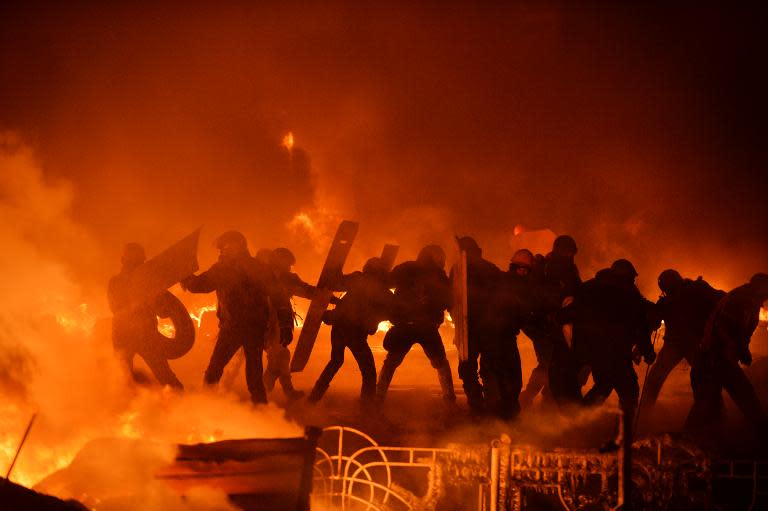 |
| January 25, 2014: Protesters clash with riot police in Kiev, Ukraine. (Source: Yahoo News) |
The government's next move was to pass new laws in mid-January greatly restricting the right to protest and sending individuals who slandered government officials to one year of "corrective labor." Protesters were undeterred, clashed with riot police, and even took over some government buildings. Yanukovych then offered the prime ministership and top government posts to opposition leaders, which they rejected. This past Tuesday, the prime minster and his cabinet resigned and the government repealed the anti-protest laws it had passed in mid-January. The government also passed an amnesty law for the protesters which was conditioned on the fact that they stop protesting within two weeks; the protesters rejected this measure.
Protests in Egypt
In Egypt, the military government has similarly found itself the target of resilient protests. Its response has escalated and been even harsher than Ukraine's. Outlawing participation in protests generally and the Muslim Brotherhood specifically failed to end anti-government protests. The government then labeled the group a terrorist organization and made mere participation in the Brotherhood an offense punishable by five years' imprisonment. The protests, as well as arrests for them, have continued into the new year.
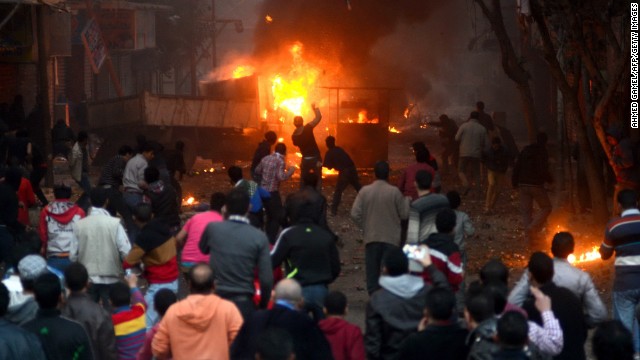 |
| January 17, 2014: Protesters clash with riot police in Cario. (Source: CNN.com) |
In 2013, the government also clamped down on freedom of the press. It shut down media it deemed to harbor pro-Brotherhood sympathies, with the notable exception of al Jazeera. The seeming exception for al Jazeera has proven illusory, as the government previously imprisoned several of the media organization's employees and just recently indicted 20 al Jazeera reporters -- eight are in custody while the rest were declared fugitives -- for creating "false" portrayals of the Brotherhood's protests.
The Bottom Line
Ukraine and Egypt are both deeply divided countries struggling to forge their respective post-revolution identities. In Ukraine, the pro-Western movement saw its 2004 Orange Revolution gains dissipate as Victor Yanukovych -- the standardbearer of pre-revolution, pro-Russian policies -- came to power. Yet Yanukovych himself took steps toward European integration, and the current crisis is a result of his backtracking on those steps. In Egypt, meanwhile, the 2011 revolution that led to Mubarak's ouster also led to the electoral victory of the Muslim Brotherhood and, after a year of rule under Mohammed Morsi, a return to military rule after a protest-inspired military coup. That military government is now struggling to clamp down the persistent protests of the ousted Brotherhood. In Ukraine, the deep split is over pro-Europe and pro-Russian sentiments (and the split is itself largely divided along geographic lines), whereas in Egypt the split is between secularism and Islamism. In both countries, however, the current crises of legitimacy stem from the governing group's inability to satisfactorily address that divide.
While the narrative of a deeply divided country is hardly unique, and indeed can be found in many countries throughout the world, what is unique to Egypt and Ukraine in current world affairs is the months-long persistence of protests aimed at bringing down a post-revolution regime. While many people imagine slow steps forward following a pro-democratic revolution, both of these countries have addressed the protests by clamping down on freedoms of protest and the press. This strategy might have prevailed in the pre-social media days or even today in a tightly-controlled country ala North Korea, but it has proven grossly ineffective in both countries. As part of their growing pains, the current regimes will have to learn that to govern means to be criticized; to govern effectively, moreover, might even mean listening to your critics.
Previous Illexum Posts
Ukraine: Overlooked, Underreported
Ukraine Protests Grow, Government Wavers, World Begins to Take Notice
Egypt Update: Muslim Brotherhood Declared Terrorist Organization
