Given that this story is a few days old, this post will be fairly brief.
The Syrian peace talks have not exactly been going splendidly. Neither side seems to be at the talks for the same reasons and the fighting continues all the while. The talks are practically an exercise in futility.
UN mediator Lakhdar Brahimi recently blamed the al-Assad regime for hampering the talks for refusing to discuss a transition of power. This should really come as no surprise. The government came to the talks indicating that it would refuse to discuss regime change. The opposition came only for that reason. It seems as if the talks were doomed from the start. Apart from discussing Syria's future, the talks have never even been on the same page.
It will be impressive if the UN, as well as the two sides who are backed by their respective world powers, can re-energize the talks to really begin to talk about facts on the ground and move toward some sort of path toward resolution and peace, however slow that may be.
Friday, February 21, 2014

Thursday, February 6, 2014
A Fundamentalist Divide: Al Qaeda Separates Itself from ISIL
It seems you can be "too much," even for al Qaeda. On Monday, the terrorist group formally cut off its relationship with the Islamic State in Iraq and the Levant (ISIL, also known as ISIS). This declaration follows al Qaeda's demand that ISIL remain separate from the al Nusra Front, al Qaeda's branch in Syria, which ISIL has attempted to consolidate into itself over the past year. In fact, it is apparent that ISIL and al Qaeda have been at odds for several years, dating to the mid 2000s. While it is unlikely that the two groups will become equal rivals, it is, at the same time, clear that they may view themselves that way in the near future. In the ongoing infighting of Syria's opposition forces, al Qaeda has propped up its links to the al Nusra Front and ISIL signed a truce with Suqour al Sham. Consolidation in the region could mean less infighting, but could also lead to a severely split opposition, making it more difficult for outside powers to support either side.


(Map of ISIL operations, Source: Red24)
Critically, al Qaeda's declaration may reflect which battle it now envisions as more winnable - Syria or Iraq. While it has made occasional gains in Iraq, al Qaeda forces, by and large, have been continually beaten back. Moreover, the continued presence of American troops and related support hinder operations in Iraq. Syria, meanwhile, has limited Western interference while it collapses - The Economist's "The Death of a Country" piece ran nearly a year ago - leaving a potential vacuum of power in all but al Assad's western strongholds. In the end, this could make Syria's near term future only more violent, a fact that is difficult to imagine given the United Nations' February 4 report detailing the violence there today.
Monday, February 3, 2014
Stifling Dissent and Thwarting Protests in Post-Revolution States
Protests in Ukraine
The protests in Ukraine have received extensive media coverage in recent weeks. These protests, which began as an almost spontaneous reaction to President Victor Yanukovych's decision to scuttle a trade deal with the EU at the last minute, have transformed into a massive expression of widespread discontent with the current regime. (The trade deal was more of a spark that ignited protests for myriad underlying reasons. For a more in-depth treatment of those underlying reasons, see this previous post from early December 2013).
The Yanukovych government's reactions to the protests have varied greatly; the common thread has been their lack of success. First, three days after the iconic toppling of the Lenin statue in Kiev, the government tried cracking down by forcibly removing protest barricades. When this proved unavailing, in mid-December the government suggested it would soon sign the trade deal with the EU after all. It soon went in the complete opposite direction, negotiating a shadowy deal with Russia on December 17th involving a $15 billion loan and large cuts in natural gas prices amounting to approximately a 1/3 drop in prices. Details of that deal remain unclear, but protesters were suspicious. In fact, the protests were re-energized in late December 2013.
The government's next move was to pass new laws in mid-January greatly restricting the right to protest and sending individuals who slandered government officials to one year of "corrective labor." Protesters were undeterred, clashed with riot police, and even took over some government buildings. Yanukovych then offered the prime ministership and top government posts to opposition leaders, which they rejected. This past Tuesday, the prime minster and his cabinet resigned and the government repealed the anti-protest laws it had passed in mid-January. The government also passed an amnesty law for the protesters which was conditioned on the fact that they stop protesting within two weeks; the protesters rejected this measure.
Protests in Egypt
In Egypt, the military government has similarly found itself the target of resilient protests. Its response has escalated and been even harsher than Ukraine's. Outlawing participation in protests generally and the Muslim Brotherhood specifically failed to end anti-government protests. The government then labeled the group a terrorist organization and made mere participation in the Brotherhood an offense punishable by five years' imprisonment. The protests, as well as arrests for them, have continued into the new year.
In 2013, the government also clamped down on freedom of the press. It shut down media it deemed to harbor pro-Brotherhood sympathies, with the notable exception of al Jazeera. The seeming exception for al Jazeera has proven illusory, as the government previously imprisoned several of the media organization's employees and just recently indicted 20 al Jazeera reporters -- eight are in custody while the rest were declared fugitives -- for creating "false" portrayals of the Brotherhood's protests.
The Bottom Line
Ukraine and Egypt are both deeply divided countries struggling to forge their respective post-revolution identities. In Ukraine, the pro-Western movement saw its 2004 Orange Revolution gains dissipate as Victor Yanukovych -- the standardbearer of pre-revolution, pro-Russian policies -- came to power. Yet Yanukovych himself took steps toward European integration, and the current crisis is a result of his backtracking on those steps. In Egypt, meanwhile, the 2011 revolution that led to Mubarak's ouster also led to the electoral victory of the Muslim Brotherhood and, after a year of rule under Mohammed Morsi, a return to military rule after a protest-inspired military coup. That military government is now struggling to clamp down the persistent protests of the ousted Brotherhood. In Ukraine, the deep split is over pro-Europe and pro-Russian sentiments (and the split is itself largely divided along geographic lines), whereas in Egypt the split is between secularism and Islamism. In both countries, however, the current crises of legitimacy stem from the governing group's inability to satisfactorily address that divide.
While the narrative of a deeply divided country is hardly unique, and indeed can be found in many countries throughout the world, what is unique to Egypt and Ukraine in current world affairs is the months-long persistence of protests aimed at bringing down a post-revolution regime. While many people imagine slow steps forward following a pro-democratic revolution, both of these countries have addressed the protests by clamping down on freedoms of protest and the press. This strategy might have prevailed in the pre-social media days or even today in a tightly-controlled country ala North Korea, but it has proven grossly ineffective in both countries. As part of their growing pains, the current regimes will have to learn that to govern means to be criticized; to govern effectively, moreover, might even mean listening to your critics.
Previous Illexum Posts
Ukraine: Overlooked, Underreported
Ukraine Protests Grow, Government Wavers, World Begins to Take Notice
Egypt Update: Muslim Brotherhood Declared Terrorist Organization
The protests in Ukraine have received extensive media coverage in recent weeks. These protests, which began as an almost spontaneous reaction to President Victor Yanukovych's decision to scuttle a trade deal with the EU at the last minute, have transformed into a massive expression of widespread discontent with the current regime. (The trade deal was more of a spark that ignited protests for myriad underlying reasons. For a more in-depth treatment of those underlying reasons, see this previous post from early December 2013).
The Yanukovych government's reactions to the protests have varied greatly; the common thread has been their lack of success. First, three days after the iconic toppling of the Lenin statue in Kiev, the government tried cracking down by forcibly removing protest barricades. When this proved unavailing, in mid-December the government suggested it would soon sign the trade deal with the EU after all. It soon went in the complete opposite direction, negotiating a shadowy deal with Russia on December 17th involving a $15 billion loan and large cuts in natural gas prices amounting to approximately a 1/3 drop in prices. Details of that deal remain unclear, but protesters were suspicious. In fact, the protests were re-energized in late December 2013.
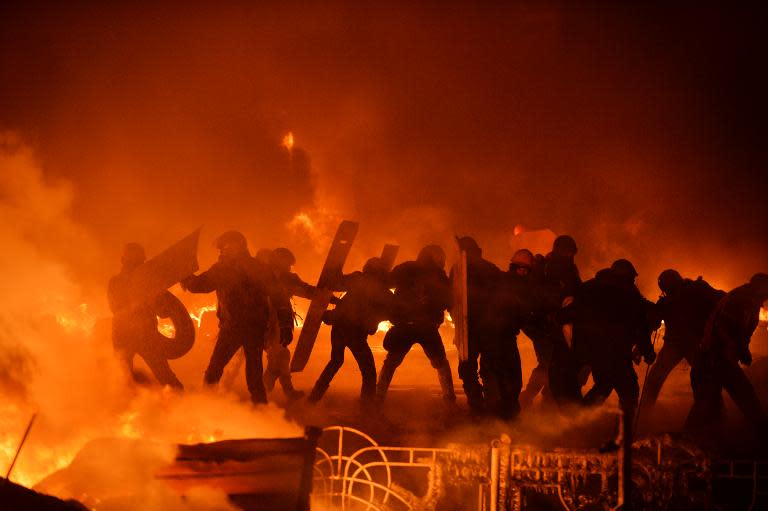 |
| January 25, 2014: Protesters clash with riot police in Kiev, Ukraine. (Source: Yahoo News) |
The government's next move was to pass new laws in mid-January greatly restricting the right to protest and sending individuals who slandered government officials to one year of "corrective labor." Protesters were undeterred, clashed with riot police, and even took over some government buildings. Yanukovych then offered the prime ministership and top government posts to opposition leaders, which they rejected. This past Tuesday, the prime minster and his cabinet resigned and the government repealed the anti-protest laws it had passed in mid-January. The government also passed an amnesty law for the protesters which was conditioned on the fact that they stop protesting within two weeks; the protesters rejected this measure.
Protests in Egypt
In Egypt, the military government has similarly found itself the target of resilient protests. Its response has escalated and been even harsher than Ukraine's. Outlawing participation in protests generally and the Muslim Brotherhood specifically failed to end anti-government protests. The government then labeled the group a terrorist organization and made mere participation in the Brotherhood an offense punishable by five years' imprisonment. The protests, as well as arrests for them, have continued into the new year.
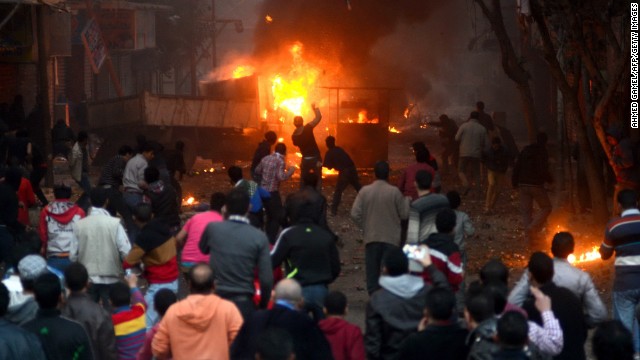 |
| January 17, 2014: Protesters clash with riot police in Cario. (Source: CNN.com) |
In 2013, the government also clamped down on freedom of the press. It shut down media it deemed to harbor pro-Brotherhood sympathies, with the notable exception of al Jazeera. The seeming exception for al Jazeera has proven illusory, as the government previously imprisoned several of the media organization's employees and just recently indicted 20 al Jazeera reporters -- eight are in custody while the rest were declared fugitives -- for creating "false" portrayals of the Brotherhood's protests.
The Bottom Line
Ukraine and Egypt are both deeply divided countries struggling to forge their respective post-revolution identities. In Ukraine, the pro-Western movement saw its 2004 Orange Revolution gains dissipate as Victor Yanukovych -- the standardbearer of pre-revolution, pro-Russian policies -- came to power. Yet Yanukovych himself took steps toward European integration, and the current crisis is a result of his backtracking on those steps. In Egypt, meanwhile, the 2011 revolution that led to Mubarak's ouster also led to the electoral victory of the Muslim Brotherhood and, after a year of rule under Mohammed Morsi, a return to military rule after a protest-inspired military coup. That military government is now struggling to clamp down the persistent protests of the ousted Brotherhood. In Ukraine, the deep split is over pro-Europe and pro-Russian sentiments (and the split is itself largely divided along geographic lines), whereas in Egypt the split is between secularism and Islamism. In both countries, however, the current crises of legitimacy stem from the governing group's inability to satisfactorily address that divide.
While the narrative of a deeply divided country is hardly unique, and indeed can be found in many countries throughout the world, what is unique to Egypt and Ukraine in current world affairs is the months-long persistence of protests aimed at bringing down a post-revolution regime. While many people imagine slow steps forward following a pro-democratic revolution, both of these countries have addressed the protests by clamping down on freedoms of protest and the press. This strategy might have prevailed in the pre-social media days or even today in a tightly-controlled country ala North Korea, but it has proven grossly ineffective in both countries. As part of their growing pains, the current regimes will have to learn that to govern means to be criticized; to govern effectively, moreover, might even mean listening to your critics.
Previous Illexum Posts
Ukraine: Overlooked, Underreported
Ukraine Protests Grow, Government Wavers, World Begins to Take Notice
Egypt Update: Muslim Brotherhood Declared Terrorist Organization
Wednesday, January 29, 2014
Homebrew: the Islamic State of Iraq and the Levant
Growing out of the chaos of Middle Eastern insurgencies, the al Qaeda-linked Islamic State of Iraq and the Levant (ISIL), also referred to as the Islamic State of Iraq and Syria (ISIS), has built its presence and spread fear throughout the region. Often viewed as one of the more violent terrorist groups in the Middle East, ISIL has taken over towns in Iraq - the first time insurgents have controlled these towns since 2003 - and is contributing to infighting among opposition fighters in Syria.
ISIL fighters have been careful, focusing on political aims to establish themselves, only to later identify with more fundamental positions. When necessary, socioeconomic and political arguments are employed to attempt to garner support among the locals. Once established, their strength limits the options to opponents, both civilian and military, as is the case in Syria. In a sense, entrenched positions are difficult to change.
ISIL's origins remain somewhat shrouded, and its role in the region has become unclear. Some reports suggest that ISIL is linked to Bashar al-Assad, Syria's President, as an attempt to fracture and debase the opposition. Others suggest that ISIL is little more than a concept Syria developed to change the face of its civil war. The BBC, though, has ISIL's formation pinned down to April 2013 as an independent terrorist organization. Analysts tend to tie it to insurgents previously known as al Qaeda in Iraq (AQI), which may be best described as an evolutionary step in that organization's history. There is much information floating around, but most of it only lightly touches on why there was an outgrowth across borders. Why did the influx of fighters into the regional coalesce into much more coherent organizations than previously? Why are they more successful now? (apart from the withdrawal from Iraq, for that can't be the reason for everything)
Countries in the region continue to grow wary. Jordan has gone so far as to note that ISIL does not operate within its borders and that the terrorist group is "no threat." This is a surprising statement given ISIL's operations in two of Jordan's neighbors. Meanwhile, ISIL has threatened to attack Turkish cities over a disputed closed border crossing. It seems that ISIL's reach may yet expand.
Looking ahead, the horizon for ISIL is unclear. Expansion opens up new fronts, builds enemies, and attracts attention. Showing its face in Syria has increased its exposure and has proven of little benefit. At the same time, there is concern for a large lawless region in northwest Syria controlled by ISIL turning into another Afghanistan. Regional powers are keen to get it all under control though, and it is unlikely for a large power vacuum to redevelop, given recent history. This homegrown movement may not get much bigger, but might redouble its efforts where it already controls the land.
ISIL fighters have been careful, focusing on political aims to establish themselves, only to later identify with more fundamental positions. When necessary, socioeconomic and political arguments are employed to attempt to garner support among the locals. Once established, their strength limits the options to opponents, both civilian and military, as is the case in Syria. In a sense, entrenched positions are difficult to change.
ISIL's origins remain somewhat shrouded, and its role in the region has become unclear. Some reports suggest that ISIL is linked to Bashar al-Assad, Syria's President, as an attempt to fracture and debase the opposition. Others suggest that ISIL is little more than a concept Syria developed to change the face of its civil war. The BBC, though, has ISIL's formation pinned down to April 2013 as an independent terrorist organization. Analysts tend to tie it to insurgents previously known as al Qaeda in Iraq (AQI), which may be best described as an evolutionary step in that organization's history. There is much information floating around, but most of it only lightly touches on why there was an outgrowth across borders. Why did the influx of fighters into the regional coalesce into much more coherent organizations than previously? Why are they more successful now? (apart from the withdrawal from Iraq, for that can't be the reason for everything)
Countries in the region continue to grow wary. Jordan has gone so far as to note that ISIL does not operate within its borders and that the terrorist group is "no threat." This is a surprising statement given ISIL's operations in two of Jordan's neighbors. Meanwhile, ISIL has threatened to attack Turkish cities over a disputed closed border crossing. It seems that ISIL's reach may yet expand.
Looking ahead, the horizon for ISIL is unclear. Expansion opens up new fronts, builds enemies, and attracts attention. Showing its face in Syria has increased its exposure and has proven of little benefit. At the same time, there is concern for a large lawless region in northwest Syria controlled by ISIL turning into another Afghanistan. Regional powers are keen to get it all under control though, and it is unlikely for a large power vacuum to redevelop, given recent history. This homegrown movement may not get much bigger, but might redouble its efforts where it already controls the land.
Thursday, January 23, 2014
Instagram the News: Sochi Edition
Instagram is the latest source of news, apparently.
Ramzan Kadyrov, Russia's hand-picked President of Chechnya, posted on his Instagram account last week that Doku Umarov had been killed by Russian special forces. Umarov, also known as Russia's "Osama bin Laden" led insurgents in the Caucasus region who had carried out attacks throughout Russia, including in Moscow. Apart from making the claim, Kadyrov offered no evidence to support his statement, fueling speculation. In the past, there have been premature reports of Umarov's death; however, there is growing confirmation amongst others in the region (on both sides) that this time it is real. Umarov had called for attacks on the 2014 Winter Olympics in the nearby Russian city of Sochi, scheduled to begin in February. The games will be the first held in Russia since the Soviet Union staged the 1980 Summer Olympics in Moscow.
Umarov's death will require insurgents in the region to look for new leadership, though whether it will impact Sochi remains unclear. While there is certainly evidence to support that eliminating the leadership of a terrorist group limits that group's impact, the short-run longitudinal effect is questionable. Kadyrov states that the threat to Sochi is now 'groundless', but security experts are certainly concerned by at least one 'Black Widow' suspect, if not more. Russia has a mixed history with 'Black Widow' terrorists, particularly suicide bombers emanating from the turbulent Caucasus region. Today, Russia is anxious to host an Olympics without incident (the 1980 games were boycotted by the United States) and revive its international presence, but with the games being compared to a military base, any attack will be railed as a failure on Russia's part.
------------------
If you enjoyed that Instagram led the news, you can take a look at Kadyrov's account, or review Foreign Policy's 11 favorite Kadyrov posts. Here's an example:

Ramzan Kadyrov, Russia's hand-picked President of Chechnya, posted on his Instagram account last week that Doku Umarov had been killed by Russian special forces. Umarov, also known as Russia's "Osama bin Laden" led insurgents in the Caucasus region who had carried out attacks throughout Russia, including in Moscow. Apart from making the claim, Kadyrov offered no evidence to support his statement, fueling speculation. In the past, there have been premature reports of Umarov's death; however, there is growing confirmation amongst others in the region (on both sides) that this time it is real. Umarov had called for attacks on the 2014 Winter Olympics in the nearby Russian city of Sochi, scheduled to begin in February. The games will be the first held in Russia since the Soviet Union staged the 1980 Summer Olympics in Moscow.
Umarov's death will require insurgents in the region to look for new leadership, though whether it will impact Sochi remains unclear. While there is certainly evidence to support that eliminating the leadership of a terrorist group limits that group's impact, the short-run longitudinal effect is questionable. Kadyrov states that the threat to Sochi is now 'groundless', but security experts are certainly concerned by at least one 'Black Widow' suspect, if not more. Russia has a mixed history with 'Black Widow' terrorists, particularly suicide bombers emanating from the turbulent Caucasus region. Today, Russia is anxious to host an Olympics without incident (the 1980 games were boycotted by the United States) and revive its international presence, but with the games being compared to a military base, any attack will be railed as a failure on Russia's part.
------------------
If you enjoyed that Instagram led the news, you can take a look at Kadyrov's account, or review Foreign Policy's 11 favorite Kadyrov posts. Here's an example:

(Source: Instagram, via Foreign Policy)
Monday, January 13, 2014
Libya's East Side Story
Flying under the radar in late 2013, leaders in the eastern half of Libya, which holds 60% of the nation's oil production, declared an autonomous government. Libya has the world's ninth largest oil reserves, and other energy resources aplenty. This declaration came about two years after Libya's Civil War ended, which also ended the 42-year reign of Muammar Gaddafi. Gaddafi's dictatorship largely held in check a nation that had a history of regional autonomy. The political subdivisions throughout Libya's history are Tripolitania, Cyernaica, and Fezzan, with most of the population residing in Tripoliatania and Cyernaica.


Libya's Subdivisions (Source: Fragile States Resource Center)
The recent announcement was certainly a blow to the centralized leadership in Tripoli, but reading the events carefully helps add details to the story. Proponents would like the return of the three-state Libya, last extant under King Irdis in 1951, and one that existed, at times, throughout Libya's history. Although this certainly could lead to a break-up of the country, leaders from the region did not explicitly declare independence, or even self-determination. Leaders seem to be seeking a status closer to the experience of the Kurdish region of Iraq following the Iraq War (though even that status is still debated).
Much like in Iraq, it may boil down to natural resources, regional access, and service delivery. The eastern shadow government is offering up oil to foreign buyers and is promising to open the region's energy resources under its own terms. The central government, meanwhile, has indicated that it will use force, if necessary, to prevent any circumvention of its authority. It has already fired toward a Maltese tanker in order to force it to deviate from an eastern port. Meanwhile, regional access and governmental service delivery are both hampered by protests and a burgeoning insurgency that has blocked off the region for months. These issues sound familiar and are a formula for bigger problems.
Infighting, and possibly even open warfare, will continue to be a risk unless the structure of Libya indicates more clearly how the central government will work with regional authorities. While levels of autonomy are integral to regional function in a territory as large as Libya, it is important that those levels are determined wisely and with both sides in agreement. Nonetheless, all sides must recognize that central governance, to some extent, is necessary.
Friday, January 10, 2014
Growing Pains in Iraq: Reconciling Federalism
Few people believed that Iraq was magically reborn following the departure of the remaining U.S. troops from Iraq in late 2011. After all, that withdrawal was years in the making, both politically and militarily. Even then, there was debate over how Iraq would be shaped, in 2012 and beyond. It was surmised that a Sunni-Shia rift would continue, fueled in part by insurgents pushing the boundaries of Iraqi security forces. At the same time, concerns about Iraq's president Nouri al-Maliki's (who is Shia) leadership also existed, in light of clear pro-Shia favoritism.


It seems that "messy democracy" is the favorite description of Iraq over the years; however, this description is really just an easy way to not say anything at all. It's a way to say Iraqi democracy is not the democracy of Norway (ranked #1 in the Democracy Index), but is also not the democracy of Zimbabwe (ranked #148). It is clear that Iraq is somewhere in the middle (#113 in 2012). But what direction is that democracy headed toward - Norway or Zimbabwe?
This is not a question that has an easy answer. Iraqi federalism has been discussed over and over gain. How will the country look? It has been debated whether Iraq can even hold itself together as a single unified country, given its history, colonially drawn borders, and somewhat diverse populations. What power-sharing structures will exist? That entails whether Iraq function as an open democracy where one viewpoint transitions power to another bloodlessly, or would a constitutional requirement for a constant mix of viewpoints be necessary. As well, the level of autonomy given to individual provinces - should Iraq even be a federation or a confederation? And in the end, who will fight who over what, and will that fighting be political or physical? To gain some insight into some of the issues that prevail today, from insurgent fighting in the West to Kurdish self-determination in the North, it helps to take a look at the political and religious boundaries in Iraq:

Religious makeup of Iraq (Source: NPR)

Political makeup of Iraq (Source: Wikipedia)

One province stands out in a grand manner: Al-Anbar in the West. On the one hand, al-Anbar is far larger than any other political division in Iraq, taking up as much as a third of the country. On the other hand, the province is sparsely populated and includes significant desert acreage.
Al-Anbar is also the source of some of the worst fighting during the Iraq War, including the First Battle of Fallujah and the Second Battle of Fallujah. More recently, it is the location of Sunni protests, and the takeover of Iraqi cities (Ramadi, the capital of Al-Anbar, and, to some extent, Fallujah) by the Islamic State of Iraq and the Levant (ISIL), which is associated with al-Qaeda.
In the past, gerrymandering was a possibility. This likely would have been an option early on when the politics of Iraq were still up for debate. However, with a Shia-led government that seemingly continues to clamp down on Sunni politics, this idea is likely off the table, or we will end up with the worst of American democratic traditions married to military conflict.
Within federalism, there exists some level of equality on a national scene, at least in the sense that everyone can, at some point, attain a leadership role and participate in national politics. Without that, there is no purpose to being part of a federalist structure. Both alienating a component of the national population and simultaneously allowing the growth of their own sub-state cannot lead to a solution.
It will take crucial and careful leadership to lead Iraq out of its federalist quagmire. It can't hurt to use the American example here as well: the United States operated under the Articles of Confederation between 1777 (informally) / 1781 (formally) until 1789, when the Constitution took effect. It took years to figure out a better way for the system to operate, and it may take years in Iraq. Focusing on the politics, and the compromises that come with politics, while avoiding warfare and open conflict, are key tenets that could lead to Iraq reconciling its federalism for a lasting state.
Subscribe to:
Posts (Atom)