Tuesday, April 29, 2014

The Us vs. Them Mentality

Last Friday (April 25), the Washington Post published an opinion piece by Ian Morris, a Stanford professor, titled In the long run, wars make us safer and richer. As you can tell, the article, which appears to be a broad summary of Morris' book, War! What is it good for?: Conflict and the progress of civilization from primates to robotshas already generated quite a number of comments in response. If one were to judge by the comments and Amazon reviews, readers are none too impressed so far.

The opinion piece outlines how the likelihood of a person's demise by violent means, namely war, has declined as wars have consolidated populations into communities and governments, growing ever larger over human history. In one way, war has made society safer and that safety has allowed society to focus on trade, which has made society and the individuals within society richer.

But the entire perspective of the article is focused on the winners of history. Those societies that won the wars have been made safer and richer. It can be argued that some of the conflicts in the 20th century benefited both winners and losers as wars over ideals and ideas supplanted those over religion, land, and gold, but that is only an argument. Over time, not everyone has equally benefited from wars - some populations became safer and others became more dangerous; some became richer and others became poorer.

If Morris' analysis differentiated how the losers of wars have fared in comparison, it may be stronger (or weaker), but it does not seem to. Morris takes humanity as a whole, but humanity as a whole is dominated by the conquerors - an us vs. them mentality that underlies Western worldviews.

It is important to not forget that these Eurocentric perspectives lurk behind much of what we consider as "normal." A great example is the world map - there is no particular reason for it being oriented the way it is:


Wednesday, April 23, 2014

Coming Elections in Syria, Sponsored Today by: Chlorine Gas

Officials claim that Syria has handed over nearly 90% of its chemical weapons stores. Percentages are easy figures when they fail to elaborate on how those numbers are derived. Intelligence has existed for some time that suggests Syria will fail to disclose its full chemical weapons stockpiles and hold on to some instead. Moreover, easily-weaponized agents could be hidden away, particularly if they are not being sought and the world believes Syria has included those in its concessions. Such concerns over dual-use components hover over rogue states like a constant fog. As long as some internal control is maintained, it isn't so hard to imagine clandestine operations of all kinds. Syria has even threatened Israel and other spillover, something that one imagines would be difficult were the government fighting to its last man and materiel for domestic control.

If (nearly) 90% of those chemical weapons are handed over, why is Syria still employing chemical weapons, as the recent chlorine gas attack indicates? Apparently, chlorine gas is not included on the list of chemical weapons Syria is giving up, although it is banned. Who knew that the agreement in Syria allowed for such leniency and compromise as to which weapons it could keep and which it must give up? At the same time, the government continues to direct blame to the rebels, who have less incentive and even less means to launch chemical weapons strikes. It just doesn't entirely add up.

Amid the conflict, al-Assad's government has set a date for new elections -June 3, 2014. That's correct - about six weeks from now, Syrians all across the country are going to go the polls to elect their new leader. That is, except for the over 150,000 people killed and millions who have fled the country as refugees - they won't be voting, but the show must go on. The United Nations has suggested to Syria that it avoid having elections during a civil war. It is unlikely there will be any significant challenger (though a puppet challenger may be brought in). Why even go through the trouble? It is not really all that possible to gloss over this kind of electoral travesty.

Monday, April 14, 2014

Playing Politics at the United Nations

Earlier this month, Iran named Hamid Aboutalebi as its United Nations ambassador, a move that quickly strained US-Iran relations that had been slowly thawing. It is alleged that Aboutalebi was intimately part of the 1979 takeover of the US embassy in Tehran, which spiraled into a 444-day hostage crisis. Aboutalebi claims he was merely a translator; however, this role does not detract his contribution to the hostage-takers objectives. Regardless of his specific role or duties, Aboutalebi participated, which makes his appointment instantly controversial and instantly problematic.

With the United Nations building in New York, it is the US who issues visas to ambassadors and staff. There doesn't seem to be a record of an ambassador being denied a visa previously, although lower-level staff have been denied and other applications have been rescinded or plans have changed. One of the higher profile incidents was Yasser Arafat being denied a visa to speak at the UN in 1998. The 1947 agreement establishing the United Nations headquarters in New York requires the US to open travel for UN purposes. However, the US has maintained its right to restrict access nonetheless, and has established the precedents that would allow it to do so. No country has previously elected to test the limits of the agreement or the repercussions.

The US has taken the first step by denying the visa for Aboutalebi on the tail of a Congressional bill that would deny Aboutalebi on national security grounds. At the same time, Iran is standing its ground and refusing to select another ambassador. Domestically, there is fairly strong consensus on the denial.

Internationally, the ramifications can be extensive. Aboutalebi, albeit a potentially minor participant, was still a participant in one of the most significant violations of diplomatic norms and laws of the twentieth century. To make a diplomatic case out of the incident, given his background, would almost be ironic. At the same time, negotiations about Iran's nuclear stores will be strained by this incident. There exists no win-win situation here - someone will need to back down.

Wednesday, April 9, 2014

Unreliable Energy Focus: Libya's Energy

Libya hasn't exactly been a united country since the fall of Muammar Gaddafi in 2011. The elected government has failed to control the rebel-held eastern half of the country, but compromise may be the order of the day. The two sides reached an agreement to return four ports (two immediately) to government hands. The ports handed over, Hariga and Zueitina, are the smaller of the four. The larger two ports, Es Sider and Ras Lanuf, will likely take more time to hand over. The first two represented goodwill while the last two are the stakes. Rebel leaders continue to demand measures of autonomy, revenue sharing, and development in return for the final pieces of the agreement. With oil exports being the primary bargaining chip, it would be expected that any agreement becomes more complicated and lengthy than the text on any page.

Libya's eastern ports (Source: WorldBulletin)

So why is Libya even important in the energy marketplace? It has lots of it, particularly oil. While currently only producing about 150,000 barrels of oil per day (leaving the government near financial disaster, though this is denied by the government), Libya has produced upwards of 1.4 million barrels per day since the civil war and upwards of 1.8 million in the years preceding it. Overall, Libya has the ninth most oil reserves in the world, even while a significant portion of its land remains a hydrocarbon terra incognita. In addition, Libya has large natural gas reserves. The upside of Libya's energy sector remains inviting, given its size, small population, and proximity to Europe. That last benefit, a geographic one that cannot be easily overcome by competitors, is critical. Much of Libya's oil is exported to Europe and it has important natural gas pipelines connecting it to the European mainland via Italy. These energy connections may prove increasingly important as European tensions with Russia increase.

The agreement this week between the government and rebels - indicating a possible resumption of Libya's higher export levels - led to a fall in the market price of oil. However, with a ten-day window before oil flows from the ports and two to four weeks before the larger two ports may be handed over, there is little celebration elsewhere thus far; even optimists are cautious. Libya is an important cog in the international energy wheel, albeit a damaged one that has been turning for some time now. If Libya re-enters the energy scene at previous levels, it will make an impact and balance Europe's energy sources.

Thursday, March 27, 2014

The G7 & Russia's Nonchalant Response

So far, this blog has been fairly quiet on the topic of Russia and Crimea (though it did have several previous posts on Ukraine). This hasn't been for any intentional reason, though the topic has been covered in the news fairly thoroughly. It is not trifling to consider that the standoff between Russia and the West contains the hallmarks of future conflict.

This week, the drama entered a new phase when the G8 became the G7. Russia was essentially booted from the G8, to which it has belonged since 1998. It seems unclear whether the expulsion is a disagreement that may be temporary, or if this action is somewhat permanent. Given the severity of the infraction and the tough talk from both sides, even a temporary suspension is unlikely to be short at all. Frankly, Russia does not seem to care.

Russian Foreign Minister Sergey Lavrov's comments are particularly telling. Lavrov didn't even really need to use words. His words echoed his actions, suggesting that Russia felt the G8 was simply an informal club to which it had experienced a temporary visit. It's not that big of a deal to leave after all.

How Russia feels is important if tensions are to calm. Russia has never felt it had an opportunity to lead in Western multilateral institutions. It has long sought to carve its own leadership role in its own institutions within spheres of influence it has much stronger control over - historically, economically, and politically. At times over the past few decades, it has sought to spread that influence, but it has always returned home. In a sense, it is a form of atavism.

The Collective Security Treaty Organization (CSTO) has been Russia's response to NATO. Russia has reassured its allies in this bloc that they are not expected to be involved in any military action related to Ukraine. While full-scale war is far off, it would be significant. If the CSTO does not exist as an alliance, how far from the Soviet Union is it? Other Russian-led institutions continue to build influence over and connections between its former republics.

Ideally, deeper conflict will be averted and solutions to the Ukraine dilemma will be found. At this time, everyone seems to be prepared for a long, entrenched fight, though the West is not nearly as sure of its next move as Russia is. It would behoove Western nations, and the United States in particular, to give the situation some serious consideration. This kind of chess has not been played in a good while.

Monday, March 17, 2014

Libya Update, Part II

Overnight, moves were taken to secure Libyan unity. United States Navy Seals boarded and took control of the oil tanker - Morning Glory - that had escaped the naval blockade of Libya's eastern, rebel-held ports. The tanker is now on its way back to Libya to an undisclosed, government-held port. This action underlines American support for Libya's government and greatly undermines the actions of the rebel government. Moreover, it emphasizes the willingness of action upon necessity, including appropriate military response.

In related news, two Israeli nationals and a Senegalese were detained upon suspicion of attempting to purchase oil from the tanker off the coast of Cyprus. They were released and it is, at this time, unclear if there is any suspicion remaining, if their actions were pure opportunism, or if they were part of any premeditated plan with the tanker's crew.

Sunday, March 16, 2014

A Divided Libya in the Backlog of International News

International events seem to be ablaze right now. Between the fear of Crimea seceding to the frantic search for Malaysia Airlines flight 370, there's just not much else that is getting more than a byline these days.

Libya seems to be one of those stories being pushed below the fold. There remains a lack of unity between the eastern and western sections of the country. The 2011 Libyan Civil War may have freed the country from Muammar Gaddafi's dictatorial chains, but they have not mended social, political, and economic divisions since. As with many resource-based economies, some of the most potent underlying resentment stems from regions where resources are found and extracted and the capital, where they are often spent. Eastern Libya has been, by many definitions, operating as an autonomous region of Libya for over a year now.

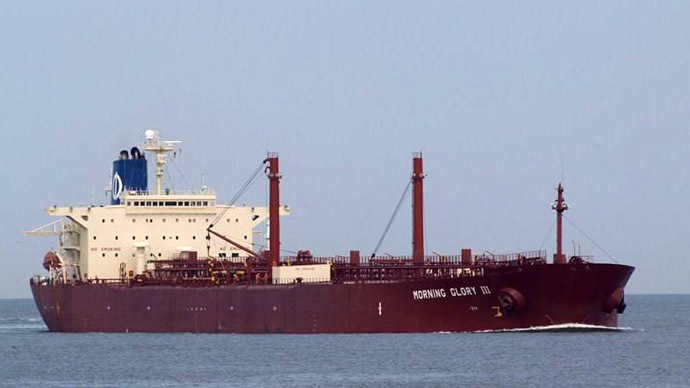
The rebel government recently tested its autonomy. Just over a week ago, an oil tanker - Morning Glory - docked in Sidra, breaking the blockade of eastern ports held by the rebel government. The rebel government quickly began to load the tanker with oil. Somewhat ironically, the tanker is flying the flag of North Korea. Initially, Libya threatened to bomb the tanker were it to load oil and attempt to leave, having previously fired warning shots at other tankers near ports. The tanker ended up loading 234,000 barrels of oil, evading the naval blockade after being fired on for two days, and is now in the Mediterranean Sea, though the rebels claim it has reached its final destination.

                                          (Morning Glory, from marinetraffic.com via RT.com)

For what it's worth, North Korea denied involvement and claimed to revoke the tanker's registration. It is unlikely that any countries within so few sailing days are willing to risk strained relations with Libya; it's last recorded position seems to be off the coast of India, but that was prior to reaching Libya. It also may have truly been under the Liberian flag.

Nonetheless, any evidence of associations between Libyan rebels and North Korea are bound to strain relations further. The weakness of Libya's government in stopping the tanker led to Prime Minister Ali Zeidan being voted out of office, which doesn't exactly help strengthen faith in government. Around the world, there exists a fear that oil will prove to be Libya's undoing and lead to a second and more violent iteration of the Civil War. It seems that, for the time being, Libya is stuck between the possibility of further war and the Iraq-Kurdistan model of resource-based autonomy, which has not fared so well either. It couldn't hurt to suggest that oil revenues be used wisely, with perhaps technical assistance and planning from some experienced Western powers. Libya's population of just over six million is not so far from Norway's five million, after all.