Showing posts with label Imran Khan. Show all posts

Monday, August 18, 2014

India and Pakistan: Domestic and Foreign Policies Collide

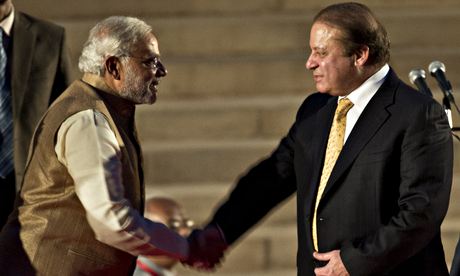
May 2014 brought the promise of progress in India-Pakistan relations.  After the historic swearing-in of Indian Prime Minister Narendra Modi - the first ever attended by a Pakistani prime minister - people were cautiously optimistic about relations between the feuding nuclear powers.  That optimism was extended when Modi and Pakistani Prime Minister Nawaz Sharif publicly exchanged letters of gratitude toward each other, which followed up on the meeting the two held after Modi's swearing-in.  In his letter, Modi also expressed India's sympathy toward Pakistan after the terror attack on Karachi's airport.

Prime Ministers Narendra Modi and Nawaz Sharif shake hands after Modi's swearing-in (source: The Guardian).

These developments were promising, and they may well continue.  Of course, it will take more than a meeting and a letter exchange to overcome decades of mistrust and border attacks.  Furthermore, both prime ministers must still deal with local populations that are not so quick to mend old wounds.  Moving too quickly toward improved relations will undercut the support both leaders need to rule.  Indeed, Sharif was condemned for the very decision to attend Modi's inauguration.

Unfortunately, both leaders have already gone back to the tried-and-true tact of using the other country as an easy target for domestic woes.  Last week, for example, Modi declared in a speech to Indian troops that Pakistan now wages a "proxy war of terrorism" because it lacks the capabilities to wage a conventional war.

Sharif, meanwhile, finds his own prime ministership at risk in the midst of large-scale protests.  Those protests are led by political rival Imran Khan of the PTI party.  Khan is calling for Sharif's ouster due to issues ranging from alleged vote-rigging in the 2013 elections to the "dynastic" nepotism of the Sharifs.  Although he has called on protesters to keep their actions peaceful, he has also called on them to stop paying taxes and bills as part of the larger protest.

Perhaps it should not come as a surprise that, in the midst of this internal challenge to Sharif's rule, Pakistani military forces attacked Indian border posts at 20 different locations yesterday.  Incidentally, none of Pakistan's major English-language outlets - Dawn, The News International, and The Express Tribune - reported on the attacks.

Ultimately, the political strategy of pandering to the local population while trying to present a more suitable international front is nothing new.  Its most recent notable iteration may be Iran's positions during the recent nuclear talks.  Iran may try to woo investors and welcome the UN nuclear watchdog, on the one hand, but talk about destruction of the U.S. in the event of an attack, on the other.  In the case of Pakistan and India, the effort to garner local support by castigating the other country is a short-term tactic.  It is also one that finds itself increasingly outdated in the digital age, where information from non-local sources is more readily available.  The longer-term strategy of mending old wounds is harder; it will involve less flashy developments like multiple trade summits, cooperation in counter-terrorism investigations, and regular regional meetings to address issues facing the two and their smaller neighbors.  This will take time, perseverance, patience, and restraint, none of which lend themselves well to the political arena.  Ultimately, the coming months will tell whether May 2014 was a new beginning or merely an aberration in the long-standing dispute.


Monday, May 20, 2013

Cautious Optimism Amidst Elections and Violence in Pakistan

With former Prime Minister Nawaz Sharif winning last week's elections, the future of the country remains unclear.

On the one hand, Sharif's succession to power will mark the rare democratic transfer of power in Pakistan.  Furthermore, Sharif ran a campaign promising economic revitalization in a country desperate for electricity and the resources to rebuild a struggling (possibly crumbling) economy.  Sharif's election also raises the specter of military détente and improved relations with India.

On the other hand, violent militant attacks continue to plague Pakistan.  On election day alone, more than 30 people were killed and more than 200 wounded by militant bombings and attacks.  Then, on the eve of a run-off election in her district, the vice president of the Tehreek-e-Insaf party (PTI, the party headed by former cricket player/celebrity Imran Khan), was murdered execution-style.  The idea of a major party's second-in-command being brutally murdered would be almost unfathomable in western democracies, yet it barely registers as a major news item.  The brazenness of such an attack on a party leader, moreover, may be a more ominous sign of Pakistan's stability than the scattered violence.

Incoming PM Sharif has a lot on his plate, yet one can only hope that a focus on economic revitalization will help promote stability in the country and the region at large.  Economic revitalization is not and should not be a separate issue from Indian relations; indeed, India appears ready to engage in cross-border transmission and pipeline projects that would go a long way toward easing Pakistan's crippling energy problems.  Given the large stakes, Mr. Sharif would do well to move swiftly.

Tuesday, March 26, 2013

Musharraf Returns to Fragmented Country

Perez Musharraf returned to Pakistan this past weekend, hoping to participate in the upcoming elections this May.  Of course, he faces a slew of problems ranging from death threats, pending legal charges that include treason for his 1999 coup, and a general lack of excitement about his return.

Although not particularly popular in Pakistan, Musharraf benefits from a highly fragmented political field that includes the Pakistan Peoples Party, the Pakistan Muslim League-Nawaz, headed by former Prime Minister and bitter Musharraf rival Nawaz Sharif (i.e. the guy who was PM when Musharraf staged his coup), and former cricket star-turned-politician Imran Khan.  Khan enjoys popularity due to a disillusioned populace receptive to his anti-two party message.  If anything, the highly fragmented field with a disgraced former leader facing criminal charges and popular non-politician figure resembles another country where recent elections raised more questions than answers.

In any event, the world will increasingly begin to follow political developments in Pakistan as hopefully free and fair elections draw near and the country continues to struggle with its own identity as well as its relationships with neighbors and the world at large.